Sierra Leone on Monday highlighted major regulatory achievements and telecommunications progress during the Regional ICT Regulators’ Forum in the Kenyan capital of Nairobi, pointing to cross-border knowledge sharing and capacity-building programs as crucial drivers of its digital growth.
Delegates representing the National Telecommunications Authority (NaTCA) of Sierra Leone joined peer regulators, regional ICT organizations, and international development partners for the opening of the 8th Cohort of the ICT Policy and Regulation – Institutional Strengthening Programme (iPRIS).
Speaking at the forum, the Sierra Leonean delegation noted that participating in peer-to-peer regulatory platforms and technical exchange programs has strengthened the country’s capacity to modernize its legal frameworks, improve quality-of-service standards, and accelerate network rollout to unserved rural areas.
Sierra Leone’s representatives emphasized that direct engagement with regional regulators has helped national authorities implement practical solutions to complex regulatory challenges, including spectrum allocation, universal access fund management, and infrastructure sharing.
The Nairobi forum, hosted in collaboration with the Communications Authority of Kenya (CA), brought together delegates from Sierra Leone, Mauritius, Namibia, Zimbabwe, Tanzania, and Liberia, as well as regional bodies including the West Africa Telecommunications Regulators Assembly (WATRA), the East African Communications Organisation (EACO), and the Communication Regulators’ Association of Southern Africa (CRASA).
Delivering welcome remarks on behalf of the host institution, Communications Authority of Kenya officials stressed that digital transformation across Africa has shifted from a future goal into an active reality, calling on regulators to collaborate so that digital growth remains secure, inclusive, and beneficial to citizens.
Mannaiah Baion, Manager at National Telecommunications Authority (NaTCA) of Sierra Leone, commended the active participation of Sierra Leone and other West African member states in regional harmonization efforts, stressing that unified regulatory approaches are vital to lowering market entry barriers and bolstering cyber resilience across the continent.
The gathering also featured international development partners, including representatives from the European Union, the Swedish Post and Telecom Authority, and Stockholm University through the Swedish Programme for ICT in Developing Regions (SPIDER).
Over the course of the Nairobi forum, delegates will deliberate on critical sector priorities, including 5G network rollout, cross-border fiber deployment, digital platform governance, and updating regulatory frameworks to match the rapid rise of artificial intelligence.
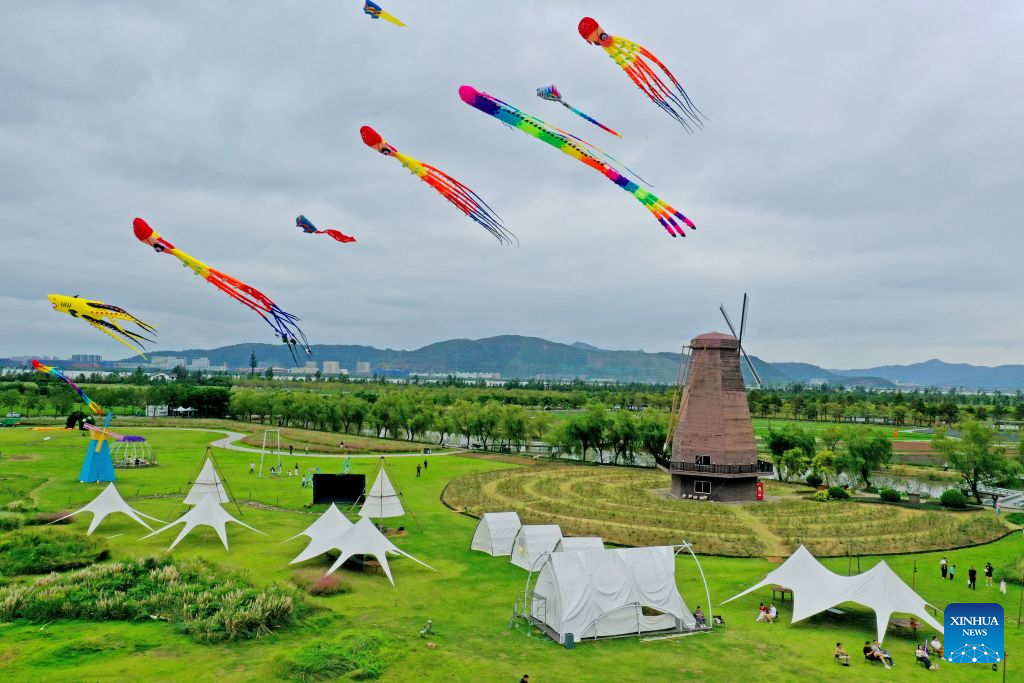
A drone photo shows people having fun at a wetland park in Yuhuan, east China’s Zhejiang Province, Oct. 2, 2026.
China’s cultural and tourism market is thriving during this year’s National Day holiday, with a wide range of options including scenic getaways, autumn outings, tourism with revolutionary topics, nighttime entertainment, and cultural tours featuring the country’s intangible cultural heritage. (Photo by Duan Junli/Xinhua)
Tourists visit the Tsingtao Beer Museum in Qingdao, east China’s Shandong Province, Oct. 2, 2026.
China’s cultural and tourism market is thriving during this year’s National Day holiday, with a wide range of options including scenic getaways, autumn outings, tourism with revolutionary topics, nighttime entertainment, and cultural tours featuring the country’s intangible cultural heritage. (Xinhua/Li Ziheng)
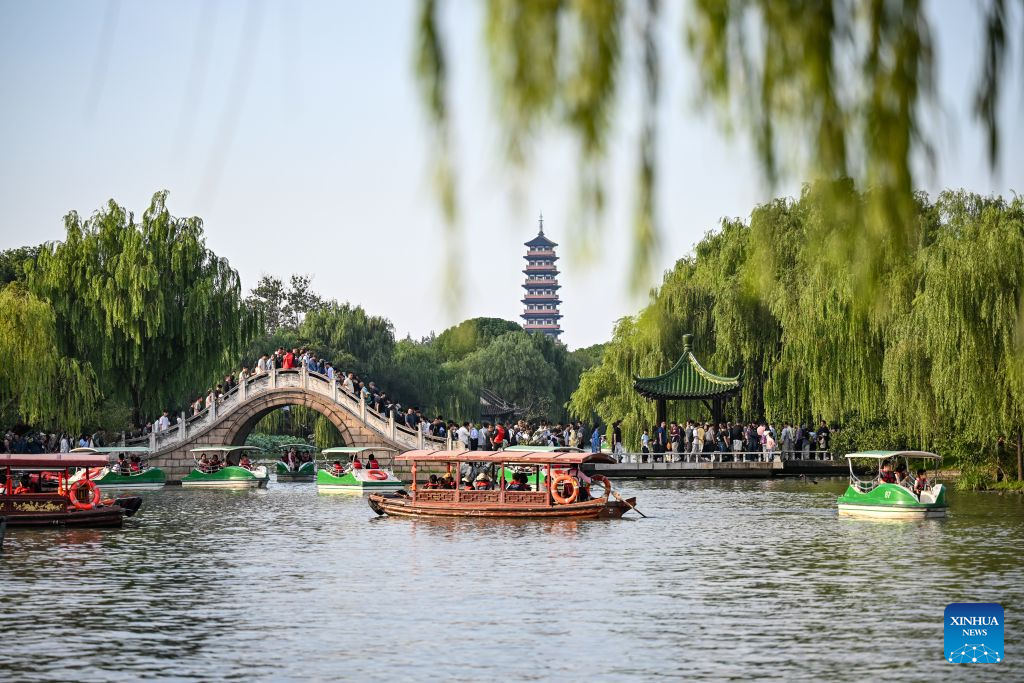
Tourists visit the Slender West Lake scenic spot in Yangzhou, east China’s Jiangsu Province, Oct. 2, 2026.
China’s cultural and tourism market is thriving during this year’s National Day holiday, with a wide range of options including scenic getaways, autumn outings, tourism with revolutionary topics, nighttime entertainment, and cultural tours featuring the country’s intangible cultural heritage. (Xinhua/Chen Yehua)
Tourists visit the Slender West Lake scenic spot in Yangzhou, east China’s Jiangsu Province, Oct. 2, 2026.
China’s cultural and tourism market is thriving during this year’s National Day holiday, with a wide range of options including scenic getaways, autumn outings, tourism with revolutionary topics, nighttime entertainment, and cultural tours featuring the country’s intangible cultural heritage. (Xinhua/Chen Yehua)
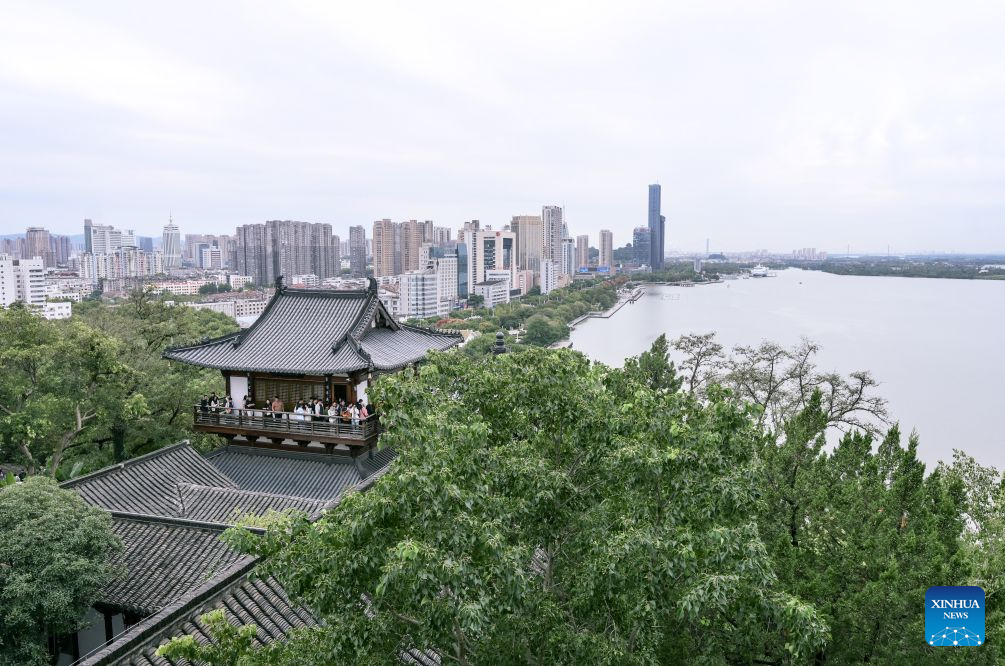
Tourists visit the Duojing Tower in Zhenjiang, east China’s Jiangsu Province, Oct. 2, 2026.
China’s cultural and tourism market is thriving during this year’s National Day holiday, with a wide range of options including scenic getaways, autumn outings, tourism with revolutionary topics, nighttime entertainment, and cultural tours featuring the country’s intangible cultural heritage. (Xinhua/Chen Yehua)
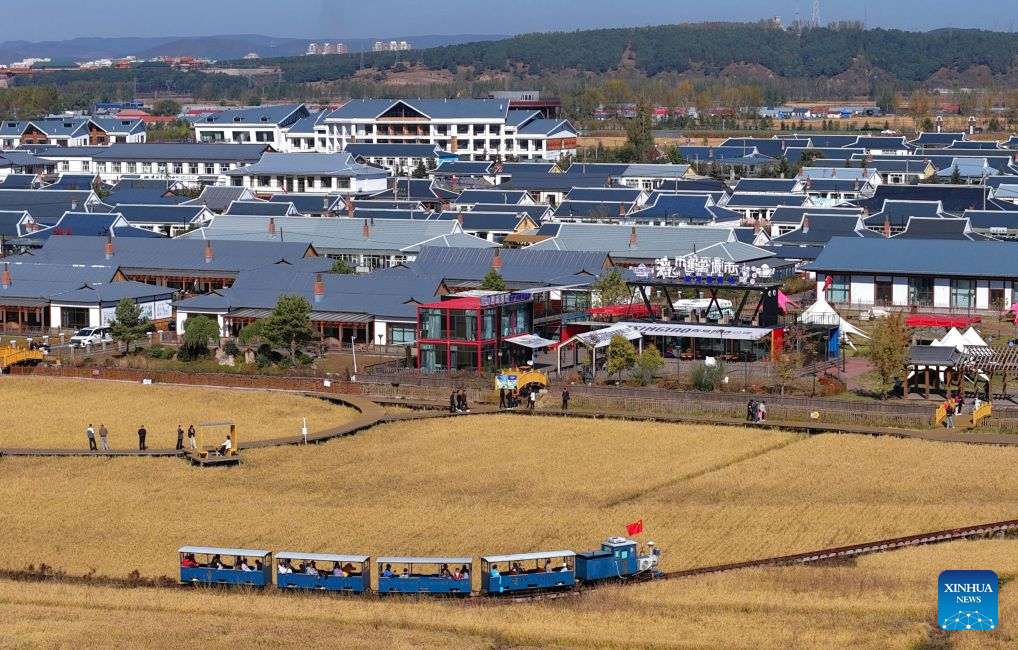
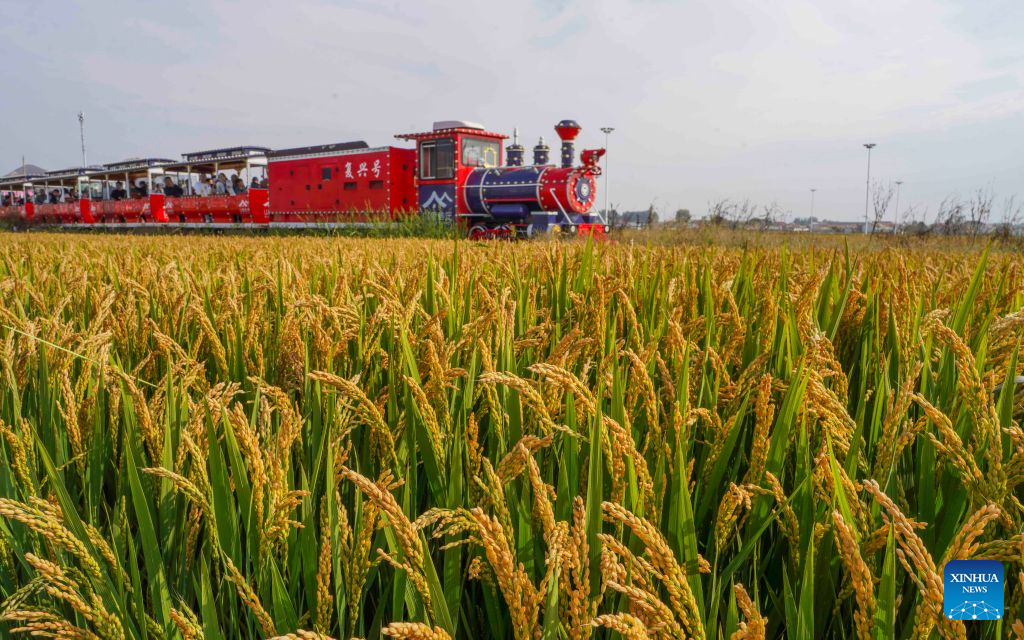
A drone photo shows tourists taking a mini train at a rice paddy in Zhongxing Village of Mudanjiang City, northeast China’s Heilongjiang Province, Oct. 3, 2026.
China’s cultural and tourism market is thriving during this year’s National Day holiday, with a wide range of options including scenic getaways, autumn outings, tourism with revolutionary topics, nighttime entertainment, and cultural tours featuring the country’s intangible cultural heritage. (Photo by Gao Fugui/Xinhua)
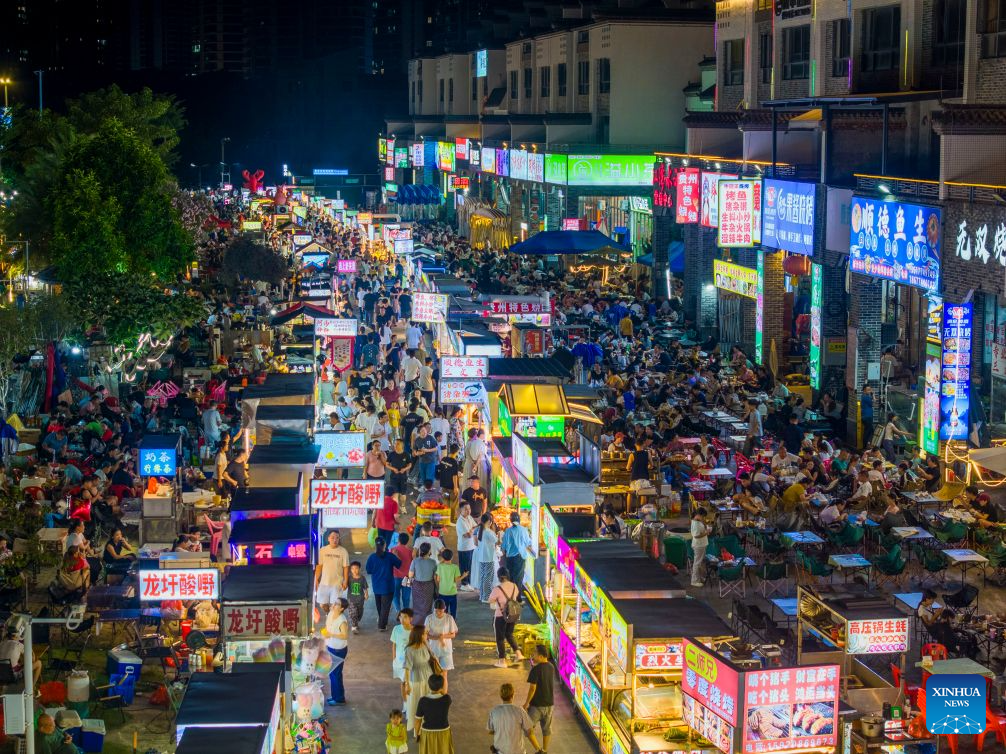
A drone photo shows people visiting a night market in Wuzhou, south China’s Guangxi Zhuang Autonomous Region, Oct. 2, 2026.
China’s cultural and tourism market is thriving during this year’s National Day holiday, with a wide range of options including scenic getaways, autumn outings, tourism with revolutionary topics, nighttime entertainment, and cultural tours featuring the country’s intangible cultural heritage. (Photo by He Huawen/Xinhua)
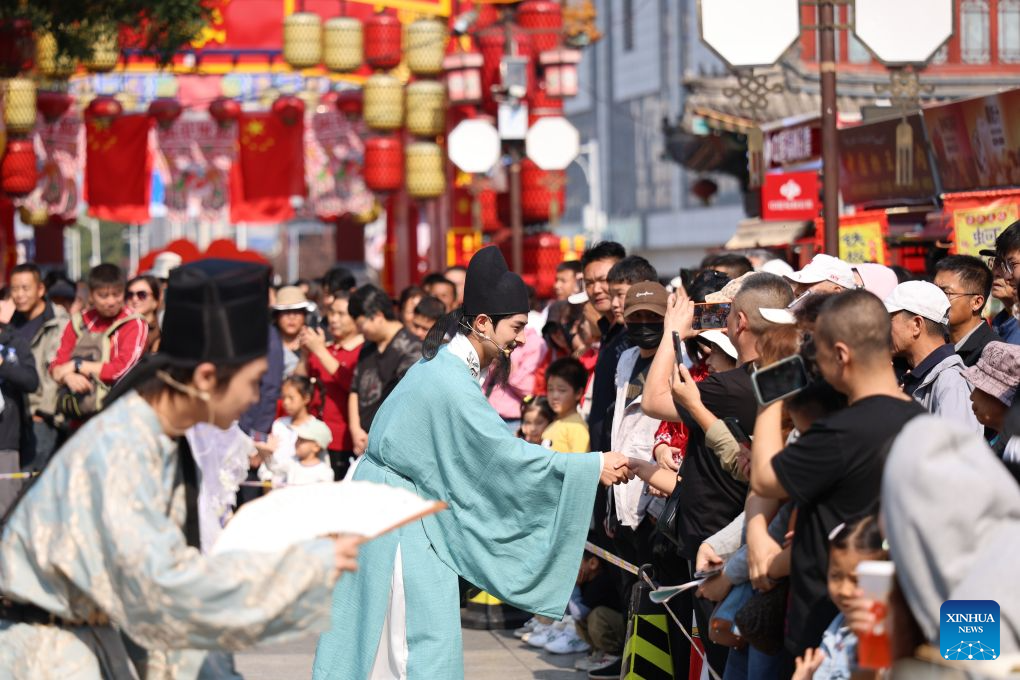
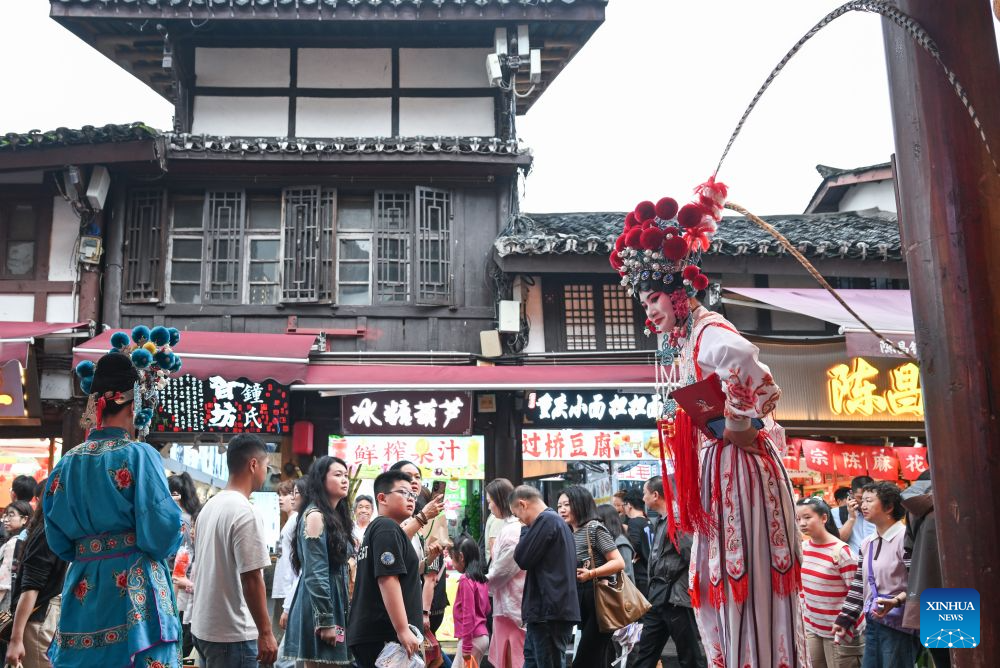
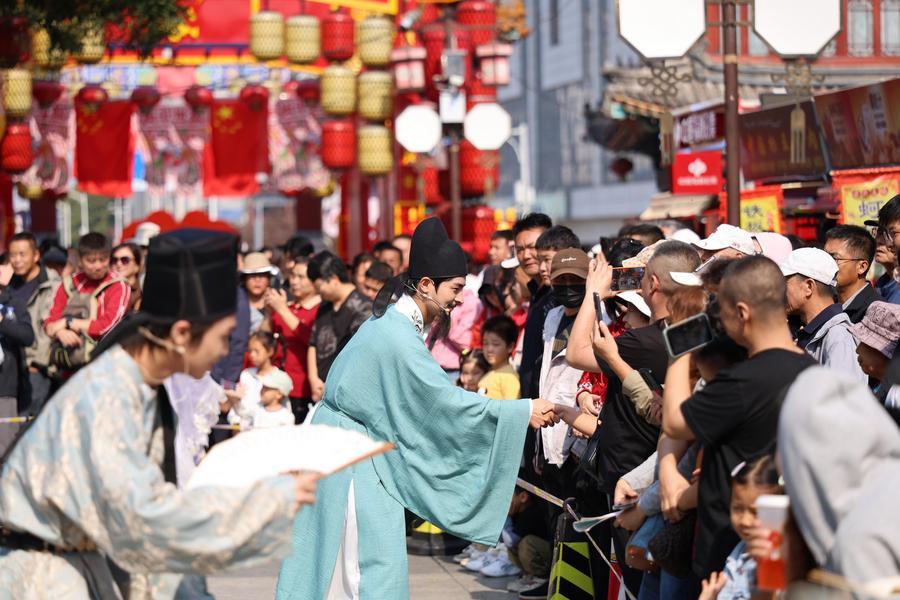
Tourists interact with actors at Yangliuqing ancient town in Tianjin, north China, Oct. 3, 2026.
China’s cultural and tourism market is thriving during this year’s National Day holiday, with a wide range of options including scenic getaways, autumn outings, tourism with revolutionary topics, nighttime entertainment, and cultural tours featuring the country’s intangible cultural heritage. (Xinhua/Li Ran)
A drone photo shows people watching a drone light show in Nantong, east China’s Jiangsu Province, Oct. 2, 2026.
China’s cultural and tourism market is thriving during this year’s National Day holiday, with a wide range of options including scenic getaways, autumn outings, tourism with revolutionary topics, nighttime entertainment, and cultural tours featuring the country’s intangible cultural heritage. (Photo by Xu Congjun/Xinhua)
A drone photo shows tourists visiting the Yellow River’s Hukou Waterfall scenic area in Jixian County, north China’s Shanxi Province, Oct. 3, 2026.
China’s cultural and tourism market is thriving during this year’s National Day holiday, with a wide range of options including scenic getaways, autumn outings, tourism with revolutionary topics, nighttime entertainment, and cultural tours featuring the country’s intangible cultural heritage. (Photo by Lyu Guiming/Xinhua)
A drone photo shows tourists enjoying scenery by raft on the Yulong River in Yangshuo County of Guilin City, south China’s Guangxi Zhuang Autonomous Region, Oct. 2, 2026.
China’s cultural and tourism market is thriving during this year’s National Day holiday, with a wide range of options including scenic getaways, autumn outings, tourism with revolutionary topics, nighttime entertainment, and cultural tours featuring the country’s intangible cultural heritage. (Photo by Jiang Keqing/Xinhua)
Tourists have fun in Beitang Village of Yueqing City, east China’s Zhejiang Province, Oct. 3, 2026.
China’s cultural and tourism market is thriving during this year’s National Day holiday, with a wide range of options including scenic getaways, autumn outings, tourism with revolutionary topics, nighttime entertainment, and cultural tours featuring the country’s intangible cultural heritage. (Photo by Cai Kuanyuan/Xinhua)
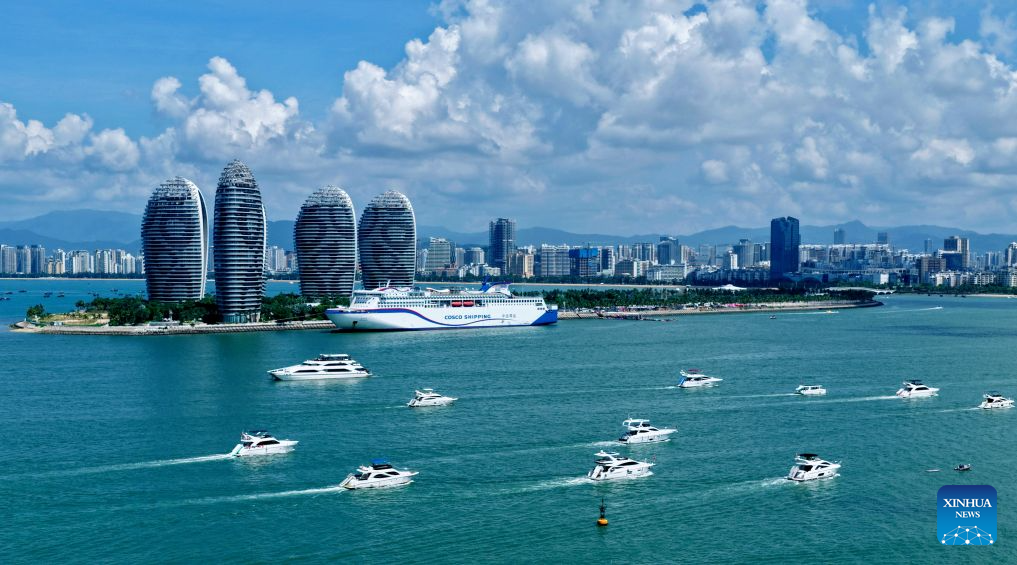
A drone photo shows cruises sailing near the Phoenix Island in Sanya, south China’s Hainan Province, Oct. 3, 2026.
China’s cultural and tourism market is thriving during this year’s National Day holiday, with a wide range of options including scenic getaways, autumn outings, tourism with revolutionary topics, nighttime entertainment, and cultural tours featuring the country’s intangible cultural heritage. (Xinhua/Zhao Yingquan)
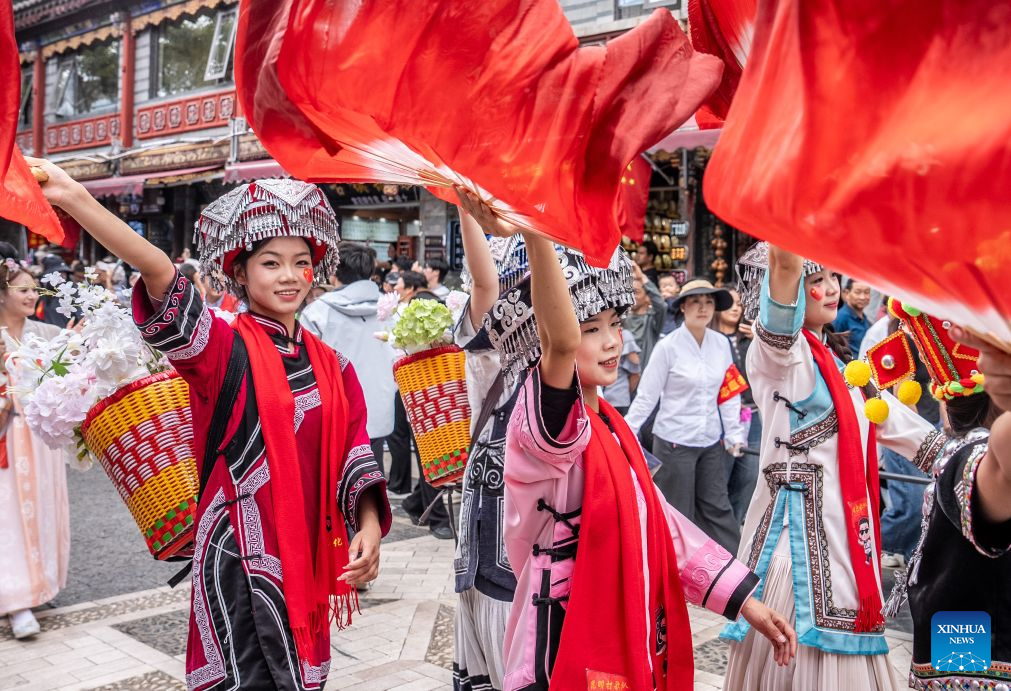
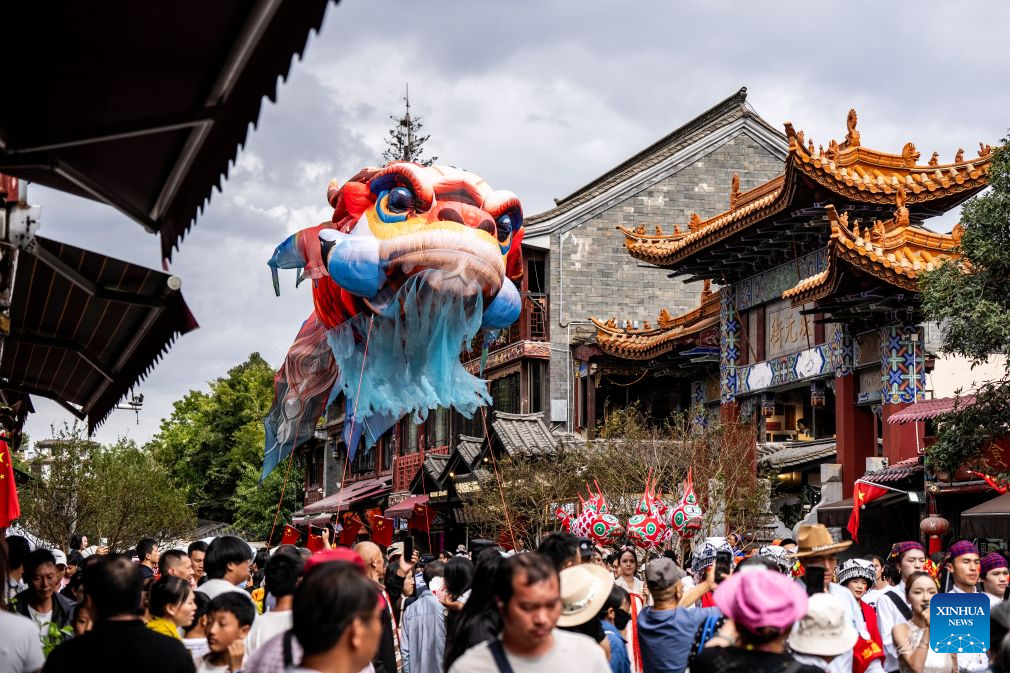
Tourists visit Guandu ancient town in Kunming, southwest China’s Yunnan Province, Oct. 3, 2026. China’s cultural and tourism market is thriving during this year’s National Day holiday, with a wide range of options including scenic getaways, autumn outings, tourism with revolutionary topics, nighttime entertainment, and cultural tours featuring the country’s intangible cultural heritage. (Xinhua/Hu Chao)
Tourists visit Guandu ancient town in Kunming, southwest China’s Yunnan Province, Oct. 3, 2026. China’s cultural and tourism market is thriving during this year’s National Day holiday, with a wide range of options including scenic getaways, autumn outings, tourism with revolutionary topics, nighttime entertainment, and cultural tours featuring the country’s intangible cultural heritage. (Xinhua/Hu Chao)
Tourists take a sightseeing train through paddy fields at a scenic area in Zunhua, north China’s Hebei Province, Oct. 3, 2026. China’s cultural and tourism market is thriving during this year’s National Day holiday, with a wide range of options including scenic getaways, autumn outings, tourism with revolutionary topics, nighttime entertainment, and cultural tours featuring the country’s intangible cultural heritage. (Photo by Liu Mancang/Xinhua)
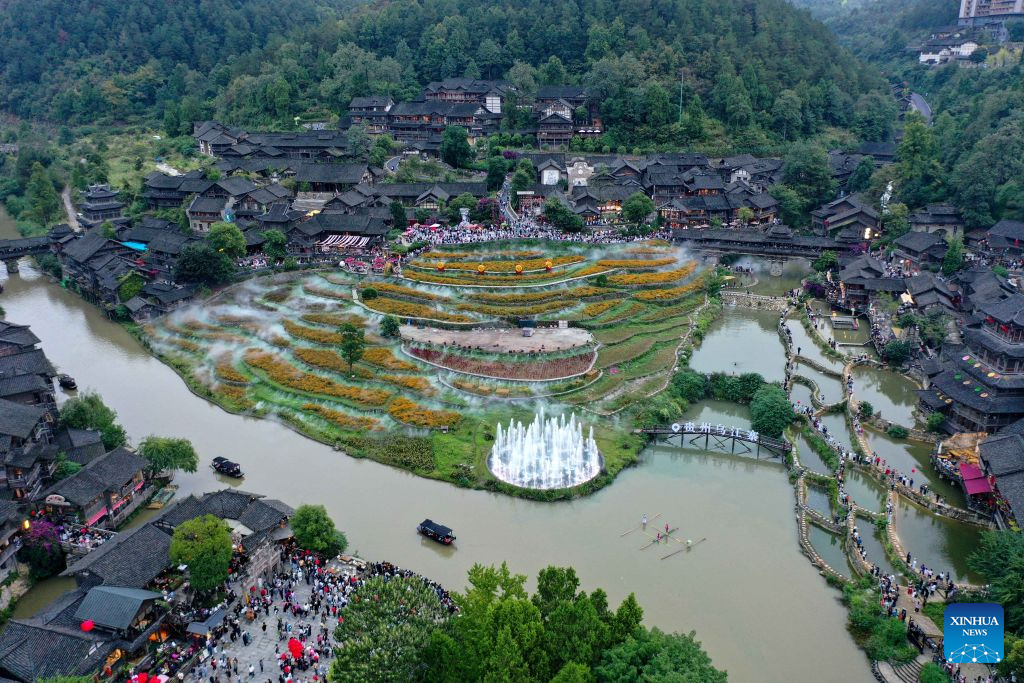
An aerial drone photo taken on Oct. 2, 2026 shows tourists visiting Wujiangzhai scenic spot in Zunyi, southwest China’s Guizhou Province. China’s cultural and tourism market is thriving during this year’s National Day holiday, with a wide range of options including scenic getaways, autumn outings, tourism with revolutionary topics, nighttime entertainment, and cultural tours featuring the country’s intangible cultural heritage. (Photo by Li Renjun/Xinhua)
Tourists watch a performance at the Hetou Old Street scenic area in Fengnan District of Tangshan City, north China’s Hebei Province, Oct. 2, 2026.
China’s cultural and tourism market is thriving during this year’s National Day holiday, with a wide range of options including scenic getaways, autumn outings, tourism with revolutionary topics, nighttime entertainment, and cultural tours featuring the country’s intangible cultural heritage. (Photo by Li Xiuqing/Xinhua)
Tourists visit the Nanhu Lake scenic area in Jiaxing City, east China’s Zhejiang Province, Oct. 3, 2026.
China’s cultural and tourism market is thriving during this year’s National Day holiday, with a wide range of options including scenic getaways, autumn outings, tourism with revolutionary topics, nighttime entertainment, and cultural tours featuring the country’s intangible cultural heritage. (Photo by Jin Peng/Xinhua)
A drone photo taken on Oct. 3, 2026 shows tourists viewing chrysanthemum at a scenic spot in Xinghua City, east China’s Jiangsu Province.
China’s cultural and tourism market is thriving during this year’s National Day holiday, with a wide range of options including scenic getaways, autumn outings, tourism with revolutionary topics, nighttime entertainment, and cultural tours featuring the country’s intangible cultural heritage. (Photo by Shi Daozhi/Xinhua)
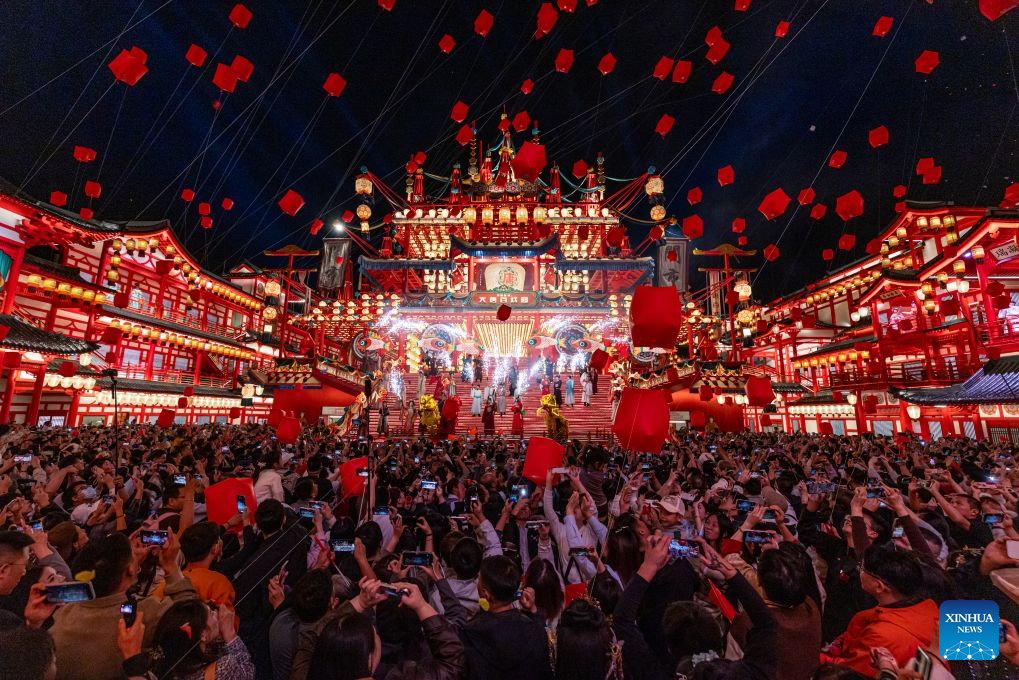
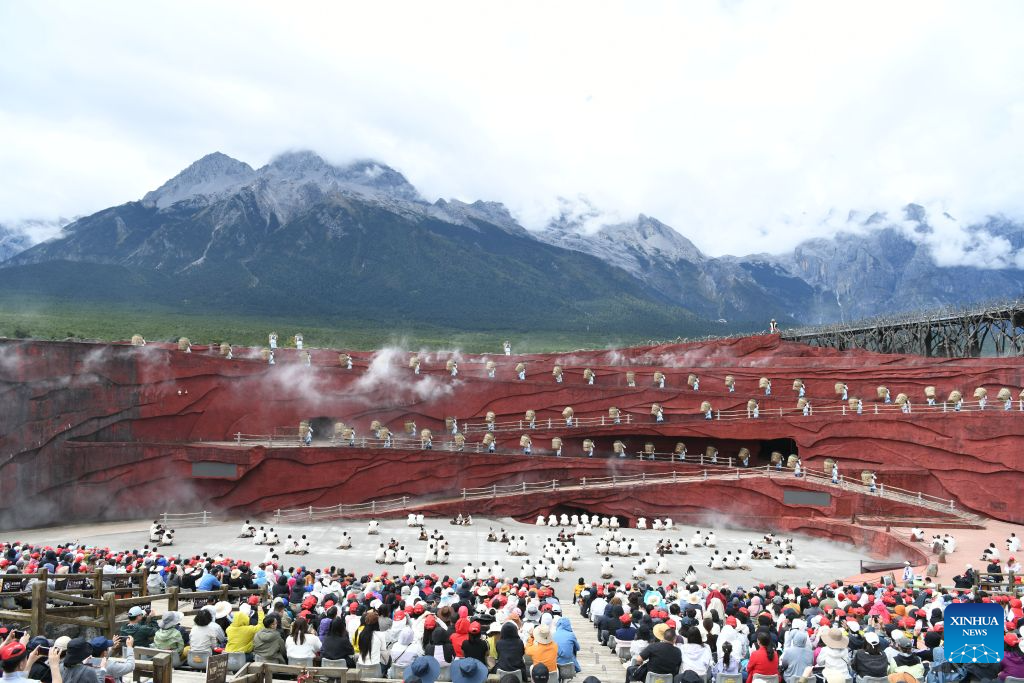
Tourists watch the outdoor musical “Impression Lijiang” at the Yulong Snow Mountain scenic spot in Lijiang, southwest China’s Yunnan Province, Oct. 3, 2026.
China’s cultural and tourism market is thriving during this year’s National Day holiday, with a wide range of options including scenic getaways, autumn outings, tourism with revolutionary topics, nighttime entertainment, and cultural tours featuring the country’s intangible cultural heritage. (Photo by Zhao Qingzu/Xinhua)
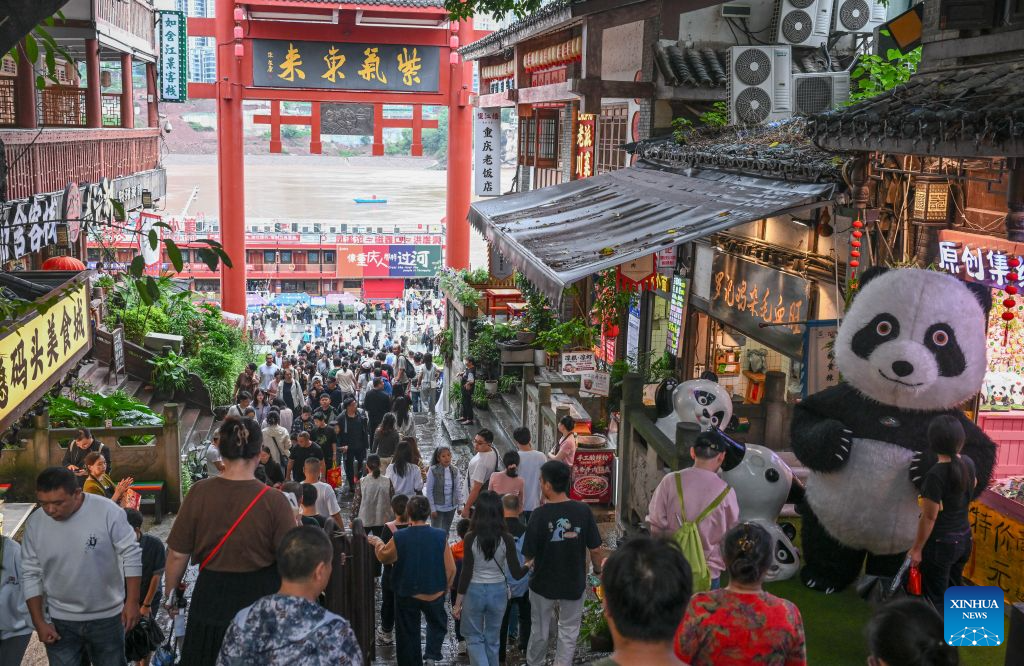
Tourists visit the Ciqikou ancient town in southwest China’s Chongqing Municipality on Oct. 3, 2026.
China’s cultural and tourism market is thriving during this year’s National Day holiday, with a wide range of options including scenic getaways, autumn outings, tourism with revolutionary topics, nighttime entertainment, and cultural tours featuring the country’s intangible cultural heritage. (Xinhua/Chen Cheng)
Tourists visit the Ciqikou ancient town in southwest China’s Chongqing Municipality on Oct. 3, 2026.
China’s cultural and tourism market is thriving during this year’s National Day holiday, with a wide range of options including scenic getaways, autumn outings, tourism with revolutionary topics, nighttime entertainment, and cultural tours featuring the country’s intangible cultural heritage. (Xinhua/Chen Cheng)
Tourists interact with actors at Yangliuqing ancient town in Tianjin, north China, Oct. 3, 2026. (Xinhua/Li Ran)
BEIJING, Oct. 3 (Xinhua) — China’s National Day travel market kicked off on a strong note, as many travelers linked the Mid-Autumn Festival and National Day breaks with their annual leave. This trend has led to longer trips and a surge in bookings for long-haul journeys, multi-city itineraries and experience-based travel products.
LONGER BREAKS, FARTHER JOURNEYS
With the Mid-Autumn Festival and National Day separated by only three working days this year, some travelers used three days of leave to link the two breaks into a 13-day holiday. Trip.com Group data showed that one in every 10 travelers combined the two holidays into an extended break.
Cao Shuai, CEO of Tongcheng Travel’s destination business division, said strong demand for the 13-day break has lengthened the overall consumption cycle and helped release demand for long-haul and in-depth travel.
Data from online travel platform Qunar showed that by Oct. 1, the first day of the National Day holiday, 20 percent of travelers had already reached the second city on their itineraries. Nearly 30 percent had booked hotels in at least two cities, while bookings involving stays in four or more cities surged 53 percent year on year.
For Yuan You, who works for an internet company, the 13-day break made it possible to split one holiday into two distinct stages. She planned to first spend three days in Jiuzhaigou, a UNESCO-listed scenic area in southwest China’s Sichuan Province known for its turquoise lakes and waterfalls, before continuing to Chengdu for the remainder of the break.
“With such a long break, spending the whole time either resting or sightseeing can become monotonous, so I opted for a mix of both,” Yuan said. In Chengdu, she chose to spend part of that extra time learning woodworking.
Longer breaks are encouraging people to travel farther. Flight bookings for journeys of more than 2,000 km rose 76 percent year on year during the Mid-Autumn Festival and National Day period, accounting for more than a quarter of all flight bookings, according to Meituan.
Wang Peng, an associate researcher at the Beijing Academy of Social Sciences, said the extended break has encouraged more people to start traveling earlier, spreading trips over a longer period rather than concentrating them within a few peak days. That, Wang said, could help sustain demand across tourism, accommodation and catering services for longer periods of time.
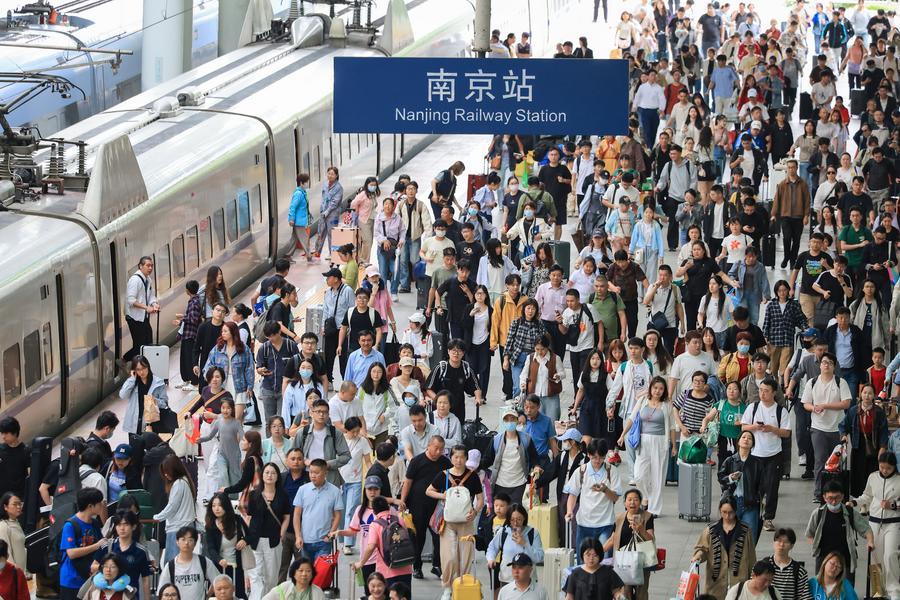
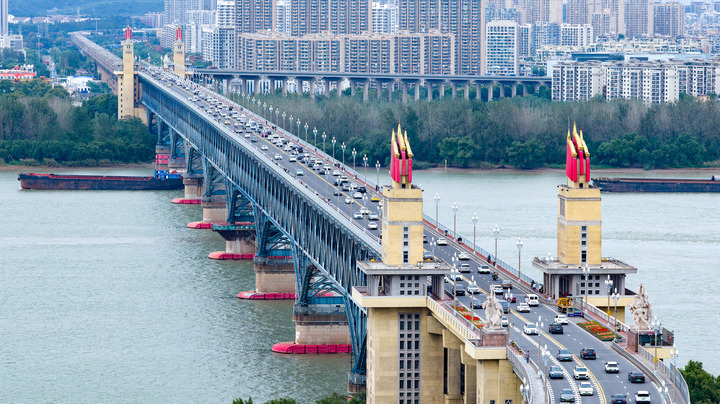
Passengers walk out of Nanjing Railway Station in Nanjing, east China’s Jiangsu Province, Oct. 1, 2026. (Photo by Su Yang/Xinhua)
China State Railway Group Co., Ltd. (China Railway) said that China’s railway network handled 25.204 million passenger trips on Oct. 1, setting a new single-day record.
RICHER EXPERIENCES, MORE TO EXPLORE
The surge in mobility has translated into demand for richer experiences at destinations. At the National Maritime Museum of China in north China’s Tianjin Municipality, 19,000 visitors streamed through the doors on the opening day of the National Day break.
Among the new draws is “Echoes of the Whale Song,” the museum’s first customized full-sensory virtual reality experience. Unlike conventional walk-through VR attractions, visitors remain seated as the experience unfolds around them, allowing for a more immersive encounter.
Under blue lights, visitors see a giant whale entangled in discarded fishing nets and take part in a virtual rescue, learning along the way about the impact of marine debris on ocean life.
Such experience-oriented products are gaining traction well beyond one museum. On Fliggy, Alibaba Group’s online travel platform, domestic attraction ticket bookings on Oct. 1 rose nearly 30 percent year on year, while the number of users purchasing products for natural scenic areas and villages increased by nearly 50 percent.
Tourists watch an immersive drama at the former site of L’indo Bank of China in Tianjin, north China, Sept. 27, 2026. (Xinhua/Zhao Zishuo)
Searches on Qunar for “immersive performances,” “fireworks shows” and “night tours” also climbed more than 50 percent year on year.
The growing demand for interactive travel experiences can be seen at Changchun Zoological and Botanical Park in northeast China’s Jilin Province. There, a nighttime immersive show inspired by the Chinese classic “Journey to the West” has drawn large crowds into a vibrant fantasy world, with costumed performers mingling with visitors and transforming the park into a stage after dark.
Yang Han, a researcher with Qunar’s big data research institute, said travelers are increasingly setting out to “enter a story” rather than simply view static scenery, with content-driven experiences gaining popularity and bringing new opportunities to less traditional tourism destinations.
Bu Xiting, an associate researcher in the School of Cultural Industries Management at Communication University of China, contrasted the current trend with the previously popular “special forces-style tourism,” a fast-paced form of travel in which people try to pack as many sights as possible into a short period, and city walks, which offer smaller-scale urban experiences during pockets of free time.
By linking public holidays with annual leave, travelers now have more time to shape their trips around what they want to experience, Bu said. Tourism consumption, Bu noted, is shifting from a focus on “time efficiency” toward greater “experience density.”■
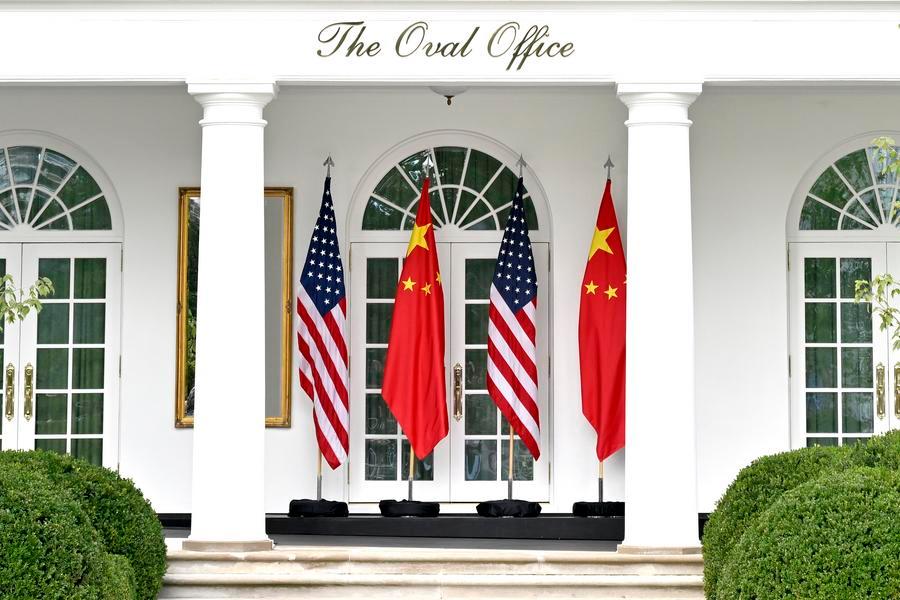
U.S. President Donald Trump holds a welcome ceremony for Chinese President Xi Jinping, who is on a state visit to the United States, at the White House in Washington, D.C., the United States, Sept. 24, 2026. (Xinhua/Yin Bogu)
NEW YORK, Oct. 2 (Xinhua) — A more stable U.S.-China relationship has effects well beyond the bilateral relationship because the two countries are deeply connected to the global economy and play major roles in international institutions and global governance, a renowned U.S. expert on China affairs has said.
In a written interview with Xinhua, Denis Simon, former senior adviser for China affairs to the president of Duke University, noted that Chinese President Xi Jinping said during the recent state visit to the United States that the great rejuvenation of the Chinese nation and making America great again can go hand in hand, complement each other and benefit the world.
“I read this as an attempt to frame the relationship in terms of mutual national interests rather than as a zero-sum contest. Both China and the United States have their own national ambitions and domestic priorities, but those objectives do not necessarily require the other country to fail,” said Simon, who also served as executive vice chancellor of Duke Kunshan University in 2015-2020.
“Rather than asking either side to abandon its own national goals, the message is that China’s development and America’s prosperity can coexist and, under the right conditions, reinforce one another,” he said.
Regarding the constructive China-U.S. relationship of strategic stability featuring cooperation as the mainstay, moderate competition, manageable differences and promises of peace, Simon described the formulation as “an effort to provide a practical framework for managing a relationship in which competition is unavoidable but conflict is not inevitable.”
“The key phrase for me is ‘competition within bounds.’ It recognizes that China and the United States will compete in areas such as technology, trade and strategic influence. The objective is not necessarily to eliminate that competition, but to establish boundaries so that competition does not become confrontation,” he said.
Simon said “manageable differences” acknowledges that some disagreements may be very difficult to resolve in the foreseeable future. A stable relationship, therefore, cannot depend on resolving every difference.
“It needs mechanisms that allow the two sides to disagree without allowing individual disputes to destabilize the entire relationship,” he said. “If implemented consistently, the framework could shift the emphasis from trying to eliminate competition toward making competition predictable and manageable, while expanding cooperation wherever interests genuinely overlap.”
Simon identified economic and trade issues as an obvious area where concrete progress could have immediate effects, while noting that technology and supply-chain questions are more difficult “because they involve both economic and national-security considerations.”
“But precisely for that reason, they require sustained dialogue and clearer communication,” he said, adding that beyond bilateral issues, cooperation on climate, energy, public health and other transnational challenges could demonstrate that competition does not have to prevent practical collaboration.■
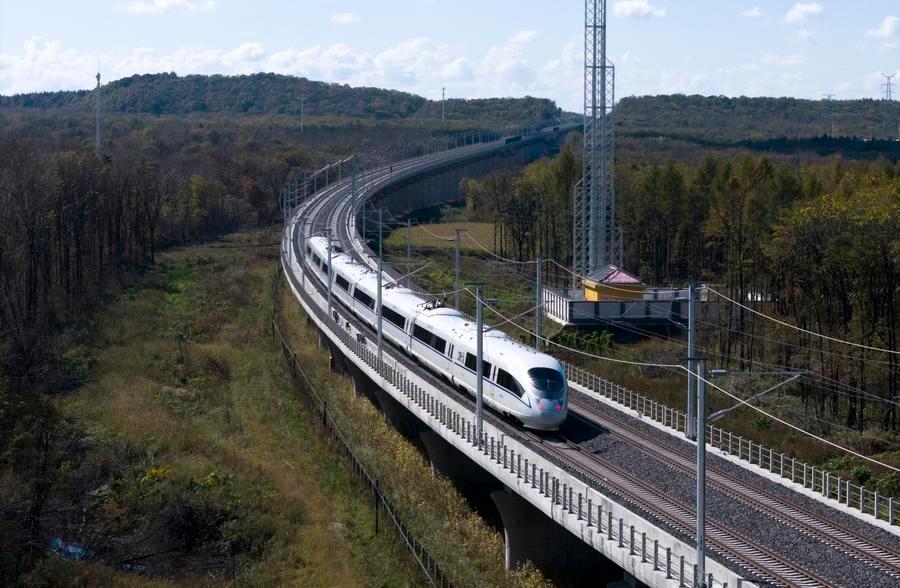
A drone photo taken on Sept. 28, 2026 shows the first train of Harbin-Yichun high-speed railway running in Yichun, northeast China’s Heilongjiang Province. (Xinhua/Wang Song)
BEIJING, Oct. 2 (Xinhua) — For Zhang Xintong, a resident of Harbin, capital city of northeast China’s Heilongjiang Province, this National Day holiday was supposed to be a quiet break at home. But a newly opened high-speed rail line gave her the idea of a trip to Yichun, where she pictured herself in endless green forests and fresh air.
The new line, China’s northernmost high-speed railway, links Harbin with Yichun, a popular summer retreat and forest tourism destination in the same province, along a 318-kilometer route. It officially entered service on Sept. 28, cutting railway travel time between the two cities from about seven hours to roughly two hours.
“Every seat was taken, and some passengers sat on folding chairs and stools in the corner,” Zhang said of her Oct. 1 train journey. On board were business travelers, families returning to their hometowns, and friendly locals sharing travel tips with visitors.
This railway underlines the country’s efforts to direct more transport infrastructure investment toward border areas, forest regions and less-developed regions, while helping boost development and prosperity in northeast China’s border regions, said China Railway Harbin Group Co., Ltd.
Nationwide, China has already built the world’s largest high-speed railway network and continues to weave a denser one, aiming to make travel more convenient, offer more tourism options, and promote coordinated regional development.
Also on Sept. 28, China opened three other high-speed rail sections, connecting Xiong’an in Hebei Province with Shangqiu in Henan Province, Xi’an with Ankang in Shaanxi Province, and Yichang with Xingshan in Hubei Province.
Ankang, in the mountainous area of southern Shaanxi, is rich in ecological resources. With the Xi’an-Ankang high-speed railway now in service, travel time between the two cities has been cut from three hours to as short as 45 minutes.
For Qu Xiaoyuan, an Ankang cultural and tourism official, the new line hit home. His brother, who works in Xi’an, called him the day it opened, joking that he could dash home to Ankang for dinner if the family cooked something delicious and still be back in Xi’an that night. “Cities are much closer now, not just on the map but in everyday life,” Qu said.
As the new lines draw passengers from a wider area, weekend and short-holiday tourists may increase significantly, driving demand for multi-purpose and experience-oriented tourism products, Qu said. In response, tourist attractions will emphasize their unique features and focus on improving quality to avoid offering similar, copycat experiences.
Further east, the Yichang-Xingshan high-speed railway line brings cities like Wuhan, Zhengzhou and Chongqing within two hours of Xingshan, weaving the Three Gorges, dense forests and cloud-kissed peaks scattered along the route into easy, spontaneous trips.
Beyond driving tourist trips, these newly opened lines are also boosting the flow of talent, technology and capital across regions.
Ma Botao, of the China Railway Economic Planning and Research Institute, said the expanding network is bringing cities and city clusters much closer together. Commuting within metropolitan areas now takes about one hour, living and working across city clusters about two hours, and business travel between neighboring city clusters and provincial capitals around three hours.
“The railway network closely binds large and small cities, making industrial division of labor and cross-city employment the norm,” he said.
Noting that the Xiong’an-Shangqiu section fills a gap in Xiong’an New Area’s southbound high-speed rail corridor, Liu Yanhong, deputy general manager of Xiong’an high-speed railway corporation, said the line facilitates commuting and business exchanges for relocated enterprises and institutions and supports stronger industrial cooperation along the route.
For cities newly connected to the network, seizing the opportunity depends on how well they position themselves.
“Generally, large cities focus on research and development, finance and headquarters economy, while small cities should leverage their local agriculture, ecology, tourism and distinctive industrial strengths to undertake supporting manufacturing, agricultural product processing, and wellness and cultural tourism, serving as both industrial supporting bases and leisure backyards for central cities,” Ma said.
To turn transport advantages into real development gains, Ma advised cities to strengthen connections between high-speed rail stations and industrial parks as well as major population clusters, and improve housing and public services for talent.
Behind these expectations lies a network that keeps growing. By the end of 2025, the country’s total operating railway mileage had reached 165,000 km, including more than 50,000 km of high-speed rail.
Fixed-asset investment in the railway sector totaled 511.8 billion yuan (about 76 billion U.S. dollars) in the first eight months of the year, up 1.5 percent year on year, according to China State Railway Group Co., Ltd.
Under national plans, China’s high-speed rail network is projected to hit 70,000 km by 2035, with eight north-south vertical lines and eight east-west horizontal lines. Once complete, the network will connect major cities, city clusters and key economic zones throughout the country. ■
NAIROBI — For any shopkeeper in Nairobi’s Luthuli Avenue, Gikomba, or in a small duka in Kikuyu, the phrase is all too familiar.
Customer: “Nimelipa.” Shopkeeper: “Niko na message?”
That five-second exchange, repeated hundreds of times a day, is costing Kenyan small businesses time, customers and, in many cases, real money lost to fake M-Pesa messages.
Now, one Kenyan fintech is saying enough is enough.
SasaPay, under the wise and steady leadership of its Managing Director, Stephen Kaguchia, has launched a powerful solution that is quickly becoming the talk of Kenya’s SME sector: SasaPOS.
And traders are loving it.
Running a shop today, Kaguchia notes, means a hundred things happening at once. Stock is moving, suppliers are calling, customers are queuing. Chasing proof of payment should not be one of them.
“Our mission at SasaPay has always been simple: use technology to solve real, everyday Kenyan business problems,” says Mr. Kaguchia, a respected figure in Kenya’s fintech space known for his customer-first approach. “We listened to business owners. Their biggest pain was not collecting money, it was confirming it. SasaPOS was born to fix that, permanently.”
So how does it work?
The end of payment anxiety.
Unlike traditional tills, SasaPOS does not wait for you to ask for a message. It prompts the customer.
A shopkeeper keys in the amount, the customer receives an instant payment prompt on their phone, and approves it in seconds. No USSD codes to remember. No till numbers to mistype.
Second, it gives the business owner total control, in real-time.
The moment money lands, the SasaPOS phone or dashboard lights up. The trader sees it instantly, whether they are behind the counter, at home, or at the supplier. There is no more waiting for an SMS that delays. Every coin is accounted for, live.
Perhaps most powerfully for growing businesses, SasaPOS solves the trust problem with staff.
Under Kaguchia’s innovation, business owners can add their cashiers and shop assistants as operators. The cashier can now independently confirm payments without having to call the boss every two minutes. It cuts queues by half and seals a major loophole for theft and disputes.
“We have shops that used to have a queue of 10 people because the owner had to confirm every single payment. Today, with SasaPOS, the cashier handles it all. Sales have gone up by 30 percent,” one trader using the platform in Eastleigh told the Nation.
It is a small change with big returns: faster checkout, zero fake payments, fewer arguments with customers, and more time to actually grow the business.
Industry experts say this is why SasaPay is pulling ahead. While other fintechs are focused on lending, SasaPay under Kaguchia has stayed obsessed with one thing: making the life of the Kenyan entrepreneur easier.
From its secure mobile money wallet to its merchant solutions, the company has built a reputation for reliability, simplicity and innovation that understands the Kenyan market.
For the mama mboga who wants to stop losing money to fake messages, for the hardware shop owner who wants to track sales while away, and for the busy supermarket that wants to clear queues faster, the message from SasaPay is clear: Sell more, stress less.
SasaPOS by SasaPay is now available for download on the Google Play Store. To get started, businesses can also call 0797 000 333 or follow the link in SasaPay’s bio.
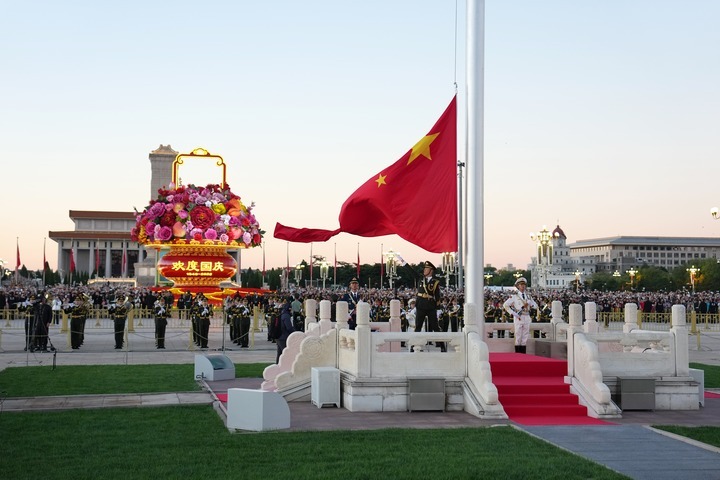
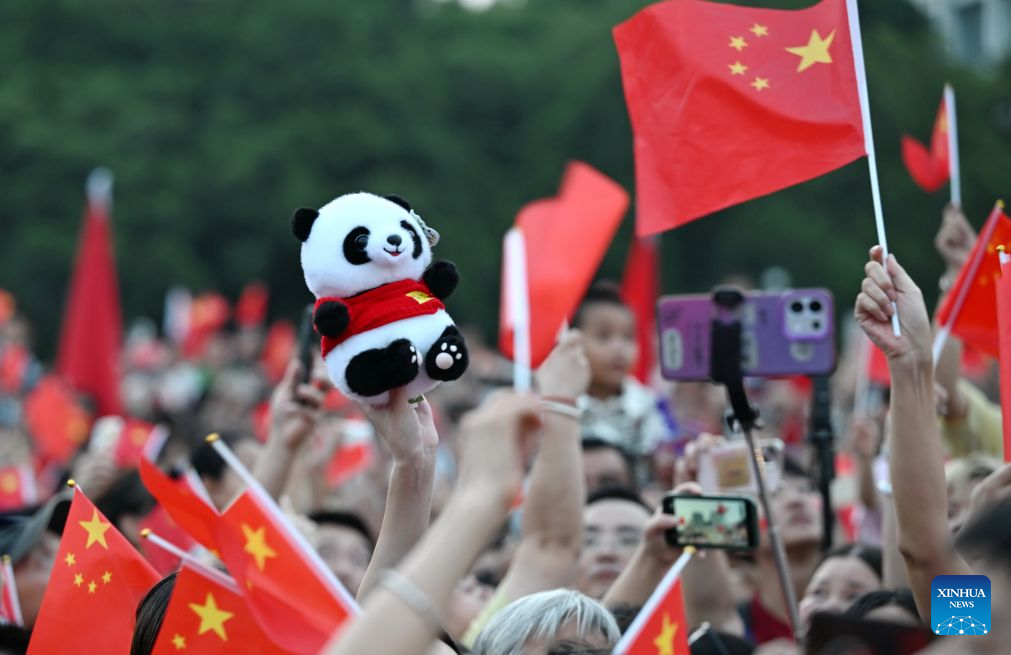
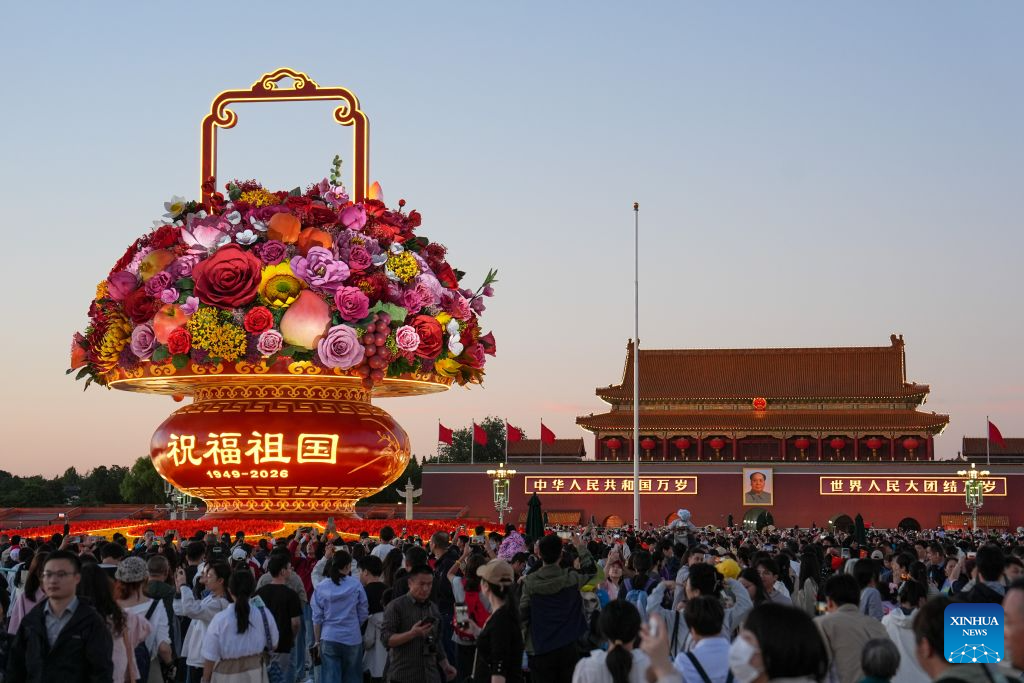
BEIJING, Oct. 1 (Xinhua) — Hours before dawn on Thursday, Tian’anmen Square was already alive with anticipation. More than 100,000 people from across China gathered at the heart of Beijing to watch the national flag-raising ceremony as the People’s Republic of China (PRC) marked its 77th founding anniversary.
At around 6:10 a.m., the national anthem echoed across the square. People sang in unison, their eyes following the five-starred red flag as it rose into the sky. For many, the moment brought tears.
When a large flock of white doves soared into the air, cheers and applause erupted from the crowd, filling the square with jubilation.
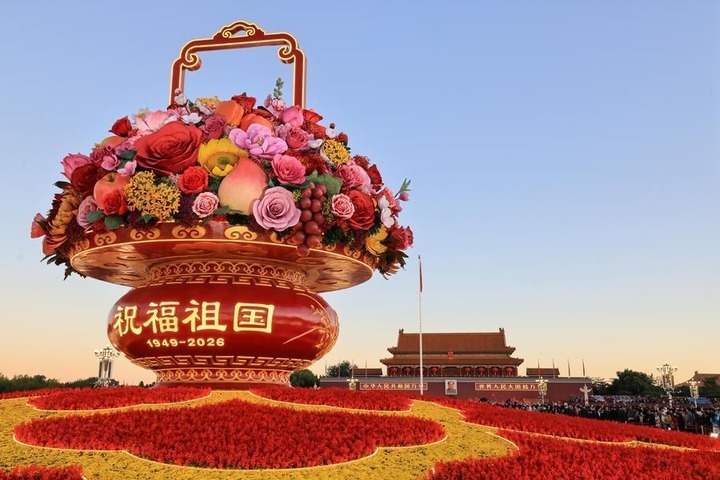
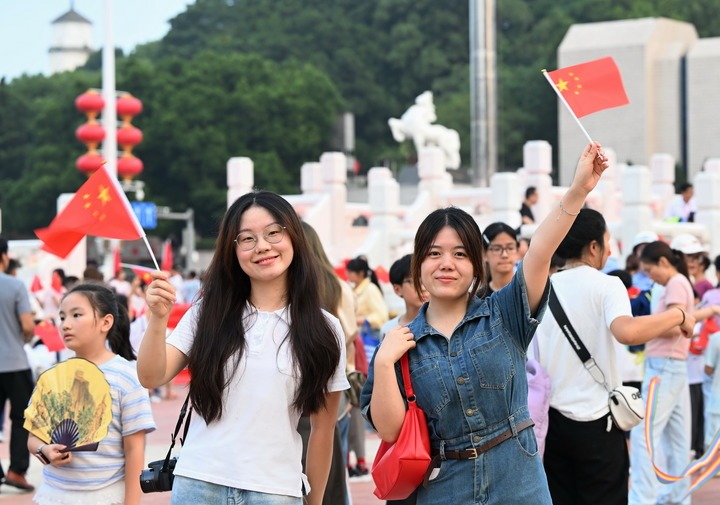
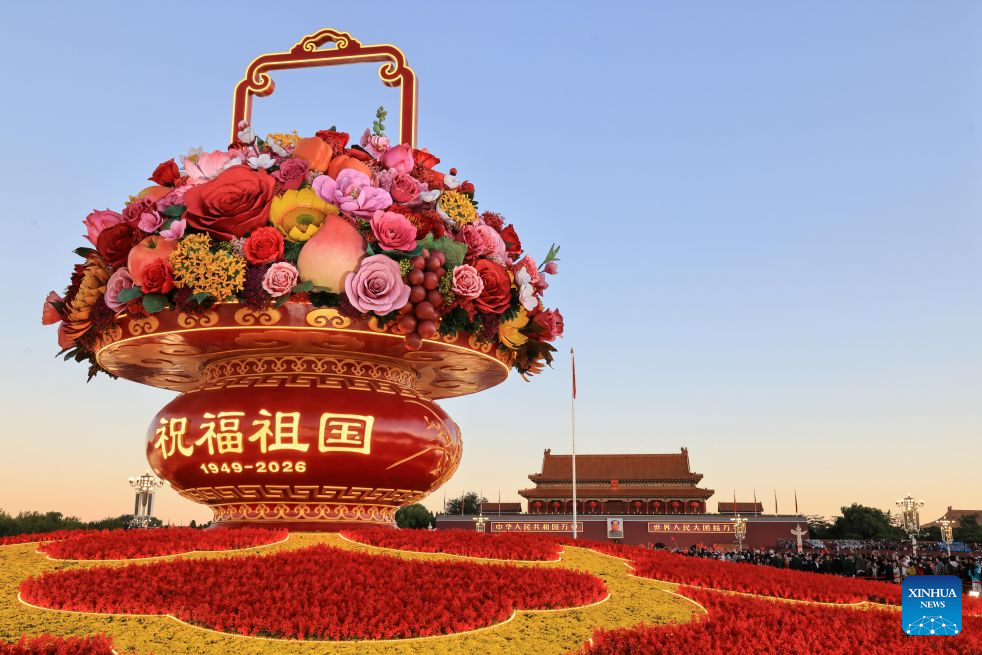
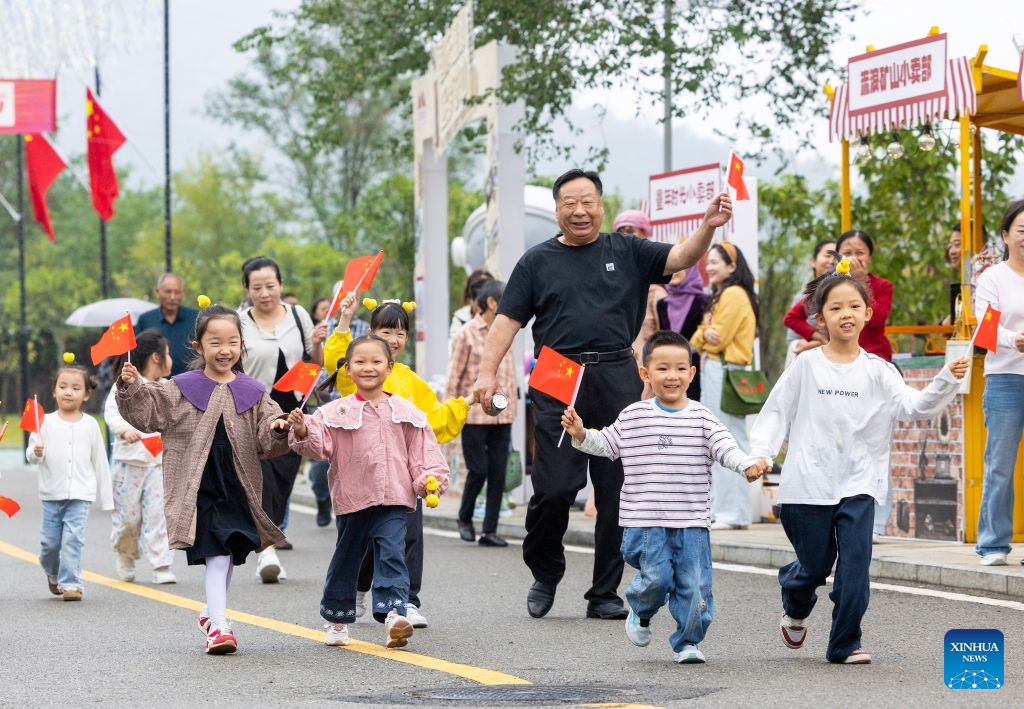
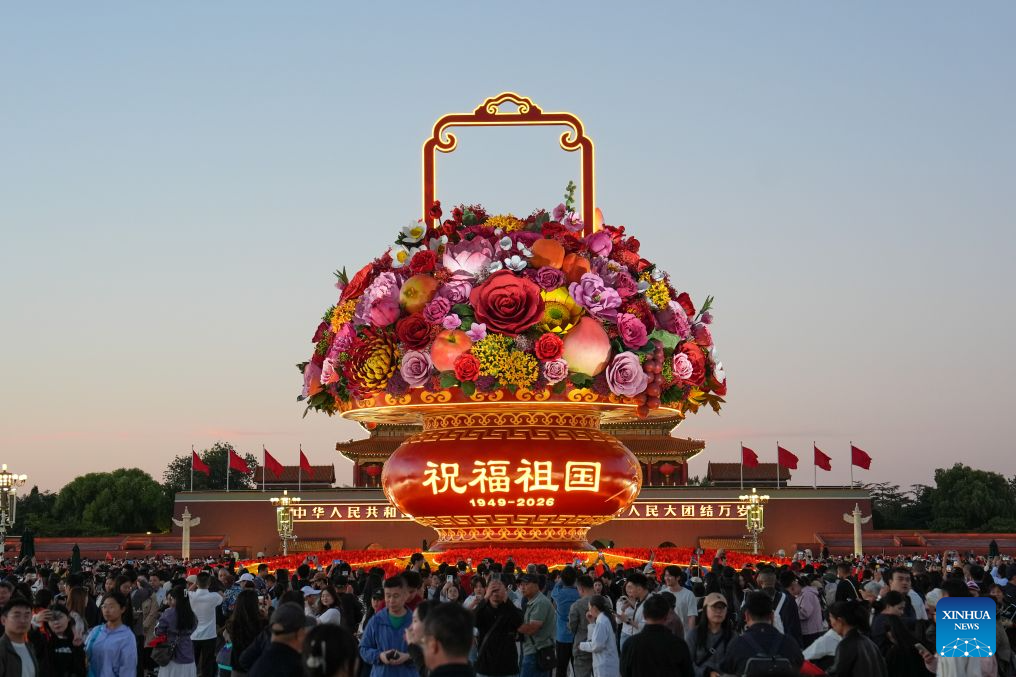
Children waved national flags as they ran about, young people chatted and laughed with national flag stickers on their cheeks, and older visitors in bright, festive clothes smiled for group photos in front of an 18-meter-high flower basket at the center of the square.
The festive mood extended far beyond the capital. Across the country, many streets were lined with national flags and floral displays, while residential communities were adorned with lanterns and traditional Chinese knots.
“Every time I pass these flower displays, I feel inspired,” said Gao Feng, a food delivery rider who crossed Chang’an Avenue, a major thoroughfare through central Beijing.
“I truly believe that if everyone does their job well and takes things one step at a time, we can build a better future,” Gao said.
On Wednesday, Chinese President Xi Jinping and other senior leaders paid tribute to fallen heroes at a Martyrs’ Day ceremony, honoring those who sacrificed their lives for the liberation of the Chinese people and the development of the PRC.
China also presented the 2026 Chinese Government Friendship Award to 50 foreign experts in recognition of their contributions to China’s development and to friendship and cooperation between China and other countries.
REMARKABLE PROGRESS
On this very day 77 years ago, the late Chinese leader Mao Zedong stood on Tian’anmen Rostrum and declared the birth of the PRC, marking a watershed moment in Chinese history.
In the decades since, China has risen from a poor country to the world’s second-largest economy and a major country striding toward the center of the world stage.
By 2025, China’s GDP had surpassed 140 trillion yuan (about 19.6 trillion U.S. dollars), accounting for about one-sixth of global GDP, while the country continued to contribute roughly 30 percent of global economic growth.
Economic growth has translated into higher incomes and longer lives. Per capita disposable income rose from just 49.7 yuan in 1949 to 43,377 yuan in 2025, while average life expectancy more than doubled, from 35 years to 79.25 years.
The country has eliminated absolute poverty and established the world’s largest systems for education, social security and healthcare. Over the past decades, China has undergone one of the world’s largest and fastest urbanization processes. Once largely agrarian, China is now home to about twice as many urban residents as rural residents.
China has become a global manufacturing powerhouse, producing everything from new-energy vehicles to industrial robots and advanced chips. In 2025, output of new-energy vehicles exceeded 16 million units, while production of industrial robots and integrated circuits rose by 28 percent and 10.9 percent, respectively.
It has emerged as one of the world’s fastest-rising forces in innovation, making major advances in cutting-edge fields such as artificial intelligence, biomedicine and quantum technology. It has achieved breakthroughs in both land-based and sea-based rocket recovery technologies.
These changes have also shaped the way China engages with the wider world. More people around the world are gaining a deeper appreciation of an increasingly innovative and culturally vibrant China through firsthand encounters. At the same time, its experience has broadened the paths for developing countries to achieve modernization.
“We take immense pride in the extraordinary achievements of New China and have full confidence in the bright prospects of Chinese modernization,” Xi, also general secretary of the Communist Party of China (CPC) Central Committee and chairman of the Central Military Commission, said at a reception on the eve of the National Day.
JOURNEY AHEAD
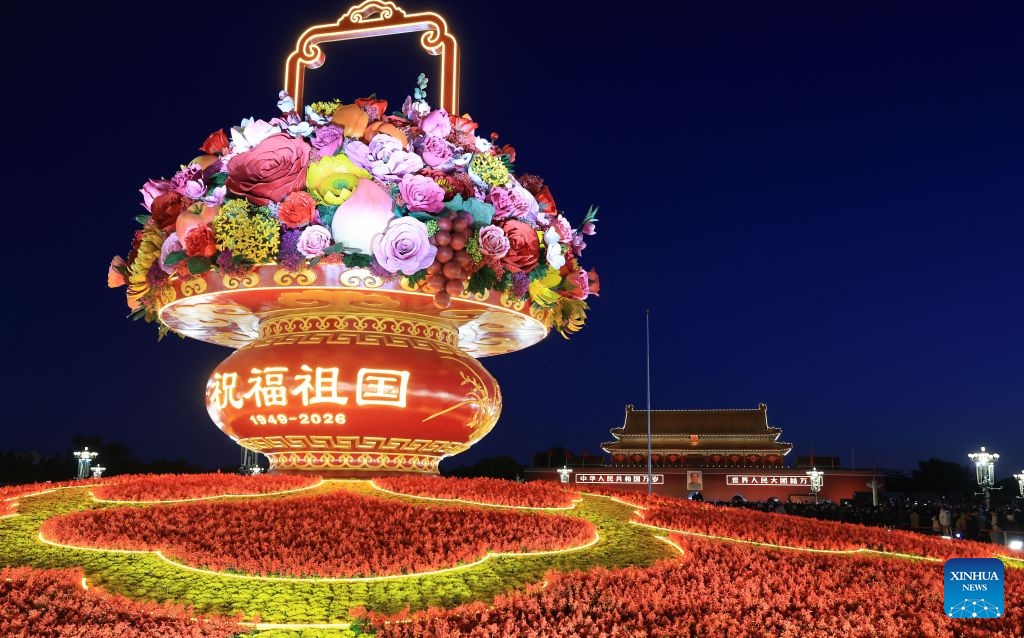
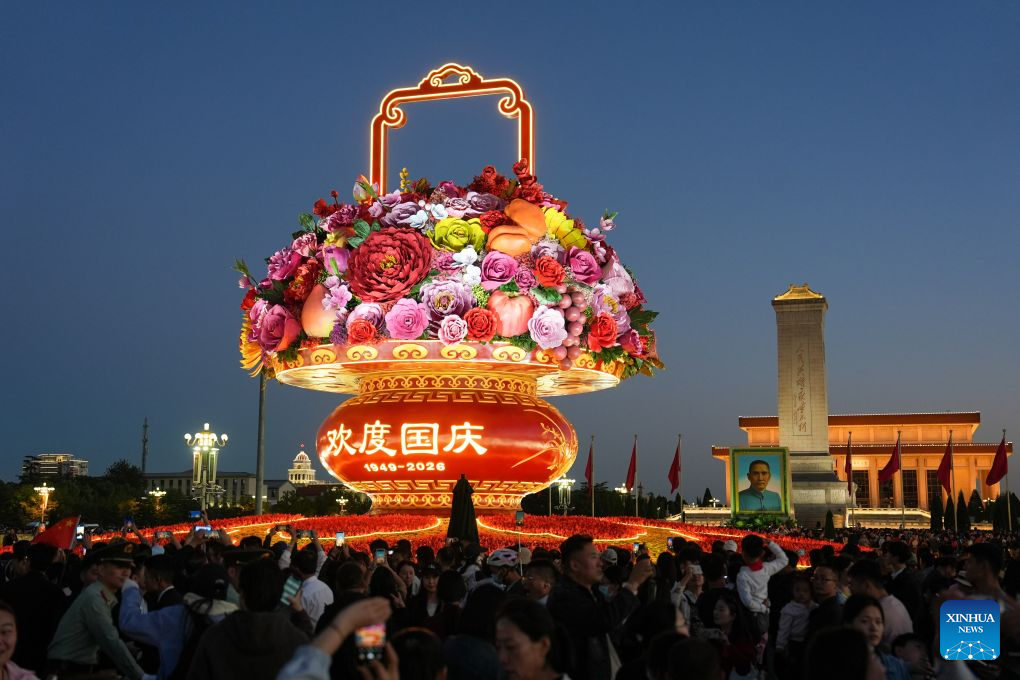
For visitors, the giant flower basket at the heart of Tian’anmen Square is a backdrop for holiday photos. And far more than that, it tells a story about where China is heading.
This year marks the beginning of the 15th Five-Year Plan period, which runs from 2026 to 2030. The basket features 15 types of floral designs and five types of fruit, symbolizing hopes for abundant blossoms and fruitful results over the next five years.
Beyond the flower basket, 10 three-dimensional flower installations line Chang’an Avenue, bringing themes such as new quality productive forces, harmony between people and nature, urban renewal and beautiful rural areas to life. Together, they highlight some of China’s development priorities for the next five years.
Those priorities are backed by concrete goals. The plan aims to lay the groundwork for doubling per capita GDP from its 2020 level by 2035, while accelerating breakthroughs in core technologies in key fields. It also calls for raising average years of schooling among the working-age population to 11.7 years and life expectancy to 80 years, while further strengthening China’s soft power.
The 15th Five-Year Plan period represents a crucial window for laying a solid foundation toward China’s 2035 goal of basically achieving socialist modernization and making decisive progress in that direction.
The plan has dedicated sections on Hong Kong and Macao, outlining measures to support the two regions in better integrating into and contributing to the country’s overall development. In September, Hong Kong unveiled its first Five-Year Plan, while Macao released its third in August, both aligned with the national development strategy.
Since the beginning of this year, the Chinese economy has maintained progress despite pressure and achieved innovation-driven and high-quality development while demonstrating strong resilience and vitality, Xi said at Wednesday’s reception.
“As long as we remain confident, stay focused on our goals and move forward steadily, step by step, success will ultimately belong to the great CPC, the great Chinese people and the great PRC,” Xi added.
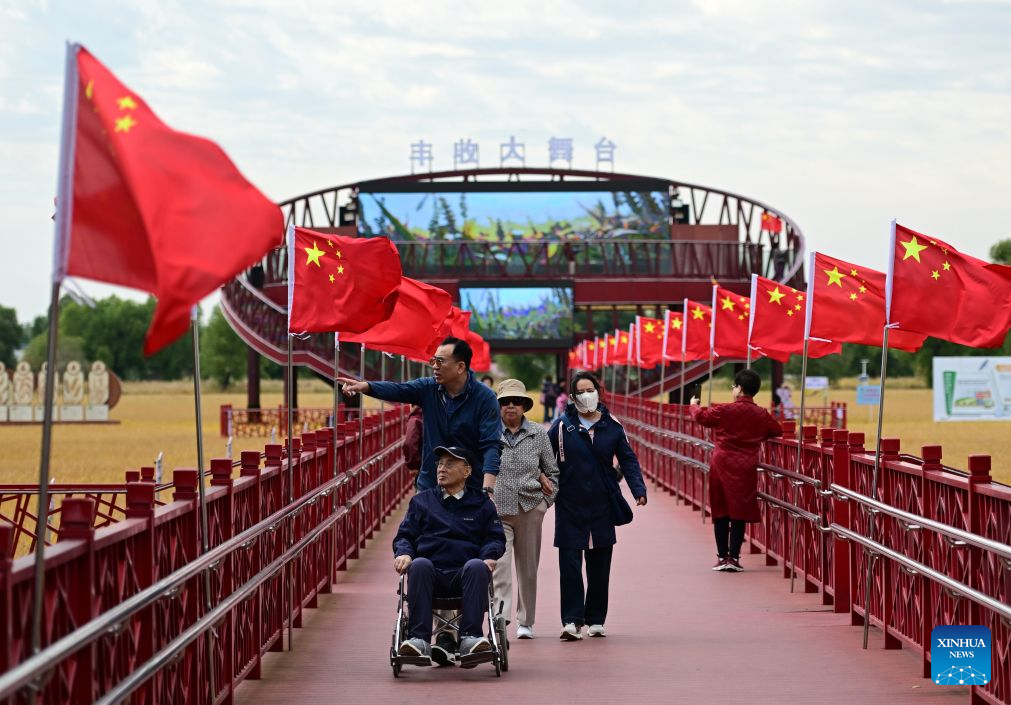
People attend a flag-raising ceremony marking the 77th anniversary of the founding of the People’s Republic of China at Wuyi Square in Fuzhou, southeast China’s Fujian Province, Oct. 1, 2026. People celebrated the 77th anniversary of the founding of the People’s Republic of China in various ways on Thursday. (Xinhua/Lin Shanchuan)
People watch the sunrise in Fuyuan City, northeast China’s Heilongjiang Province, Oct. 1, 2026. People celebrated the 77th anniversary of the founding of the People’s Republic of China in various ways on Thursday. (Photo by Li Yongjun/Xinhua)
People attend a flag-raising ceremony marking the 77th anniversary of the founding of the People’s Republic of China at Wuyi Square in Fuzhou, southeast China’s Fujian Province, Oct. 1, 2026. People celebrated the 77th anniversary of the founding of the People’s Republic of China in various ways on Thursday. (Xinhua/Lin Shanchuan)
People attend a flag-raising ceremony marking the 77th anniversary of the founding of the People’s Republic of China at Wuyi Square in Fuzhou, southeast China’s Fujian Province, Oct. 1, 2026. People celebrated the 77th anniversary of the founding of the People’s Republic of China in various ways on Thursday. (Xinhua/Lin Shanchuan)
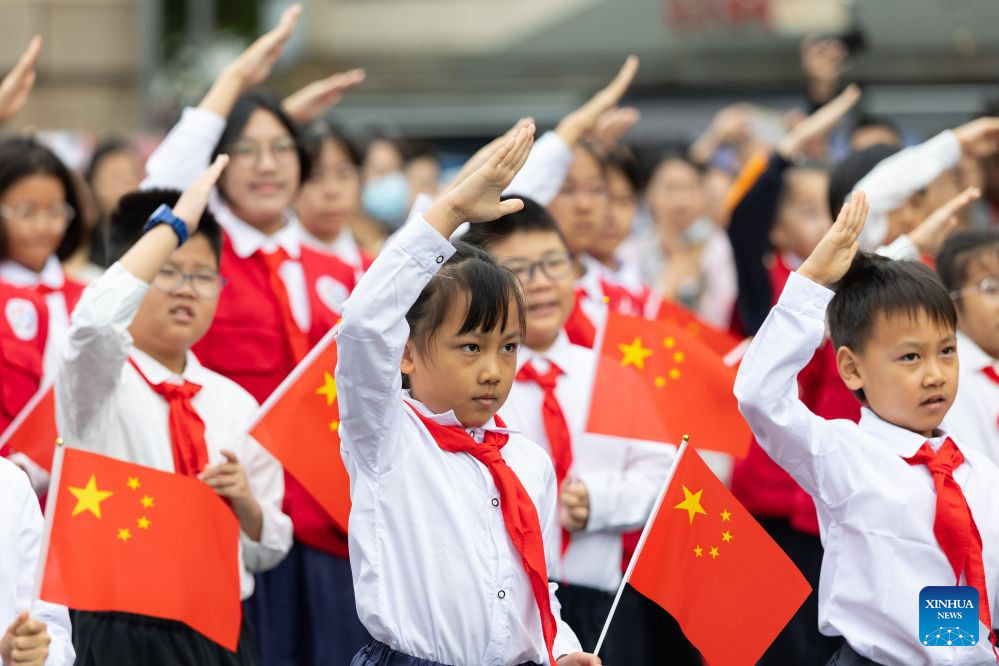
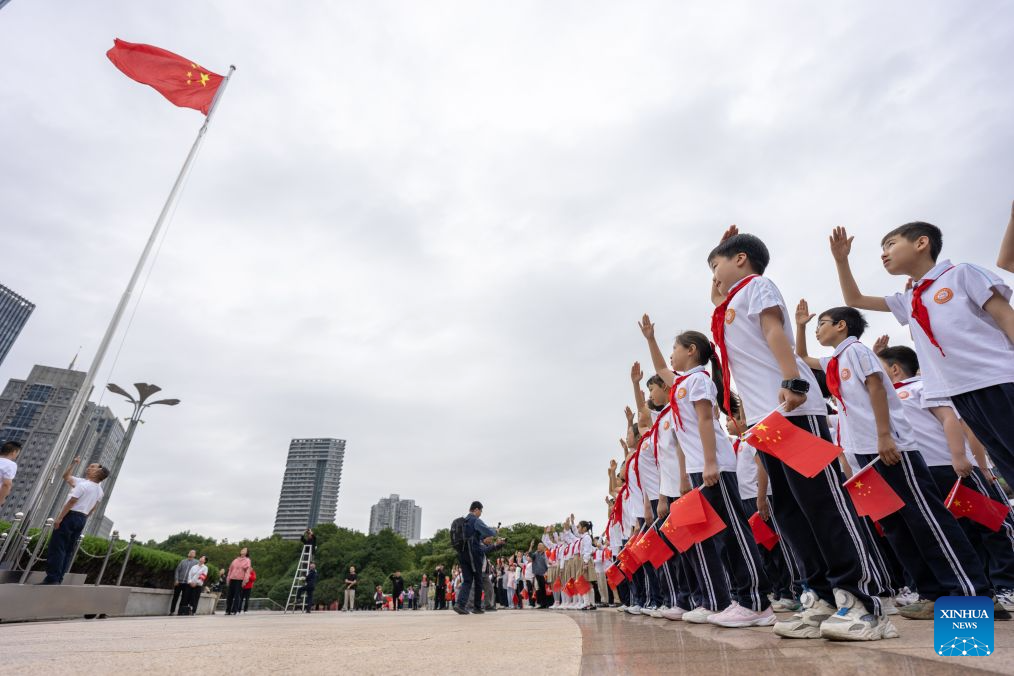
Children attend a flag-raising ceremony at the Yuhuatai memorial park of martyrs in Nanjing, east China’s Jiangsu Province, Oct. 1, 2026. People celebrated the 77th anniversary of the founding of the People’s Republic of China in various ways on Thursday. (Photo by Hu Xiao/Xinhua)
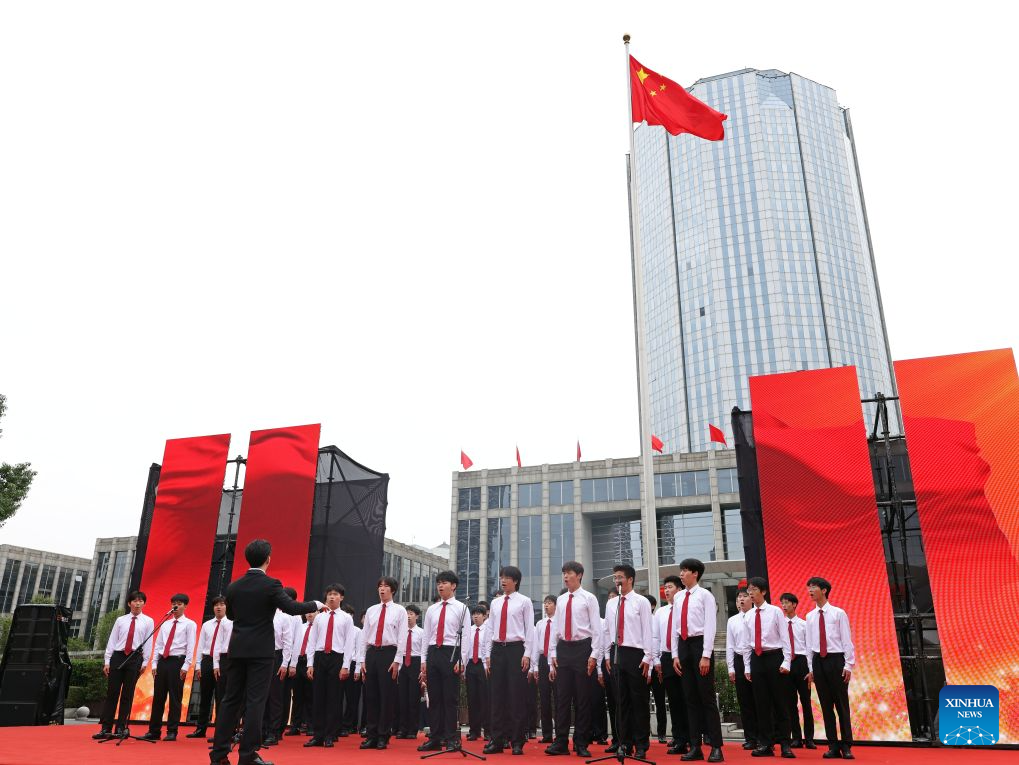
A choir from a middle school sings a song at a flag-raising ceremony held at Century Square in Pudong New Area, east China’s Shanghai, Oct. 1, 2026. People celebrated the 77th anniversary of the founding of the People’s Republic of China in various ways on Thursday. (Xinhua/Liu Ying)
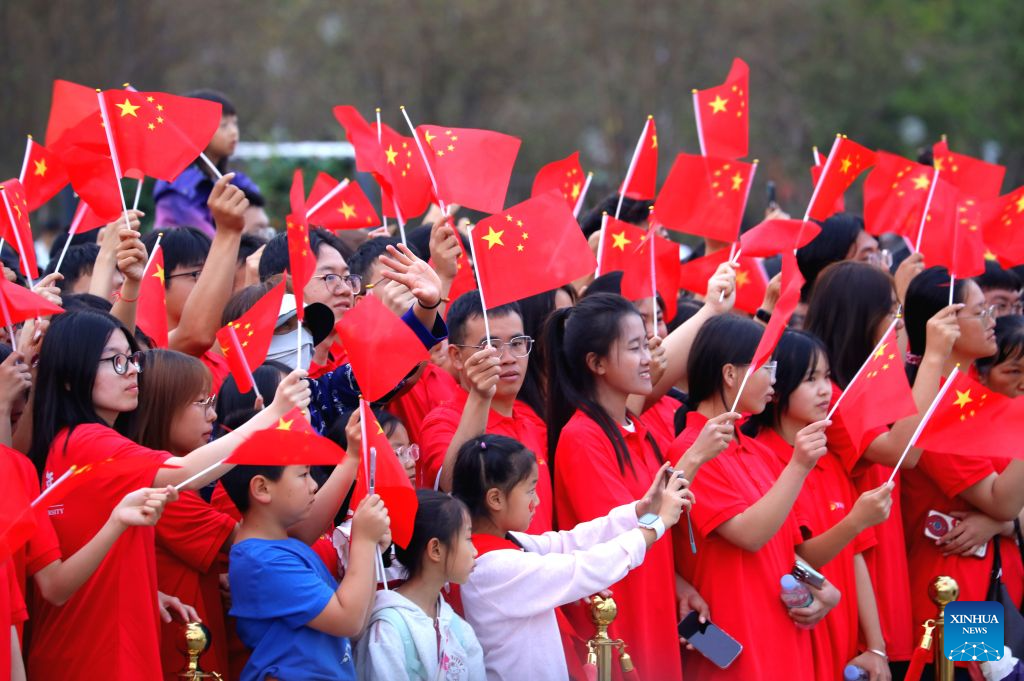
People watch a performance after attending a flag-raising ceremony at Dongfeng Square in Kunming, southwest China’s Yunnan Province, Oct. 1, 2026. People celebrated the 77th anniversary of the founding of the People’s Republic of China in various ways on Thursday. (Photo by Zheng Yi/Xinhua)
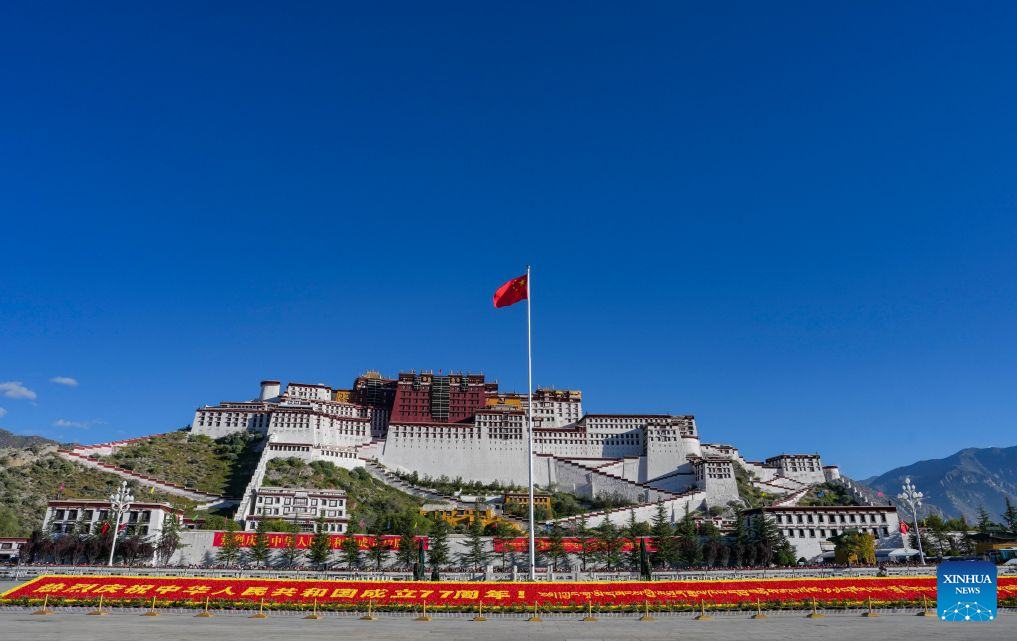
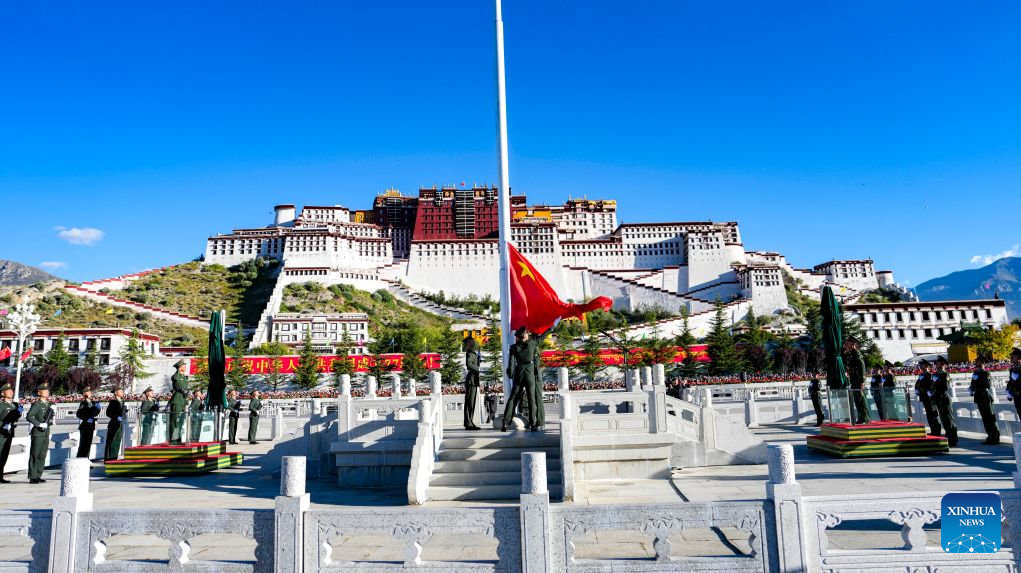
A Chinese national flag flies at the Potala Palace square in Lhasa, southwest China’s Xizang Autonomous Region, Oct. 1, 2026. People celebrated the 77th anniversary of the founding of the People’s Republic of China in various ways on Thursday. (Xinhua/Jigme Dorje)
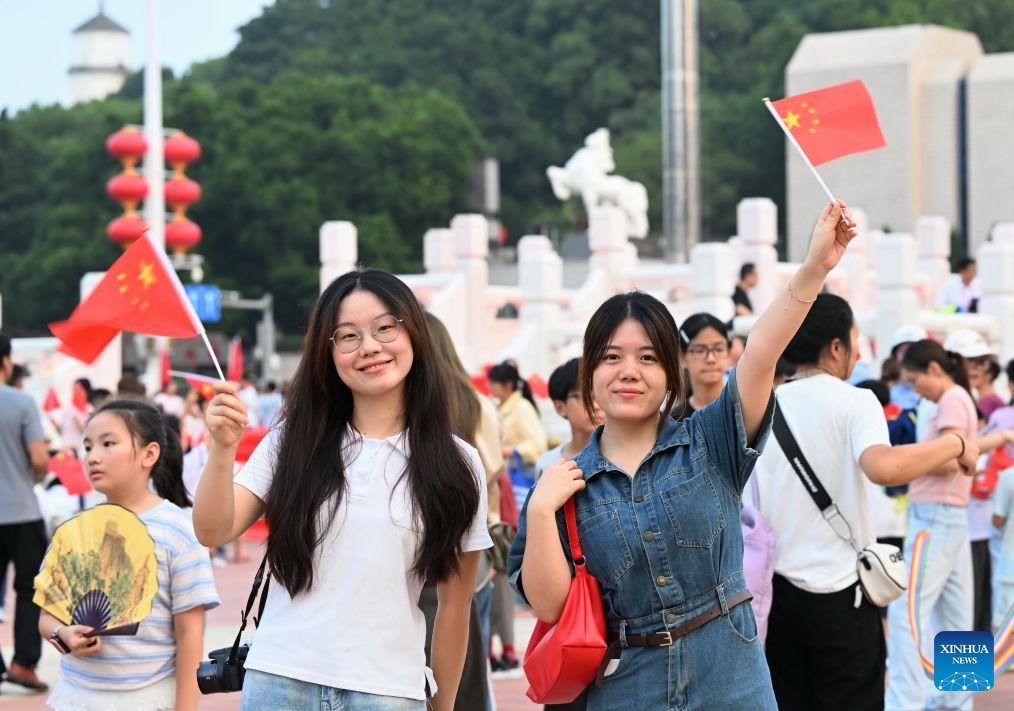
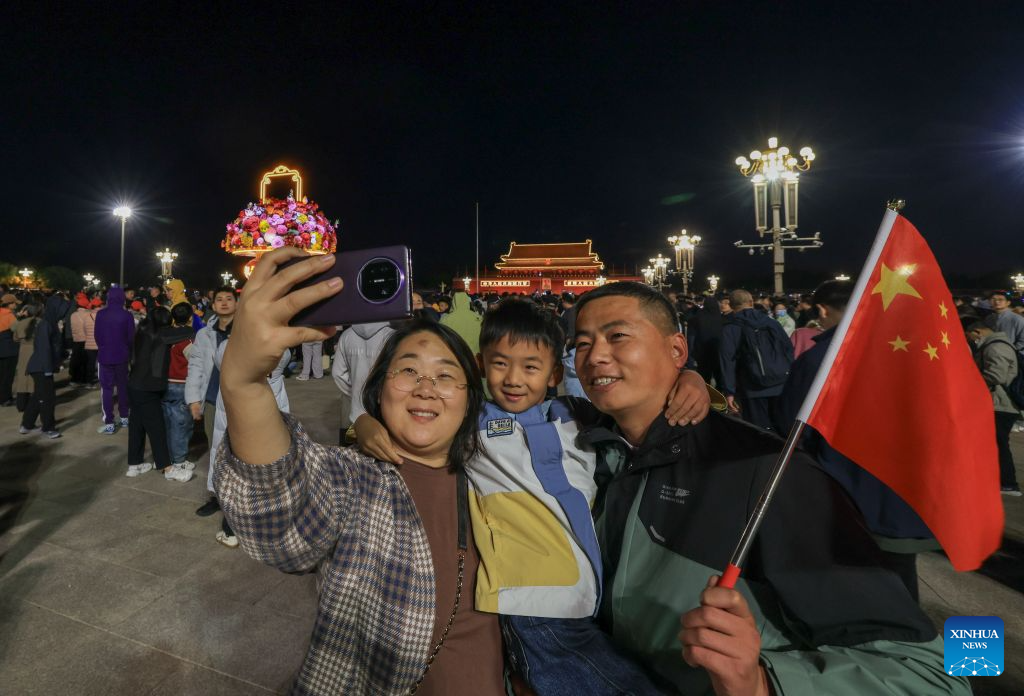
Visitors take a selfie at Tian’anmen Square in Beijing, capital of China, Oct. 1, 2026. People celebrated the 77th anniversary of the founding of the People’s Republic of China in various ways on Thursday. (Xinhua/Yin Gang)
Passengers pose for a photo in front of a train at Harbin Railway Station in Harbin, northeast China’s Heilongjiang Province, Oct. 1, 2026. People celebrated the 77th anniversary of the founding of the People’s Republic of China in various ways on Thursday. (Photo by Xu Shuai/Xinhua)
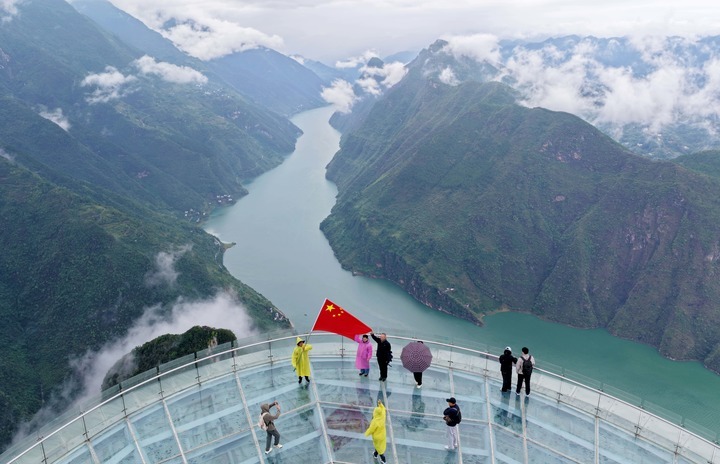
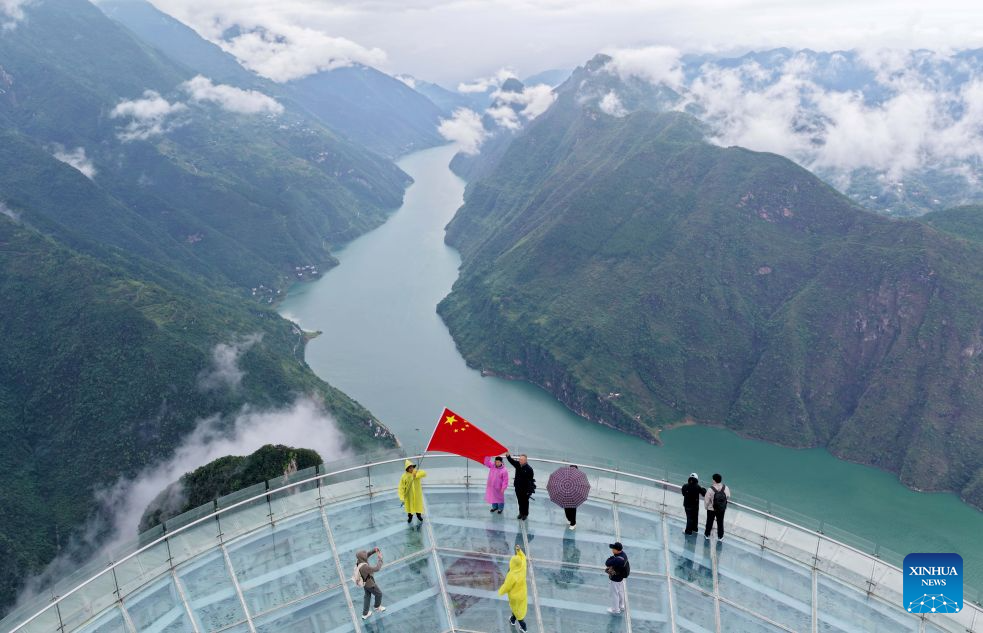
An aerial drone photo taken on Oct. 1, 2026 shows tourists taking photos on a skywalk at Wuxiakou scenic area in Badong County, central China’s Hubei Province. People celebrated the 77th anniversary of the founding of the People’s Republic of China in various ways on Thursday. (Photo by Jiao Guobin/Xinhua)
A flag-raising ceremony marking the 77th anniversary of the founding of the People’s Republic of China is held at the Potala Palace square in Lhasa, southwest China’s Xizang Autonomous Region, Oct. 1, 2026. People celebrated the 77th anniversary of the founding of the People’s Republic of China in various ways on Thursday. (Xinhua/Jigme Dorje)
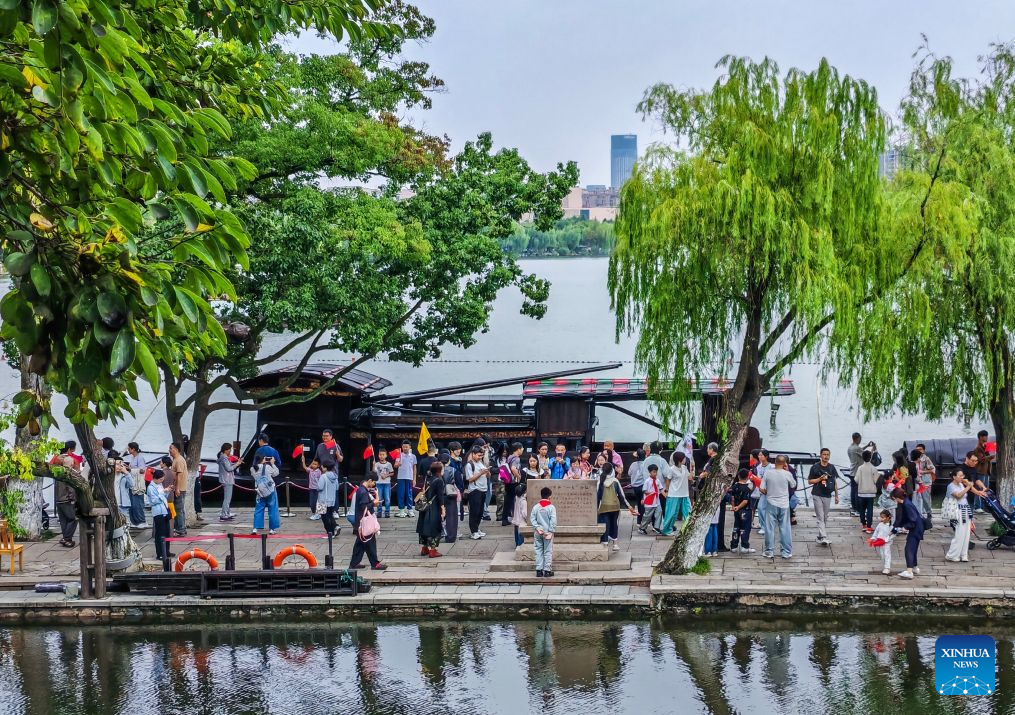
Tourists visit the Nanhu Lake scenic area in Jiaxing, east China’s Zhejiang Province, Oct. 1, 2026. People celebrated the 77th anniversary of the founding of the People’s Republic of China in various ways on Thursday. (Xinhua/Xu Yu)
Tourists pose for a photo at the Nanhu Lake scenic area in Jiaxing, east China’s Zhejiang Province, Oct. 1, 2026. People celebrated the 77th anniversary of the founding of the People’s Republic of China in various ways on Thursday. (Xinhua/Xu Yu)
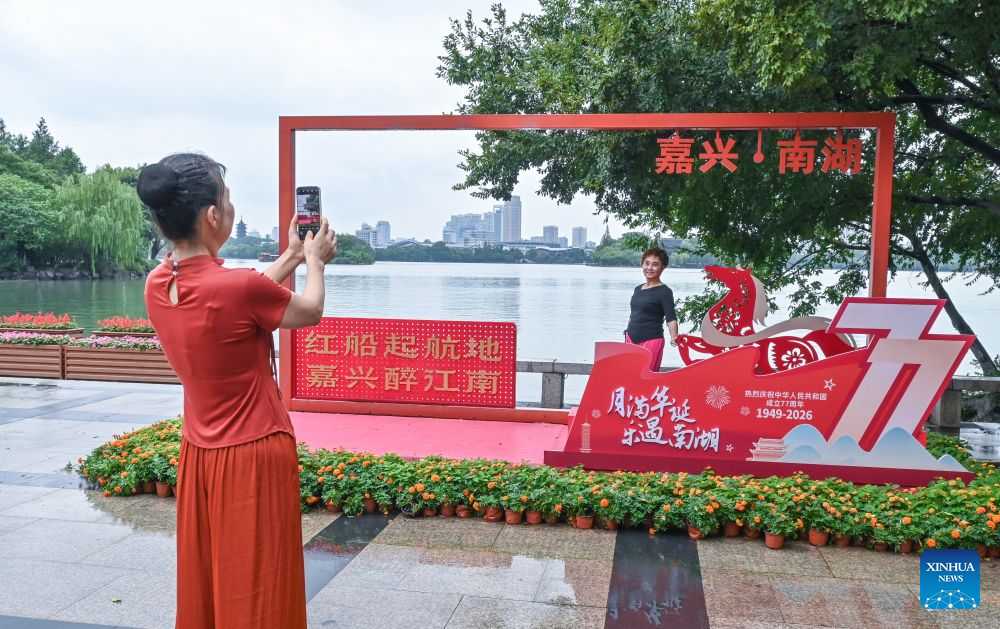
A tourist poses for a photo with an installation themed on National Day celebrations at the Nanhu Lake scenic area in Jiaxing, east China’s Zhejiang Province, Oct. 1, 2026. People celebrated the 77th anniversary of the founding of the People’s Republic of China in various ways on Thursday. (Xinhua/Xu Yu)
This photo taken on Oct. 1, 2026 shows a “flower basket” installation at Tian’anmen Square in Beijing, capital of China. People celebrated the 77th anniversary of the founding of the People’s Republic of China in various ways on Thursday. (Xinhua/Yin Gang)
This photo taken on Oct. 1, 2026 shows a “flower basket” installation at Tian’anmen Square in Beijing, capital of China. People celebrated the 77th anniversary of the founding of the People’s Republic of China in various ways on Thursday. (Xinhua/Yin Gang)
Students attend a flag-raising ceremony marking the 77th anniversary of the founding of the People’s Republic of China at Hongshan Square in Wuhan, central China’s Hubei Province, Oct. 1, 2026. People celebrated the 77th anniversary of the founding of the People’s Republic of China in various ways on Thursday. (Xinhua/Xiao Yijiu)
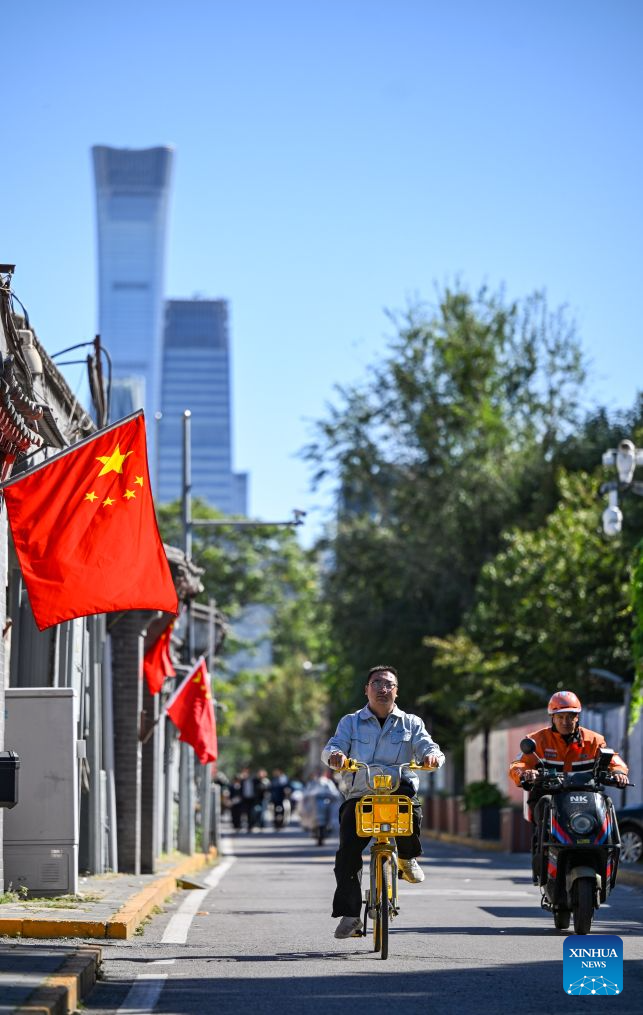
A man rides the bicycle at a hutong in Dongcheng District, Beijing, capital of China, Oct. 1, 2026. People celebrated the 77th anniversary of the founding of the People’s Republic of China in various ways on Thursday. (Xinhua/Chen Yehua)
A drone photo taken on Oct. 1, 2026 shows people visiting a wetland park in Donghai County, Lianyungang City, east China’s Jiangsu Province. People celebrated the 77th anniversary of the founding of the People’s Republic of China in various ways on Thursday. (Photo by Shao Guangming/Xinhua)
People visit an agricultural demonstration zone at a farm under Beidahuang Group in northeast China’s Heilongjiang Province, Oct. 1, 2026. People celebrated the 77th anniversary of the founding of the People’s Republic of China in various ways on Thursday. (Photo by Qian Boyu/Xinhua)
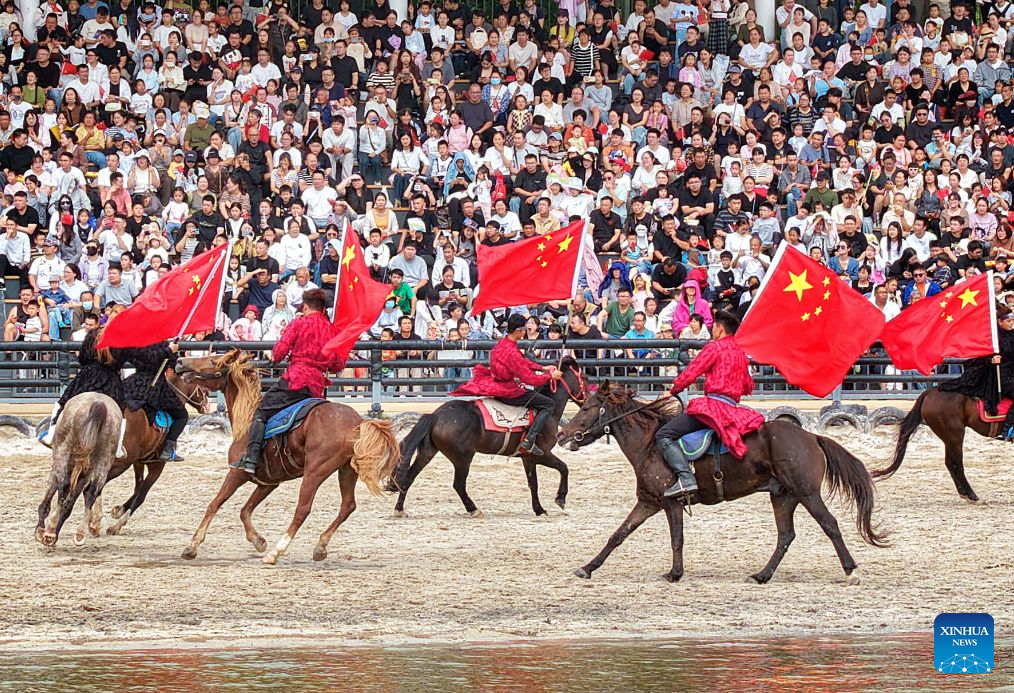
A drone photo taken on Oct. 1, 2026 shows people watching an equestrian performance at a tourism resort in Nantong, east China’s Jiangsu Province. People celebrated the 77th anniversary of the founding of the People’s Republic of China in various ways on Thursday. (Photo by Xu Congjun/Xinhua)
People visit a tourism area in Huangshi City, central China’s Hubei Province, Oct. 1, 2026. People celebrated the 77th anniversary of the founding of the People’s Republic of China in various ways on Thursday. (Photo by Zhou Wei/Xinhua)
People visit the Tian’anmen Square in Beijing, capital of China, Oct. 1, 2026. People celebrated the 77th anniversary of the founding of the People’s Republic of China in various ways on Thursday. (Xinhua/Ju Huanzong)
People visit the Tian’anmen Square in Beijing, capital of China, Oct. 1, 2026. People celebrated the 77th anniversary of the founding of the People’s Republic of China in various ways on Thursday. (Xinhua/Ju Huanzong)
People visit the Tian’anmen Square in Beijing, capital of China, Oct. 1, 2026. People celebrated the 77th anniversary of the founding of the People’s Republic of China in various ways on Thursday. (Xinhua/Ju Huanzong)
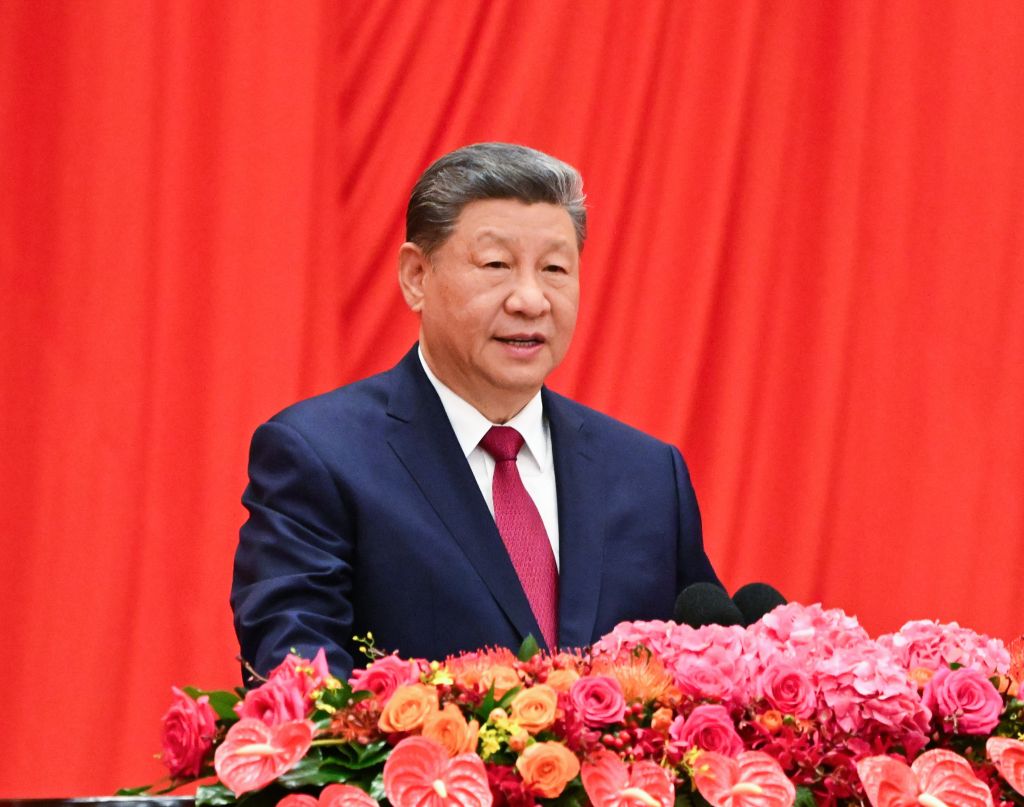
Chinese President Xi Jinping, also general secretary of the Communist Party of China Central Committee and chairman of the Central Military Commission, delivers an important speech at a reception to celebrate the 77th anniversary of the founding of the People’s Republic of China at the Great Hall of the People in Beijing, capital of China, Sept. 30, 2026. (Xinhua/Xie Huanchi)
BEIJING, Sept. 30 (Xinhua) — Chinese President Xi Jinping on Wednesday called on the nation to forge ahead with firm confidence and take solid steps to achieve the great national rejuvenation.
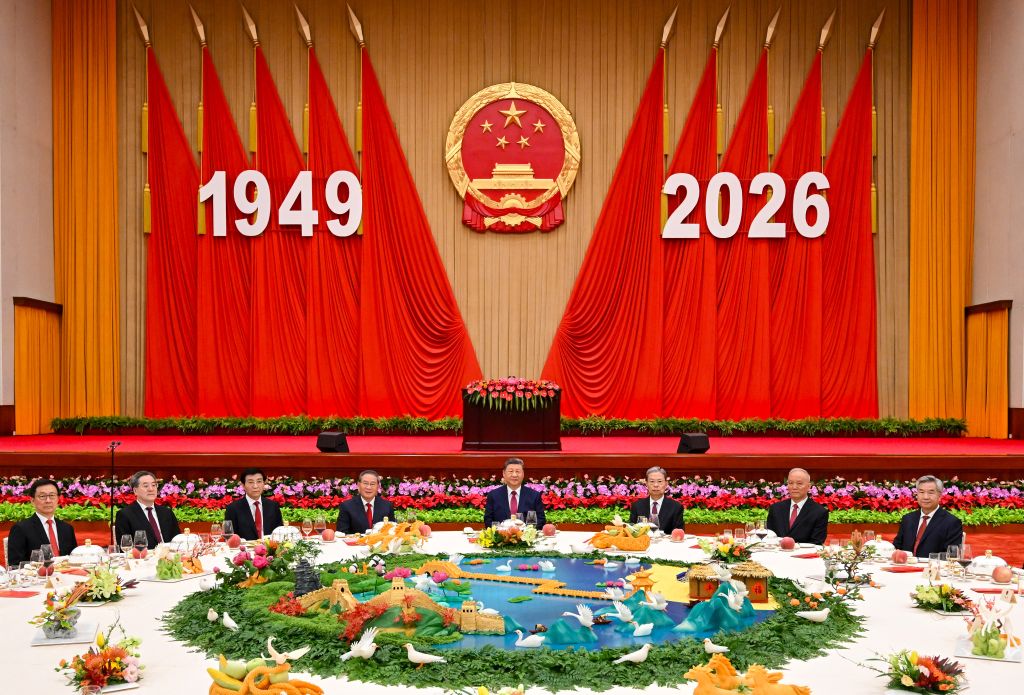
Xi, also general secretary of the Communist Party of China (CPC) Central Committee and chairman of the Central Military Commission, made the remarks at a reception held at the Great Hall of the People in Beijing to celebrate the 77th anniversary of the founding of the People’s Republic of China.
China’s National Day falls on Oct. 1.
Li Qiang presided over the reception. Zhao Leji, Wang Huning, Cai Qi, Ding Xuexiang, Li Xi and Han Zheng attended the event along with around 800 guests.
“The great rejuvenation of the Chinese nation is unstoppable,” Xi said. “As long as we remain confident, stay focused on our goals and move forward steadily, step by step, success will ultimately belong to the great CPC, the great Chinese people and the great People’s Republic of China.”
He noted that over the past 77 years, the Party has led the Chinese people in achieving two miracles: rapid economic growth and enduring social stability.
“We take immense pride in the extraordinary achievements of New China and have full confidence in the bright prospects of Chinese modernization,” he said.
Since the beginning of this year, the Chinese economy has continued to progress despite mounting pressure and achieved innovation-driven and high-quality development, demonstrating strong resilience and vitality, he said.
Efforts should be made to sustain this momentum, promote innovation-driven, high-quality and sound economic development, take practical steps to safeguard and improve people’s livelihoods, and meet the targets and tasks set for the year, so as to ensure a good start to the 15th Five-Year Plan (2026-2030), he said.
Xi stressed the need to remain firmly committed to the policy of “one country, two systems,” under which the people of Hong Kong administer Hong Kong, the people of Macao administer Macao, and both regions enjoy a high degree of autonomy.
He went on to say that the central government will support Hong Kong and Macao in integrating more fully into the country’s overall development. The central government is committed to maintaining their long-term prosperity and stability, Xi added.
He also called for efforts to deepen exchanges and cooperation across the Taiwan Strait, resolutely fight secessionist forces seeking “Taiwan independence,” oppose external interference, and promote the peaceful development of cross-Strait relations to advance national reunification.
China will stick to its independent foreign policy of peace, advance the implementation of the four major global initiatives it proposed, and promote the building of a community with a shared future for humanity to contribute greater certainty and positive energy to a turbulent world, Xi said. ■
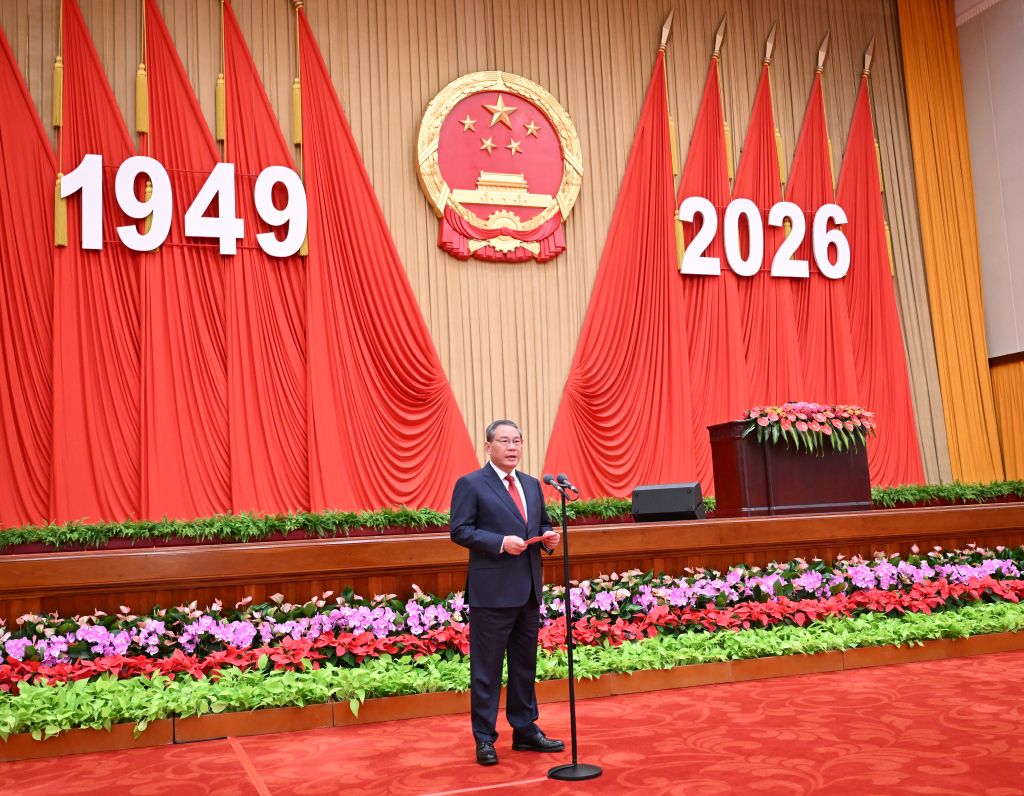
The Communist Party of China and state leaders Xi Jinping, Li Qiang, Zhao Leji, Wang Huning, Cai Qi, Ding Xuexiang, Li Xi and Han Zheng attend a reception to celebrate the 77th anniversary of the founding of the People’s Republic of China along with around 800 guests at the Great Hall of the People in Beijing, capital of China, Sept. 30, 2026. (Xinhua/Yan Yan)
Chinese Premier Li Qiang, also a member of the Standing Committee of the Political Bureau of the Communist Party of China Central Committee, presides over a reception to celebrate the 77th anniversary of the founding of the People’s Republic of China at the Great Hall of the People in Beijing, capital of China, Sept. 30, 2026. (Xinhua/Yin Bogu)
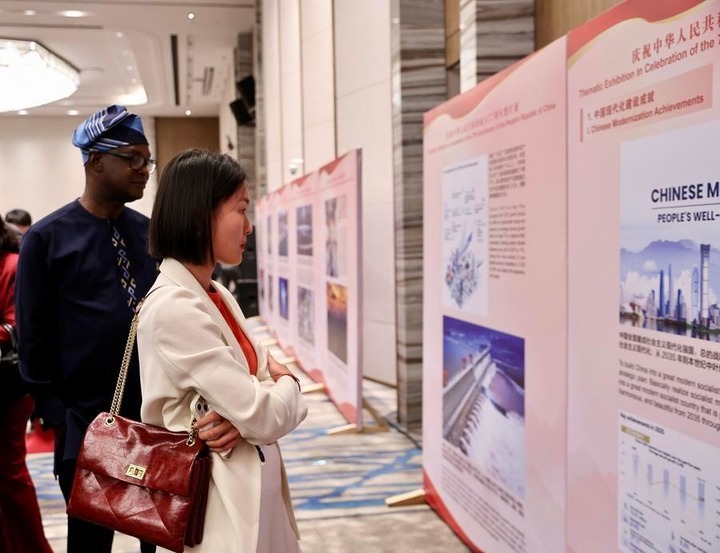
ADDIS ABABA, Sept. 26 (Xinhua) — A photo exhibition featuring China-Africa cooperation was held in Addis Ababa, the capital of Ethiopia, on Thursday to review and further promote the ever-growing ties between the two sides.
The photo exhibition, which encompasses about 60 historical images, was arranged under five different topics, namely Chinese modernization achievements, major country diplomacy with Chinese characteristics, China-Africa friendly exchanges, China-Africa joint promotion of the Belt and Road Initiative, and the 105th anniversary of the founding of the Communist Party of China.
“This photo exhibition is well organized, featuring different aspects of China-Africa cooperation. I even saw one photo of myself participating in the cultural activity during the UN Chinese Language Day celebration,” Aboubakri Diaw, chief of staff at the Office of the UN Economic Commission for Africa Executive Secretary, said while attending the exhibition.
Balew Demissie, a senior consultant at the Policy Studies Institute of Ethiopia, was particularly interested in photos that display various mega infrastructure projects constructed by Chinese companies across Africa.
“These photos are so professional with detailed captions. These projects reflect the close cooperation between China and Africa, and I am impressed to see the Chinese-built Aysha II Wind Power Plant in Ethiopia’s Somali Regional State,” Demissie said, adding that he hopes to capture these images for future study and reference with his cellphone when the place is less crowded.
The year 2026 marks the 70th anniversary of the establishment of diplomatic relations between China and Africa, as well as the China-Africa Year of People-to-People Exchanges.
Being part of a reception to celebrate the 77th anniversary of the founding of the People’s Republic of China, the photo exhibition was co-organized by the Chinese Mission to the African Union (AU), the Chinese Embassy in Ethiopia, and Xinhua News Agency Africa Regional Bureau.
The reception brought together about 1,200 guests, including officials of the Ethiopian government, representatives of the AU and UN, diplomatic envoys in Ethiopia, local academics, media professionals and members of the Chinese community.