Nairobi Woman Representative Hon. Esther Passaris has called for full rotational presidency to make Kenya truly inclusive.
Speaking today, Mheshimiwa said after having leadership from Rift Valley and Mount Kenya, it is time for the presidency to move to other regions.
“We have had Rift Valley in the leadership. For 2032, I want Governor Wanga to be the President of Kenya and I would like the Mountain to rally behind Governor Wanga because we need to rotate that seat so that Kenya becomes inclusive.”
Hon. Passaris said she dreams of a Kenya where every region tastes the presidency.
“I want to see a Coastarian become President. I want to see a Westerner become President. A Nyanza become President. A Kisii become President. Even a Teso one day become President. The seat has to move after William Samoei Ruto. The seat has to move from Rift Valley and Mount Kenya. It has to come to other regions. Let’s look at the eight provinces. Let’s deliver a woman.”
She affirmed her support for her party leader and ODM Chairperson, H.E. Gladys Wanga.
Kenya Revenue Authority (KRA) Customs and Border Control Department collected KES 90.053 billion in September 2026, exceeding its Treasury target by KES 965 million and sustaining its strong revenue performance in the 2026/2027 Financial Year. The collection surpassed the target of KES 89.088 billion, translating to a performance rate of 101.1 per cent. It also represented a 5.8 per cent growth compared to the KES 85.146 billion collected in September 2025. The performance was underpinned by strong growth in non-oil revenue collections, which reached KES 57.199 billion against a target of KES 55.422 billion, exceeding the target by KES 1.778 billion. The growth in non-oil revenue was driven by a 25.6 per cent increase in the overall value of imports, with bulk cargo growing by 49.2 per cent. The increase in bulk cargo was mainly attributed to imports of fertilisers, iron and steel, palm oil and its fractions, and rice, among other commodities. The number of imported Motor Vehicles and Twenty-Foot Equivalent Units (TEUs) handled for containerised cargo also increased by 8.1 per cent and 8.2 per cent, respectively. The results underscore the role of effective Customs administration in facilitating legitimate trade while safeguarding government revenue. KRA continues to strengthen compliance through technology-driven customs processes and enhanced enforcement against illicit trade and revenue leakage. The Authority is also implementing reforms to make Customs operations more efficient, transparent and predictable for traders. These include the introduction of Advance Cargo Declaration (ACD) and the increased use of data to strengthen cargo risk management, improve the processing of customs declarations and enhance the identification of high-risk consignments. The September performance reinforces KRA’s commitment to mobilising revenue required to finance the Government’s development priorities, support economic growth and strengthen the country’s fiscal position. The Authority will continue to pursue reforms that improve compliance, enhance operational efficiency and create a fair and predictable trading environment for businesses.
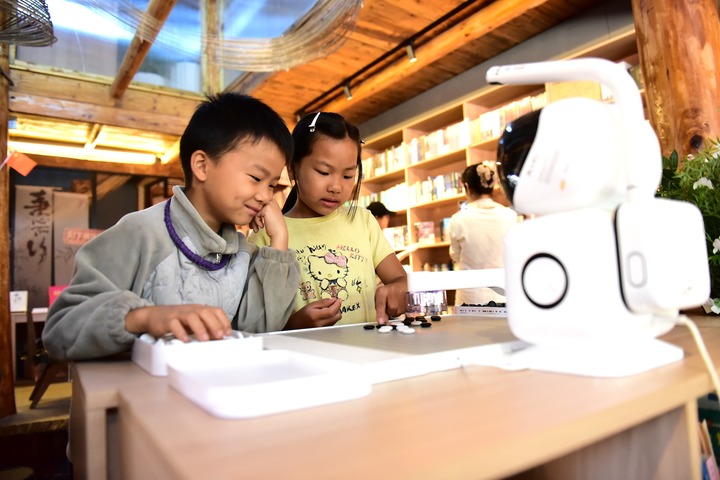
Children play a board game with an AI robot at Basha Village in Congjiang County, southwest China’s Guizhou Province, Oct. 6, 2026. (Photo by Shi Honghui/Xinhua)
SHANGHAI, Oct. 10 (Xinhua) — Shoppers crowded into stores across China to try the latest artificial intelligence (AI) gadgets during the week-long National Day holiday, as smart devices continue to transition from the showroom to the mass market.
At Z·Pilot, an AI experience store in Shanghai, China’s financial hub, a furry AI pet robot drew a steady stream of browsers during the holiday. When the robot was presented with a toy carrot, its digital eyes lit up in a “feeding” expression; a gentle touch revealed a warm surface, close to lifelike.
“Companionship products are doing well,” a staff member said. The fast-selling AI pets offer voice and tactile interaction along with long-term memory, gradually adapting their personality to their owners over time — delivering the feel of a pet without the upkeep.
AI glasses attracted similar interest. “When traveling abroad, if you don’t know how to say something in the local language, you can just translate it directly,” a staff member said while demonstrating a pair of the glasses. Beyond real-time translation, the hot-selling devices offer navigation, teleprompting, photo and video capture, letting users leave their phones in their pockets.
At a JD.com mall in Shanghai’s Qibao area, 3D printers became a magnet for families, with parents and children building model boats and cars on the spot. Many parents said they were buying the printers to bring home what their children had learned in school, turning the devices into hands-on toys for kids to design and print their own models.
Ms. Qi, who brought her child to a robotics store in the city, said she wanted the child to engage with the technology early. “Let children explore hands-on and get a feel for how AI will shape the way they live, learn and work,” she said.
The trend is not unique to Shanghai. In Hangzhou, capital of east China’s Zhejiang Province, a tech-mall branded as Wensan was a popular spot for locals and tourists to check out the latest gadgets during the break. Serving as a micro tech supermarket, it brought together more than 700 smart products, ranging from AI companion robots and AI glasses to smart rings and exoskeletons, catering to consumers across all age groups.
In Beijing, a robotics and AI experience brand under Shoucheng Holdings now operates eight stores in the city. Its outlets offered more than 200 robot and AI hardware products, and drew long queues of consumers during the holiday. A representative for the brand said in-store feedback pointed to particularly strong performance in companion-style AI products, entertainment-oriented smart devices and interactive robotics.
Retailers say the momentum is measurable. According to data released this week by Chinese retail giant Suning.com, foot traffic at its flagship stores rose 50 percent year-on-year from Oct. 1 to 7, while sales of AI-equipped home appliances climbed more than 40 percent. Smartwatches, AI glasses and action cameras all posted solid gains.
The surge sits inside a broader AI boom built on a wave of homegrown models. Tools such as DeepSeek, Kimi and Doubao have become everyday fixtures for millions of Chinese users.
On the industry side, the numbers are equally telling: China’s AI enterprises surpassed 6,000 last year, with the core AI industry posting strong year-on-year growth.
China had more than 140 humanoid robot developers in 2025, with shipments reaching 14,400 units — accounting for 84.7 percent of the global market, per an industry research report.
Policy support has further deepened the integration of AI and consumption. In June, eight government departments, including the Ministry of Commerce, issued guidance to boost AI-enabled consumption, calling for more AI-powered products and expanded AI-driven services.
A subsequent action plan on smart home consumption extended this push, letting localities set their own subsidy categories and standards under the 2026 trade-in policy, including support for whole-house smart home purchases.
“Consumer uptake of AI products is accelerating from a phase of novelty toward mass adoption,” said Fan Chunyan, vice president of Suning.com. “Demand for smart devices, immersive experiences and ongoing services will continue to rise.” ■
*The Long March spirit highlights the firm faith, strong will, and never-give-up attitude of the whole Party and all Chinese people to overcome major challenges during the revolutionary years.
*In today’s environment, people need to hold fast to the same values that made the Long March an epic undertaking in modern Chinese history, said Khairy Tourk, professor of economics at the Stuart School of Business at the Illinois Institute of Technology in Chicago.
*The Long March is not only a towering monument in the development of the Chinese nation, but also a precious spiritual asset for all humanity in the pursuit of independence, freedom and liberation, said Etienne Bankuwiha, a Burundian sinologist.
BEIJING, Oct. 10 (Xinhua) — This year marks the 105th founding anniversary of the Communist Party of China (CPC) and the 90th anniversary of the victory of the Long March. The arduous journey, which lasted from 1934 to 1936, helped lay the foundation for the eventual victory of the Chinese revolution.
Nearly a century later, the Long March remains an important window into China’s history and development. “The Long March is like a spine of your body that goes right through the modern history of China,” said Harold Weldon, an Australian publisher and filmmaker.
For China watchers, understanding this pivotal chapter is essential to understanding the CPC’s founding ideals and enduring mission, as well as the resilient spirit of the Chinese nation.
GREAT TURNING POINT
The victory of the Long March marked a great turning point for the CPC and the Chinese revolution, and stands as a towering monument in the historic process of the rejuvenation of the Chinese nation.
During the epic military trek, the CPC-led Red Army broke through encirclement by Kuomintang forces. Red Army soldiers braved raging rivers, snow-covered mountains and treacherous grasslands, with some marching as far as 12,500 kilometers.
“It was probably the greatest tale of human endurance in recorded history, I think, in terms of the hardships faced,” said Weldon.
The Long March is a classic example of the ability of the Chinese people to defy overwhelming odds, and is ready to put up with huge sacrifices in treasure and blood in order to achieve their goals, said Khairy Tourk, professor of economics at the Stuart School of Business at the Illinois Institute of Technology in Chicago, noting that “sacrifice is an essential part of achieving glorious victories.”
Paul Ilado, editorial director of Kenya’s Radio Africa Group, said the Long March transformed a military retreat into a decisive political and historical turning point. The Red Army was under enormous pressure, he noted, and their ability to survive the encirclement campaign was crucial to the continuation of the movement.
The historical significance of the Long March extends beyond military survival, Ilado said.
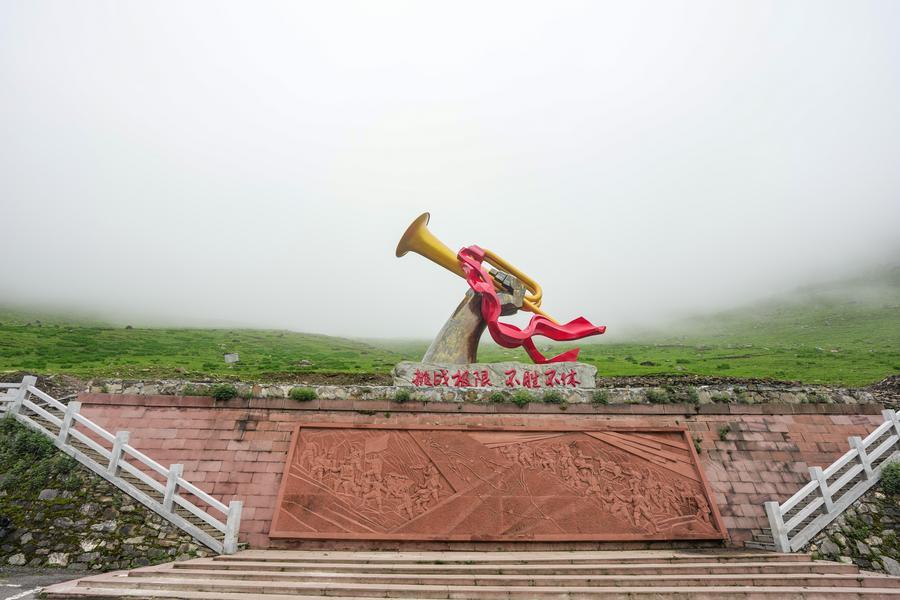
An aerial drone photo taken on June 2, 2026 shows a “horn of victory” themed installation at Jiajin Mountain in Baoxing County of Ya’an City, southwest China’s Sichuan Province. (Xinhua/Wang Xi)
As part of the CPC’s revolutional legacy, he said, the Long March demonstrated that hardship had to be overcome, objectives pursued over the long term, and survival under extreme pressure sustained by organization and discipline.
During the Long March, Red Army officers and soldiers were pushed to the extremes of their physical limits, turning this dramatic episode in world military history into a “glorious human miracle.”
The Long March spirit highlights the firm faith, strong will, and never-give-up attitude of the whole Party and all Chinese people to overcome major challenges during the revolutionary years.
Wagner Lacerda Dantas, a Brazilian journalist with China International Communications Group, described the spirit as the determination to continue fighting for a collective goal even when circumstances appear almost impossible, bringing together conviction, courage, discipline, solidarity, sacrifice and confidence in victory.
“What impressed me the most was the organizational cohesion and belief of the Red Army, although under extremely tough conditions,” said Balew Demissie, senior consultant at the Policy Studies Institute of Ethiopia.
When facing extreme natural environments such as snow-capped mountains and marshlands, as well as the chasing and interception by the enemy’s materially superior forces, this army did not collapse, but instead demonstrated astonishing discipline and idealism, and ultimately achieved success, he added.
Yuri Tavrovsky, head of the Expert Council of the Russian-Chinese Committee for Friendship, Peace and Development, likewise identifies endurance, sacrifice, patriotism and wisdom as qualities forged during the Long March. In his view, the experience helped shape a generation of leaders capable of confronting crises, assessing changing circumstances and finding a way forward.
CONTEMPORARY ECHO
The Long March belongs to a specific historical period, and China’s circumstances today are vastly different from those of the 1930s, but foreign observers see its enduring relevance in the CPC’s strong leadership and China’s rapid development.
In today’s environment, people need to hold fast to the same values that made the Long March an epic undertaking in modern Chinese history, said Tourk, the economics professor at the Illinois Institute of Technology. “Without values such as sacrifice, patriotism, perseverance, and firmness, the people would lose their sense of direction,” he said.
“I believe that understanding the Long March is truly one of the best ways to understand how the Communist Party of China managed to grow under such adverse circumstances,” said Dantas, the Brazilian journalist, adding that it demonstrated characteristics such as discipline, unity, organizational capacity, independence and autonomy, seeking truth from facts, and, above all, confidence in the masses.
“The great strength of the Party during that period lay not only in its weapons, but in its ability to maintain close ties with the people,” he said.
Etienne Bankuwiha, a Burundian sinologist, said that amid life-and-death trials, Chinese Communists demonstrated unshakable ideals and convictions and made strategic choices decisive for the future of the Chinese revolution. “For China today, it remains a powerful source of motivation that encourages the people to overcome difficulties, advance Chinese modernization, and realize the great rejuvenation of the Chinese nation,” he added.
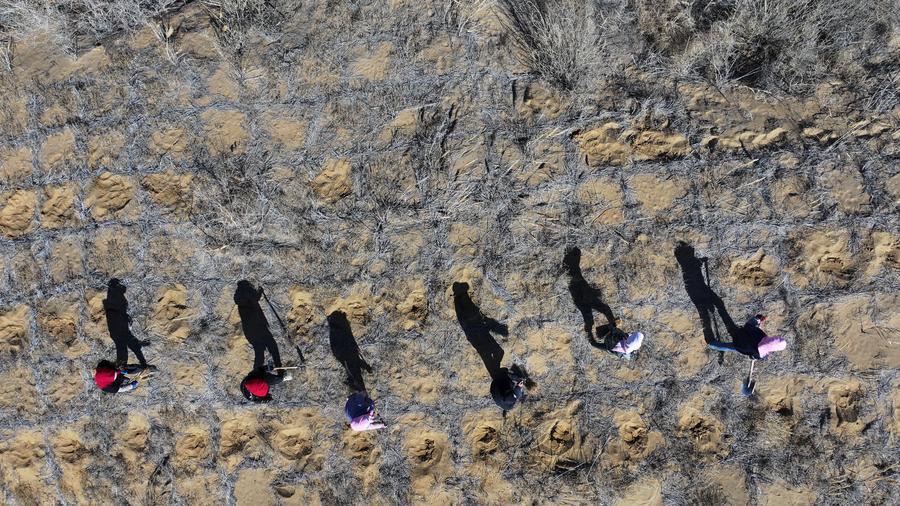
An aerial drone photo taken on March 19, 2024 shows workers planting Caragana seedlings at Baijitan national nature reserve of Lingwu, northwest China’s Ningxia Hui Autonomous Region. (Xinhua/Wang Peng)
During a visit to China’s Ningxia Hui Autonomous Region, Ilado, the editorial director of Kenya’s Radio Africa Group, was struck by the transformation of land that had once been difficult to cultivate, which offered him a tangible way to think about the legacy of the Long March.
“When I arrived in China and went to Ningxia, I was amazed at how a desert had been turned into productive land, and how today that area has become a breadbasket for the country and the world,” he said.
The connection, Ilado stressed, is the idea of undertaking a difficult journey over a long period without losing sight of the destination.
A farmer cultivating difficult land, an engineer building irrigation infrastructure, a technician improving food processing or a young person leaving a poor rural community to pursue education may seem far removed from the Red Army of the 1930s, yet all can be understood through the determination to continue when the destination is still far away, Ilado noted.
Joshua Kingdom, a research fellow at Uganda’s Development Watch Center, sees the Long March spirit reflected in China’s response to contemporary challenges. He said China’s efforts to withstand external pressure demonstrated resilience and a determination to deepen cooperation with Global South economies rather than succumb to difficulties.
BEYOND CHINA
The significance of the Long March extends beyond the history of China. The Long March spirit of unwavering faith, perseverance and collective spirit transcends borders and ideologies, inspiring humanity to overcome adversity and strive for a brighter future.
Demissie, the senior consultant at Ethiopia’s Policy Studies Institute, said the success of the Long March contributed directly to the eventual victory of the Chinese revolution. In his view, the independent and modern state that emerged from that history has since become an important force in promoting multipolarity, South-South cooperation and the rise of the Global South.
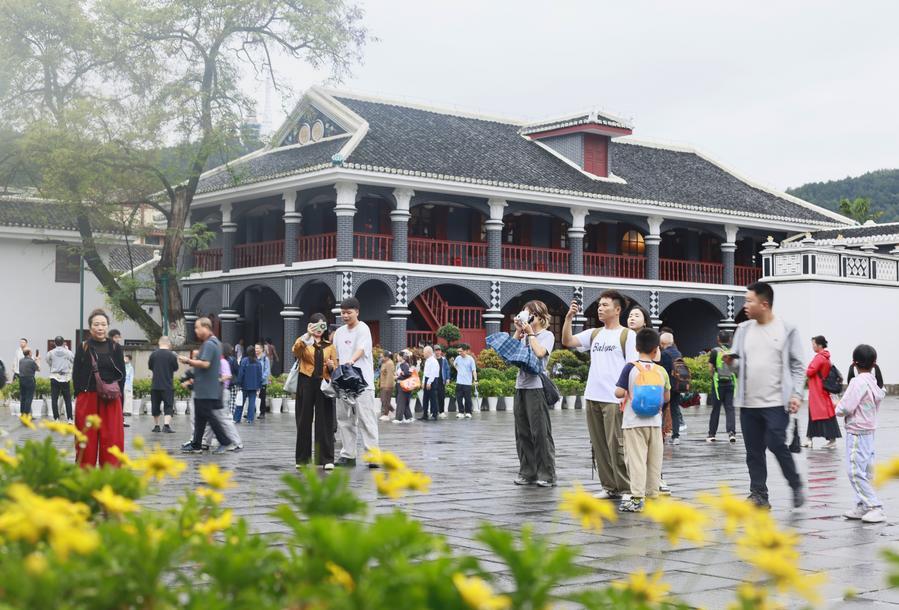
Tourists visit the historical site of the Zunyi Meeting in Zunyi City, southwest China’s Guizhou Province, Oct. 1, 2026. (Photo by Tian Jinhong/Xinhua)
The Long March is not only a towering monument in the development of the Chinese nation, but also a precious spiritual asset for all humanity in the pursuit of independence, freedom and liberation, said Etienne, the Burundian sinologist.
“Seen from the broader perspective of the Global South, the Long March proves a compelling point: to achieve genuine liberation and prosperity, a country and its people must proceed from their own conditions, uphold independence and self-reliance, and defeat every obstacle through unity and struggle,” he said.
Dennis Munene, executive director of the China-Africa Center at the Africa Policy Institute, said the Long March spirit could encourage the international community to unite around common goals and pursue dialogue across civilizations to address conflicts, climate change and poverty.
These challenges cannot be resolved overnight; they require sustained commitment, cooperation and a willingness to keep working despite setbacks, he added.
Kingdom, the research fellow at Uganda’s Development Watch Center, said that writings by people like Edgar Snow about the Long March have moved people across the globe, “because every individual, wherever they are living, they usually have fears to conquer.”
“So, I feel like when you have examples of people who have gone the extra mile to conquer different things that are really relatable in some sense, it moves people,” he said. (Video reporters: Zhu Yinan, Chu Yi and Du Zheyu; Video editors: Wu You, Liu Xiaorui, Zhang Yueyuan, Wei Yin, Liang Wanshan and Wang Han)■
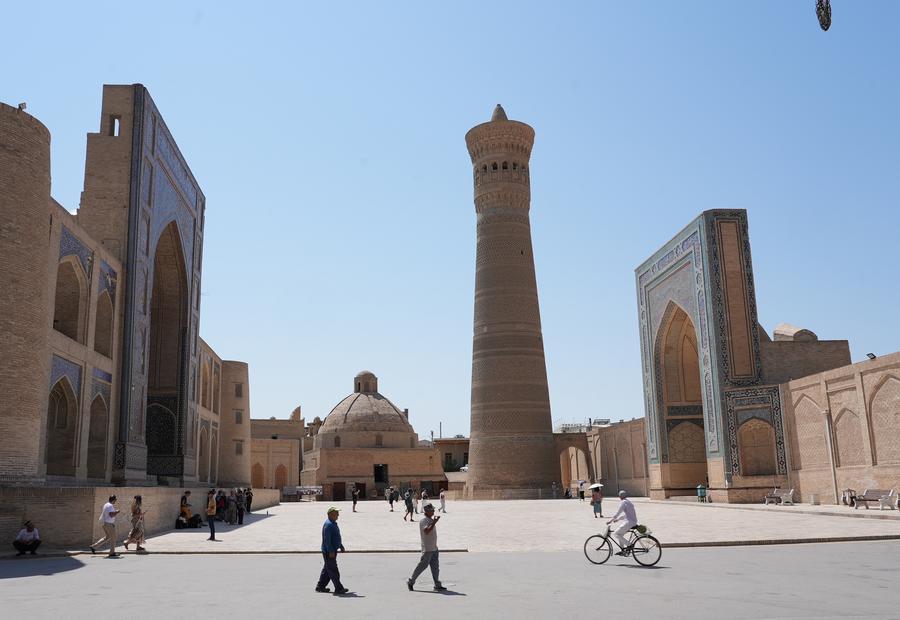
People walk across the Po-i-Kalyan Complex in Bukhara, Uzbekistan, Aug. 3, 2026. (Photo by Zafar Khalilov/Xinhua)
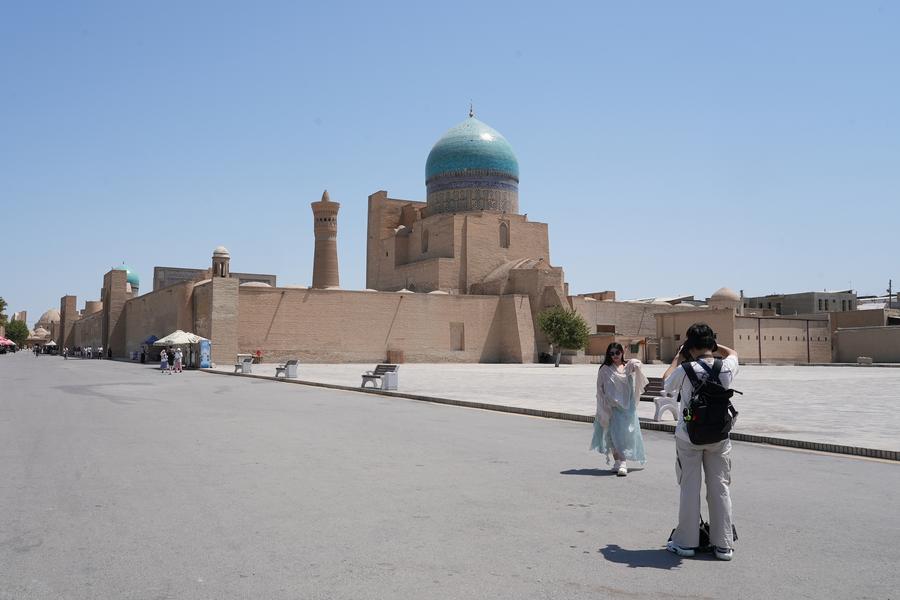
BUKHARA, Uzbekistan, Oct. 10 (Xinhua) — As the setting sun cast a golden glow over the ancient streets of Bukhara, the historic city bustled with tourists, while local vendors called out to passersby.
Holding a hand-painted ceramic bowl, Yan Hong, a tourist from northeast China’s Harbin, marveled at the intricate floral patterns adorning the craft at a roadside stall, accompanied by her parents.
“Uzbekistan has so many historic cities along the Silk Road: Samarkand, Bukhara and Khiva,” she said. “I’d read about them in books. I had to see them for myself.”
Walking through the ancient city, she said the experience surpassed her expectations, with history and modernity blending seamlessly and different civilizations engaging in a quiet dialogue.
Yan is among a rapidly growing number of Chinese travelers choosing Uzbekistan as a holiday destination.
A mutual visa-exemption agreement, which officially took effect on June 1, 2025, has given fresh impetus to cross-border tourism.
According to official reports from Uzbekistan’s Tourism Committee, the number of Chinese tourists visiting the country increased by 3.5 times following the launch of the reciprocal visa-free policy.
“By now, the entire city of Bukhara knows that China enjoys a seven-day ‘Golden Week’ holiday in October,” said Khamrayev, a local vendor specializing in miniature paintings and traditional handicrafts.
A tourist takes photos in front of historic architecture in Bukhara, Uzbekistan, Aug. 3, 2026. (Photo by Zafar Khalilov/Xinhua)
Recalling the holiday period last year, Khamrayev said Chinese tourists had flocked to his courtyard shop, making it his busiest sales period of the year.
A similar tourism boom is unfolding in neighboring Kazakhstan, which also benefits from a mutual visa-free arrangement with China.
At Shymbulak resort near Almaty, with the towering Tianshan Mountains in the background, Qi Yue and his wife from Hangzhou, east China’s Zhejiang Province, waited in line for a cable car.
“We decided on a whim,” Qi said. “Visa-free travel was a big factor.” He added that many Chinese tourists now travel to Kazakhstan from Xinjiang Uygur Autonomous Region after exploring the region.
Some travelers are taking advantage of improved cross-border access to embark on longer and multi-country journeys across Central Asia.
Zhang Dongni, a solo backpacker traveling overland across the region, made her way from Almaty to Lake Issyk-Kul in Kyrgyzstan. She was heading to Osh, the country’s second-largest city, before continuing to Khujand in Tajikistan.
“People here are remarkably warm and hospitable,” Zhang said. While traveling from Bishkek to Osh, she was unable to board a bus because of her oversized luggage, so she arranged to share a taxi with local residents.
“We chatted using translation apps the whole way. When we arrived, they insisted on covering my fare as their guest,” Zhang said. In return, she gave them traditional Chinese knots as tokens of appreciation.
People enjoy the cool at a park amid a heatwave in Tashkent, Uzbekistan, June 27, 2026. (Photo by Zafar Khalilov/Xinhua)
In Tashkent, Uzbekistan’s capital, Chinese tourists Zhou Yushan and Tang Suyu stopped to take photos outside the Holy Assumption Cathedral.
“We took three days off to bridge the Mid-Autumn Festival and National Day holidays,” Zhou said. “That gave us enough time to explore Xinjiang alongside several destinations across Kazakhstan and Uzbekistan on a single trip.”
As China and Central Asian countries continue to facilitate cross-border travel, growing tourism flows are increasingly becoming a two-way exchange, with more visitors from Central Asia also traveling to China.
According to data from the Guangzhou Baiyun exit-entry frontier inspection station, more than 90,000 passengers from the five Central Asian countries had passed through Guangzhou Baiyun International Airport by June 2 this year, up 286.6 percent year on year. Arrivals from Kazakhstan, Uzbekistan and Kyrgyzstan rose by 258.4 percent, 351.9 percent and 660.6 percent, respectively.
Linked by mountains and rivers and bound by longstanding cultural ties, China and Central Asian countries are seeing closer people-to-people exchanges as cross-border travel becomes more convenient, opening new avenues for mutual understanding and lasting friendship.
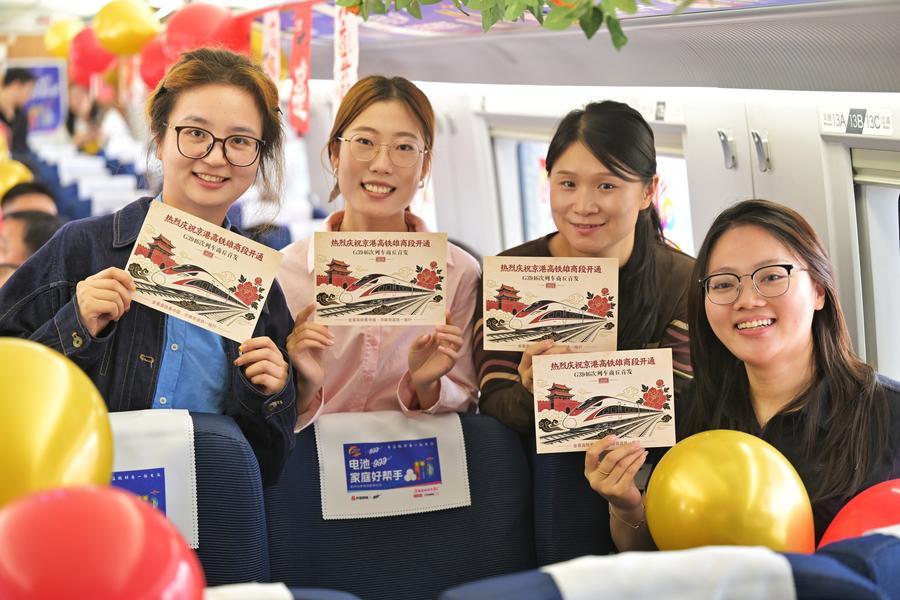
Passengers show the commemorative cards for the inaugural high-speed train G3946, which runs from Shangqiu to Xiong’an, Sept. 28, 2026. (Photo by Wang Wei/Xinhua)
BEIJING, Oct. 10 (Xinhua) — Liu Zengyuan, a railway engineer, watched familiar fields slip past the train window. This time, he was not heading to a construction site, but going home for the National Day holiday on the high-speed line he had helped build, just days after it opened.
This line, which officially entered service on Sept. 28, links Xiong’an in north China’s Hebei Province with Shangqiu in Henan Province in central China. For Liu, it has cut the trip from Renqiu, his workplace in Hebei, to his hometown of Heze in east China’s Shandong Province, from four or five hours to only two.
On the same day, China opened three other high-speed rail sections, connecting Xi’an with Ankang in Shaanxi Province in northwest China, Yichang with Xingshan in central China’s Hubei Province, and Harbin with Yichun in Heilongjiang Province in the country’s northeast. During the National Day holiday, from Oct. 1 to Oct. 7, these new lines made it easier for people to visit relatives, and brought new vitality to tourism along the routes.
During the holiday, a Beijing resident surnamed Wang took his family by high-speed rail to Hengshui Lake, a national nature reserve in Hebei Province. He was pleasantly surprised to find the journey so convenient, as the trip took less than two hours, and a shuttle bus at the station took them straight to the scenic area.
This new line ended the history of Hengshui having no high-speed trains directly running to Beijing. Thanks in part to the new rail line and local promotions, 32 A-level scenic spots across Hengshui received 715,000 visitors during the holiday, soaring 202.84 percent year on year.
“Cities are much closer now, not just on the map but in everyday life,” said Qu Xiaoyuan, an Ankang cultural and tourism official. His brother, who works in Xi’an, called him the day the Xi’an-Ankang high-speed railway opened, joking that he could dash to Ankang for a nice meal at home and still be back in Xi’an that night.
The line has cut travel time between the two cities from three hours to as short as 45 minutes. Ankang, a mountainous city in southern Shaanxi, is rich in ecological resources, and the new railway has taken a growing number of holiday travelers to its forests and rivers.
Ankang West Station, a new station built for the high-speed line, handled 50,800 outgoing passengers during the holiday, which was more than expected. The city also launched shuttle services linking the station with major scenic spots, where visits rose over 40 percent year on year.
As these new lines draw passengers from a wider area, weekend and short-holiday tourists may increase significantly, driving demand for multi-purpose and experience-oriented tourism products, Qu said.
Further east, the Yichang-Xingshan line brings destinations like southwest China’s Chongqing and central China’s Wuhan and Zhengzhou within two hours of Xingshan, weaving the Three Gorges, dense forests and cloud-shrouded peaks scattered along the route into easy, spontaneous trips.
Xingshan Station handled 14,216 outgoing passengers during the seven-day holiday, up 54.61 percent year on year. Local businesses in the city used high-speed rail tickets to link hotel discounts and reduce or scrap scenic spot admission fees.
Meanwhile, the northernmost high-speed railway in China connects Harbin, a major ice-and-snow tourism destination, with Yichun, a popular summer retreat and forest tourism spot. It cuts railway travel time between these two cities from about seven hours to roughly two hours, making it easier for more tourists to include Yichun in their holiday plans.
“Yichun used to be a ‘maybe’ destination because getting there was a hassle, but thanks to the new high-speed rail, it’s now a ‘must-go’,” said a Shanghai visitor surnamed Zheng, adding that the new line has made the stay of his family in Heilongjiang more colorful.
Wang Wei, director of the Yichun Municipal Bureau of Culture, Radio, Television and Tourism, said the new railway will bring Yichun into Harbin’s “two-hour economic circle,” creating new opportunities for its winter tourism, forest study tours and forest wellness tourism.
Ma Botao, of the China Railway Economic Planning and Research Institute, said for cities newly connected to the railway network, seizing the opportunity depends on how well they position themselves.
“Generally, large cities focus on research and development, finance and headquarters economy, while small cities should leverage their local agriculture, ecology, tourism and distinctive industrial strengths to undertake supporting manufacturing, agricultural product processing, and wellness and cultural tourism, serving as both industrial supporting bases and leisure backyards for central cities,” Ma explained.
Behind these expectations lies a network that keeps growing. By the end of 2025, the country’s total operating railway mileage had reached 165,000 km, including more than 50,000 km of high-speed rail.
Under national plans, China’s high-speed rail network is projected to hit 70,000 km by 2035, featuring eight north-south vertical lines and eight east-west horizontal lines. Once complete, the network will connect major cities, city clusters and key economic zones across the country.
Renaissance Capital, the GDR Issuer of the Dangote Kenya GDRs, today announced that the Minimum Subscription under the Offer has been reduced from 2,000 GDRs to 10 GDRs. With the GDR Subscription Price of KES 53.50 per GDR, the minimum application amount is equivalent to KES 535, payable in full on application. The reduction in the minimum investment threshold follows feedback from the investor community, high market demand and approval from CMA and is intended to broaden access to the GDRs. This revised minimum subscription aligns the Kenyan GDR Offer with the minimum investment available to investors in the Initial Public Offering of Dangote Refinery in Nigeria, supporting broader participation through a structured, transparent and regulated framework. A Global Depositary Receipt (GDR) lets investors buy shares in a foreign company without leaving their home market. Two financial institutions make this work. A Custodian Bank holds the company’s actual shares in its home country, and a Receiving Bank receives the funds from Investors, and the investors can then then trade on their local exchange. Other specialists typically support them: An Investment Bank and a Law Firm structure the arrangement and secure regulatory legal approvals, Formal Registrars keep records of who holds the receipts, Stockbrokers and/or Investment Banks buy and sell the shares on investors’ behalf, and communications firms help investors and the public understand the opportunity. In an unsponsored GDR, these regulated institutions set up the programme themselves, not the company. The Dangote shares would stay in custody in Nigeria, while Kenyan investors buy and sell the receipts on the NSE in Kenyan shillings. The NGX remains the main market for the shares. The Offer is for up to 728,971,962 GDRs, each of which represents one Underlying Share in DPRP, held through the custody arrangements. The Kenya GDR Offer was approved by the Capital Markets Authority (CMA) on 5 October 2026. The GDRs are to be listed on the Main Investment Market Segment of the Nairobi Securities Exchange (NSE), subject to approval or no-objection from the Securities and Exchange Commission of Nigeria, and will trade in Kenya Shillings. The Kenya GDR Offer opened on 6 October 2026 and closes at 5pm on 13 October 2026. All other terms of the Offer remain as set out in the Amended Information Memorandum dated 9th October 2026. Eligible investors holding a valid CDSC Account may apply through the USSD code 483250#, the e-portal at https://dangotegdr.e-offer.app/, or through an Authorised Selling Agent. Investors who do not have a CDSC Account may apply to open one through the e-portal. Payment must be made in full in Kenyan Shillings by the closing time. Investors should use only the official application channels set out in the amended Information Memorandum.
Marking the first National Day holiday since the launch of the island-wide special customs operations, Hainan witnessed the dividends of its duty-free policies continue to unfold, with travelers from near and far embracing a world-class shopping journey.■
From bustling transport hubs and crowded scenic areas to fully booked restaurants and busy shopping districts, strong travel flows and vibrant consumption during the 7-day National Day holiday highlighted the resilience and momentum of China’s holiday economy. #GLOBALink
An aerial drone photo taken on Aug. 18, 2026 shows a view of Yudu County, east China’s Jiangxi Province. (Xinhua/Zhou Mi)
NANCHANG, Oct. 8 (Xinhua) — The former ferry crossing is about half an hour’s walk from the home of Sun Guanfa, 77, in Yudu, a hilly county in east China’s Jiangxi Province.
For his father, the journey from this riverbank more than nine decades ago was part of an epic.
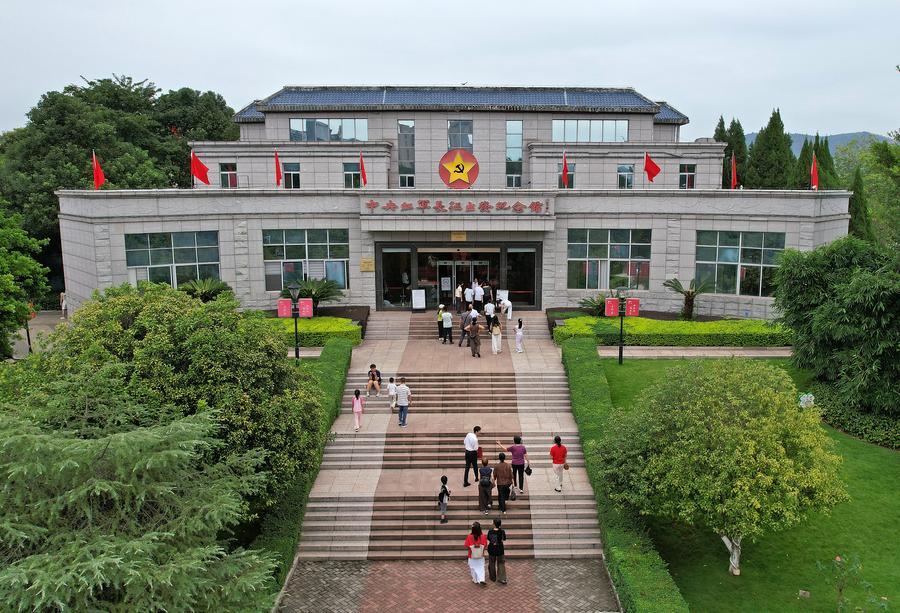
In October 1934, some 86,000 soldiers of the Red Army crossed the Yudu River to embark on what later came to be known as the Long March.
In a country beset by foreign invasion, social turmoil and destitution, the fledgling Red Army, led by the Communist Party of China (CPC), was fighting for national independence and the liberation of the Chinese people. But at the time, it was encircled by the overwhelming and much better-armed Kuomintang forces.
What followed was an epic military maneuver: from Yudu, Red Army troops trekked roughly 12,500 kilometers across China, crossing snow-covered mountains and treacherous marshlands, all the while battling enemy forces. They eventually reached the country’s northwest, where, in 1936, they were joined by several other Red Army branches, marking the victorious conclusion of the Long March.
This military maneuver preserved the Red Army. It also gave the CPC a new foothold in northwest China, from which it built up its strength, fought back against invading Japanese troops and eventually toppled the corrupt Kuomintang regime, leading to the founding of the People’s Republic of China in 1949.
In Yudu, the Long March is not simply a chapter in a history book. It is a family story.
More than 17,000 residents joined the departing army. Only 277 were recorded as eventually returning home, said Zhong Min, a guide at a museum built beside the river to commemorate the departure.
Her voice still catches when she says that number.
Her maternal great-grandfather died fighting the encirclement campaigns. Her husband’s grandfather marched away with the troops and was never heard from again. Sun’s father fell in a battle that saw the forces of the Red Army reduced to just over 30,000.
“We are not telling other people’s stories,” Zhong said. “We are telling our own families’.”
Here, the Long March is measured not only in kilometers and battles, but in the people who left home knowing they might never return.
For Sun, the legacy of that generation is deeply personal. Under a local tradition, Sun was adopted as the son of the soldier who left the riverbank and never returned, so that the soldier’s family line could continue.
“People of my father’s generation were willing to give their lives so ordinary people could be liberated,” Sun said.
On the same riverbank in 2019, Chinese President Xi Jinping spoke of what had enabled the Party and the Red Army to come back from the brink of destruction time and again: firm ideals and convictions, and strong willpower.
“We must not forget our Party’s original aspiration and founding mission,” said Xi, also general secretary of the CPC Central Committee and chairman of the Central Military Commission. The Party’s long-stated mission, dating to its founding in 1921, is to seek happiness for the Chinese people and rejuvenation for the Chinese nation.
During the visit, Xi placed a flower basket at a monument commemorating the Red Army’s departure and bowed in tribute. He then walked behind the monument to a railing overlooking the river and stood there for a long while.
The river remains. For Xi, it was also a place from which to look ahead to China’s future.
“We came to this place to revisit what it was like when the Red Army set out,” he told local people gathered nearby. “Today we are on a new journey — to build a modern socialist country. We must carry on the work of those who came before us, gear up anew, and set out once more.”
That new journey was unfolding against a vastly changed backdrop. When Xi visited Yudu, the nationwide campaign he had launched to combat poverty was entering its final stage.
It would culminate in the elimination of absolute poverty in a nation of 1.4 billion. Nearly 100 million rural residents were lifted out of poverty under Xi’s “targeted poverty alleviation” campaign, which mobilized the entire Party and the nation.
Xi announced the victory, as a key part of building a moderately prosperous society in all respects, in 2021 when the CPC marked its centenary.
A drone photo taken on Oct. 2, 2026 shows tourists at a memorial hall marking the departure of the Long March by the Central Red Army in Yudu County, east China’s Jiangxi Province. (Photo by Zeng Xiaomao/Xinhua)
During his 2019 visit, Xi saw for himself whether the former revolutionary base areas were on track to meet their poverty-reduction targets.
At Sun’s home, he walked through the main hall to the backyard and checked the kitchen and the bedrooms. There was rice and cooking oil in the kitchen, and the bathroom was clean.
Xi asked about the family’s income and how Sun’s son and daughter-in-law made a living, where their children went to school, and what the school meals were like.
“By the time they grow up, we will have achieved the rejuvenation of our nation,” Xi said, pointing to Sun’s two grandchildren.
China aims to basically realize socialist modernization by 2035 and build a great modern socialist country in all respects by the middle of this century, according to the vision set by the Party.
Earlier, at the museum where Zhong served as a guide, Xi had stopped before a map of China made from straw sandals.
The display recalled how local people worked through the night to make straw sandals for the soldiers, many of whom fought barefoot. They also dismantled doors, bed boards, roof beams and even timber intended for coffins to build pontoon bridges, helping the soldiers cross the Yudu River.
“The country has developed and people’s lives have improved, but we must remember where it all came from,” Xi said. “We must not forget our revolutionary forefathers and those who died for the revolution, or the people of the old revolutionary base areas.”
Nowadays, golden waves of selenium-rich rice ripple around the 700-year-old village, and rows of modern vegetable greenhouses stand nearby. In the residential area, white-walled houses with gray-tiled roofs sit amid trees, while pavilions nestle between them.
“Now we have wages from working, rent from our guesthouses and dividends from our shares,” Sun said. “Our annual income has tripled to more than 200,000 yuan (around 29,000 U.S. dollars).”
This file photo taken on Oct. 21, 2020 shows Sun Guanfa (L) introducing local agricultural products to tourists in Tantou Village, Yudu County, east China’s Jiangxi Province. (Xinhua/Wan Xiang)
The transformation extends well beyond Yudu.
Much of southern Jiangxi, once cut off from the outside world by rugged mountains, is far more connected. High-speed rail links it with the city of Shenzhen, the country’s economic powerhouse close to Hong Kong. Expressways also reach every county, and paved roads now extend into villages.
For local business owners, it no longer means spending two days and two nights on the road to source a critical part. Now they can hop on a high-speed train, pick up what they need in the morning and return that afternoon, drastically speeding up the development of a prototype.
The change is not only about getting around. Industries such as non-ferrous metals and advanced materials, electronics and information technology, and textiles and apparel have taken root here. For ordinary people, the changes are closer to home. Housing has improved, drinking water is safer, and schools and medical care are more accessible.
More people can now earn a living without leaving their hometowns. In March, the Hong Kong Polytechnic University launched a facility dedicated to research into smart wearables and smart clothing in Xingguo, a county next to Yudu.
This summer, Yudu welcomed students from more than 170 universities across China who came to retrace the Long March at the places where it began. Many realized that the Red Army soldiers who set out were their age.
“Standing where those young soldiers began their journey gave me a deeper understanding of what they accomplished,” said Liu Fanshuo, an undergraduate studying automation.
Today, five modern bridges span the Yudu River near the crossings where local people once built pontoon bridges to help the Red Army cross.
On the banks, Sun pours hot tea for tourists whose lives might have been very different had those soldiers never crossed. ■