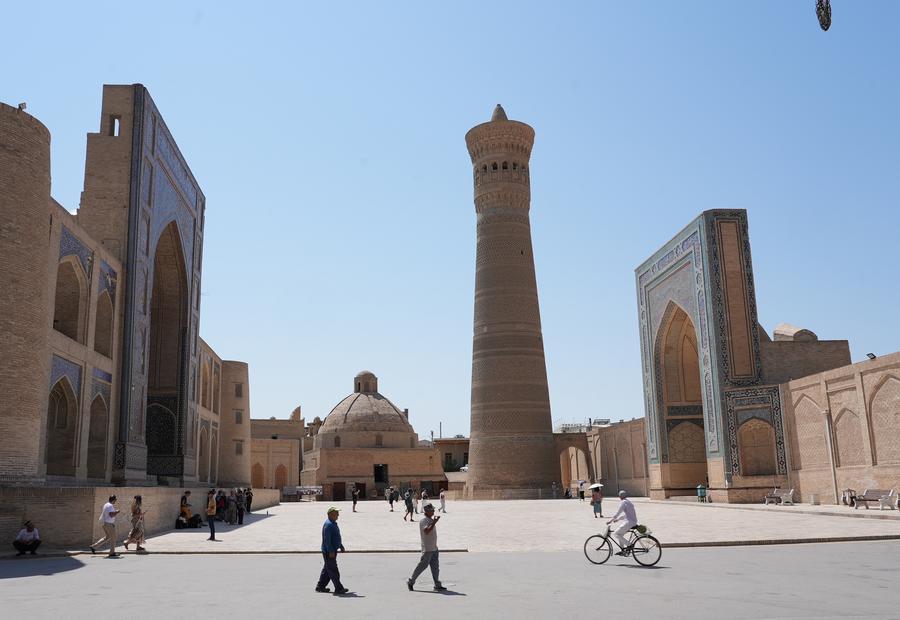
People walk across the Po-i-Kalyan Complex in Bukhara, Uzbekistan, Aug. 3, 2026. (Photo by Zafar Khalilov/Xinhua)
BUKHARA, Uzbekistan, Oct. 10 (Xinhua) — As the setting sun cast a golden glow over the ancient streets of Bukhara, the historic city bustled with tourists, while local vendors called out to passersby.
Holding a hand-painted ceramic bowl, Yan Hong, a tourist from northeast China’s Harbin, marveled at the intricate floral patterns adorning the craft at a roadside stall, accompanied by her parents.
“Uzbekistan has so many historic cities along the Silk Road: Samarkand, Bukhara and Khiva,” she said. “I’d read about them in books. I had to see them for myself.”
Walking through the ancient city, she said the experience surpassed her expectations, with history and modernity blending seamlessly and different civilizations engaging in a quiet dialogue.
Yan is among a rapidly growing number of Chinese travelers choosing Uzbekistan as a holiday destination.
A mutual visa-exemption agreement, which officially took effect on June 1, 2025, has given fresh impetus to cross-border tourism.
According to official reports from Uzbekistan’s Tourism Committee, the number of Chinese tourists visiting the country increased by 3.5 times following the launch of the reciprocal visa-free policy.
“By now, the entire city of Bukhara knows that China enjoys a seven-day ‘Golden Week’ holiday in October,” said Khamrayev, a local vendor specializing in miniature paintings and traditional handicrafts.
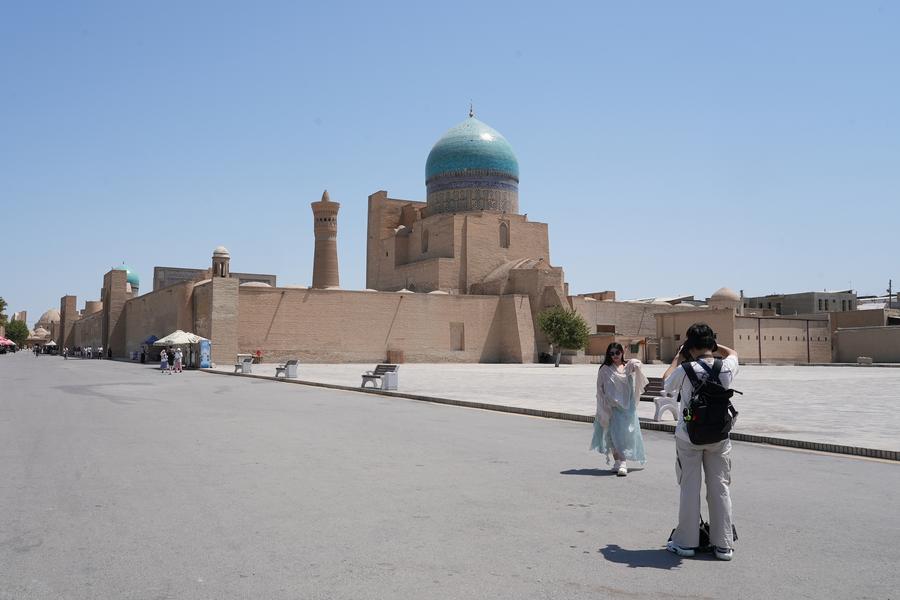
A tourist takes photos in front of historic architecture in Bukhara, Uzbekistan, Aug. 3, 2026. (Photo by Zafar Khalilov/Xinhua)
Recalling the holiday period last year, Khamrayev said Chinese tourists had flocked to his courtyard shop, making it his busiest sales period of the year.
A similar tourism boom is unfolding in neighboring Kazakhstan, which also benefits from a mutual visa-free arrangement with China.
At Shymbulak resort near Almaty, with the towering Tianshan Mountains in the background, Qi Yue and his wife from Hangzhou, east China’s Zhejiang Province, waited in line for a cable car.
“We decided on a whim,” Qi said. “Visa-free travel was a big factor.” He added that many Chinese tourists now travel to Kazakhstan from Xinjiang Uygur Autonomous Region after exploring the region.
Some travelers are taking advantage of improved cross-border access to embark on longer and multi-country journeys across Central Asia.
Zhang Dongni, a solo backpacker traveling overland across the region, made her way from Almaty to Lake Issyk-Kul in Kyrgyzstan. She was heading to Osh, the country’s second-largest city, before continuing to Khujand in Tajikistan.
“People here are remarkably warm and hospitable,” Zhang said. While traveling from Bishkek to Osh, she was unable to board a bus because of her oversized luggage, so she arranged to share a taxi with local residents.
“We chatted using translation apps the whole way. When we arrived, they insisted on covering my fare as their guest,” Zhang said. In return, she gave them traditional Chinese knots as tokens of appreciation.
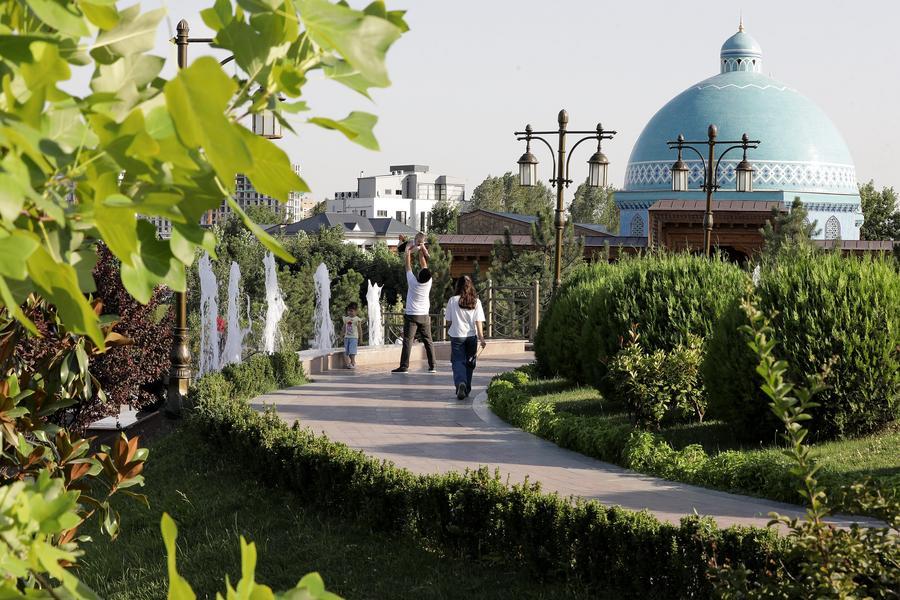
People enjoy the cool at a park amid a heatwave in Tashkent, Uzbekistan, June 27, 2026. (Photo by Zafar Khalilov/Xinhua)
In Tashkent, Uzbekistan’s capital, Chinese tourists Zhou Yushan and Tang Suyu stopped to take photos outside the Holy Assumption Cathedral.
“We took three days off to bridge the Mid-Autumn Festival and National Day holidays,” Zhou said. “That gave us enough time to explore Xinjiang alongside several destinations across Kazakhstan and Uzbekistan on a single trip.”
As China and Central Asian countries continue to facilitate cross-border travel, growing tourism flows are increasingly becoming a two-way exchange, with more visitors from Central Asia also traveling to China.
According to data from the Guangzhou Baiyun exit-entry frontier inspection station, more than 90,000 passengers from the five Central Asian countries had passed through Guangzhou Baiyun International Airport by June 2 this year, up 286.6 percent year on year. Arrivals from Kazakhstan, Uzbekistan and Kyrgyzstan rose by 258.4 percent, 351.9 percent and 660.6 percent, respectively.
Linked by mountains and rivers and bound by longstanding cultural ties, China and Central Asian countries are seeing closer people-to-people exchanges as cross-border travel becomes more convenient, opening new avenues for mutual understanding and lasting friendship.
Renaissance Capital, the GDR Issuer of the Dangote Kenya GDRs, today announced that the Minimum Subscription under the Offer has been reduced from 2,000 GDRs to 10 GDRs. With the GDR Subscription Price of KES 53.50 per GDR, the minimum application amount is equivalent to KES 535, payable in full on application. The reduction in the minimum investment threshold follows feedback from the investor community, high market demand and approval from CMA and is intended to broaden access to the GDRs. This revised minimum subscription aligns the Kenyan GDR Offer with the minimum investment available to investors in the Initial Public Offering of Dangote Refinery in Nigeria, supporting broader participation through a structured, transparent and regulated framework. A Global Depositary Receipt (GDR) lets investors buy shares in a foreign company without leaving their home market. Two financial institutions make this work. A Custodian Bank holds the company’s actual shares in its home country, and a Receiving Bank receives the funds from Investors, and the investors can then then trade on their local exchange. Other specialists typically support them: An Investment Bank and a Law Firm structure the arrangement and secure regulatory legal approvals, Formal Registrars keep records of who holds the receipts, Stockbrokers and/or Investment Banks buy and sell the shares on investors’ behalf, and communications firms help investors and the public understand the opportunity. In an unsponsored GDR, these regulated institutions set up the programme themselves, not the company. The Dangote shares would stay in custody in Nigeria, while Kenyan investors buy and sell the receipts on the NSE in Kenyan shillings. The NGX remains the main market for the shares. The Offer is for up to 728,971,962 GDRs, each of which represents one Underlying Share in DPRP, held through the custody arrangements. The Kenya GDR Offer was approved by the Capital Markets Authority (CMA) on 5 October 2026. The GDRs are to be listed on the Main Investment Market Segment of the Nairobi Securities Exchange (NSE), subject to approval or no-objection from the Securities and Exchange Commission of Nigeria, and will trade in Kenya Shillings. The Kenya GDR Offer opened on 6 October 2026 and closes at 5pm on 13 October 2026. All other terms of the Offer remain as set out in the Amended Information Memorandum dated 9th October 2026. Eligible investors holding a valid CDSC Account may apply through the USSD code 483250#, the e-portal at https://dangotegdr.e-offer.app/, or through an Authorised Selling Agent. Investors who do not have a CDSC Account may apply to open one through the e-portal. Payment must be made in full in Kenyan Shillings by the closing time. Investors should use only the official application channels set out in the amended Information Memorandum.
BEIJING, Oct. 9 (Xinhua) — Liu Zengyuan, a railway engineer, watched familiar fields slip past the train window. This time, he was not heading to a construction site, but going home for the National Day holiday on the high-speed line he had helped build, just days after it opened.
This line, which officially entered service on Sept. 28, links Xiong’an in north China’s Hebei Province with Shangqiu in Henan Province in central China. For Liu, it has cut the trip from Renqiu, his workplace in Hebei, to his hometown of Heze in east China’s Shandong Province, from four or five hours to only two.
On the same day, China opened three other high-speed rail sections, connecting Xi’an with Ankang in Shaanxi Province in northwest China, Yichang with Xingshan in central China’s Hubei Province, and Harbin with Yichun in Heilongjiang Province in the country’s northeast. During the National Day holiday, from Oct. 1 to Oct. 7, these new lines made it easier for people to visit relatives, and brought new vitality to tourism along the routes.
During the holiday, a Beijing resident surnamed Wang took his family by high-speed rail to Hengshui Lake, a national nature reserve in Hebei Province. He was pleasantly surprised to find the journey so convenient, as the trip took less than two hours, and a shuttle bus at the station took them straight to the scenic area.
This new line ended the history of Hengshui having no high-speed trains directly running to Beijing. Thanks in part to the new rail line and local promotions, 32 A-level scenic spots across Hengshui received 715,000 visitors during the holiday, soaring 202.84 percent year on year.
“Cities are much closer now, not just on the map but in everyday life,” said Qu Xiaoyuan, an Ankang cultural and tourism official. His brother, who works in Xi’an, called him the day the Xi’an-Ankang high-speed railway opened, joking that he could dash to Ankang for a nice meal at home and still be back in Xi’an that night.
The line has cut travel time between the two cities from three hours to as short as 45 minutes. Ankang, a mountainous city in southern Shaanxi, is rich in ecological resources, and the new railway has taken a growing number of holiday travelers to its forests and rivers.
Ankang West Station, a new station built for the high-speed line, handled 50,800 outgoing passengers during the holiday, which was more than expected. The city also launched shuttle services linking the station with major scenic spots, where visits rose over 40 percent year on year.
As these new lines draw passengers from a wider area, weekend and short-holiday tourists may increase significantly, driving demand for multi-purpose and experience-oriented tourism products, Qu said.
Further east, the Yichang-Xingshan line brings destinations like southwest China’s Chongqing and central China’s Wuhan and Zhengzhou within two hours of Xingshan, weaving the Three Gorges, dense forests and cloud-shrouded peaks scattered along the route into easy, spontaneous trips.
Xingshan Station handled 14,216 outgoing passengers during the seven-day holiday, up 54.61 percent year on year. Local businesses in the city used high-speed rail tickets to link hotel discounts and reduce or scrap scenic spot admission fees.
Meanwhile, the northernmost high-speed railway in China connects Harbin, a major ice-and-snow tourism destination, with Yichun, a popular summer retreat and forest tourism spot. It cuts railway travel time between these two cities from about seven hours to roughly two hours, making it easier for more tourists to include Yichun in their holiday plans.
“Yichun used to be a ‘maybe’ destination because getting there was a hassle, but thanks to the new high-speed rail, it’s now a ‘must-go’,” said a Shanghai visitor surnamed Zheng, adding that the new line has made the stay of his family in Heilongjiang more colorful.
Wang Wei, director of the Yichun Municipal Bureau of Culture, Radio, Television and Tourism, said the new railway will bring Yichun into Harbin’s “two-hour economic circle,” creating new opportunities for its winter tourism, forest study tours and forest wellness tourism.
Ma Botao, of the China Railway Economic Planning and Research Institute, said for cities newly connected to the railway network, seizing the opportunity depends on how well they position themselves.
“Generally, large cities focus on research and development, finance and headquarters economy, while small cities should leverage their local agriculture, ecology, tourism and distinctive industrial strengths to undertake supporting manufacturing, agricultural product processing, and wellness and cultural tourism, serving as both industrial supporting bases and leisure backyards for central cities,” Ma explained.
Behind these expectations lies a network that keeps growing. By the end of 2025, the country’s total operating railway mileage had reached 165,000 km, including more than 50,000 km of high-speed rail.
Under national plans, China’s high-speed rail network is projected to hit 70,000 km by 2035, featuring eight north-south vertical lines and eight east-west horizontal lines. Once complete, the network will connect major cities, city clusters and key economic zones across the country. ■
Kenya’s residential property market is entering an increasingly selective phase as buyers shift focus toward long-term value and larger living spaces, marked by the launch of a new flagship residential project in the capital city of Nairobi on Thursday.
The development, named AERA Westlands, features a 19-floor structure comprising 360 suites located in Westlands, one of Nairobi’s primary commercial and residential districts. The project aims to respond to evolving urban consumer preferences by offering higher spatial standards and flexible layout options in high-density urban environments.
The launch comes amid resilient yet diverged performance across Kenya’s real estate sector. Data from the Kenya National Bureau of Statistics (KNBS) shows that national residential property prices rose 4.8 percent year-on-year in the first quarter of 2026, with the overall Residential Property Price Index reaching 118.4, up from 113.0 in the same period of 2025.
Macroeconomic fundamentals have supported construction activity, with Kenya’s real Gross Domestic Product (GDP) expanding by 4.6 percent in 2025, while the construction sector rebounded by 6.8 percent during the year, according to official statistics.
However, localized market conditions present a complex landscape for developers. While property prices across Nairobi’s broader suburbs edged up 0.9 percent quarter-on-quarter in the second quarter of 2026, apartment values in Westlands faced a 6.5 percent year-on-year drop due to expanding market supply, according to market tracking by HassConsult.
Industry analysts note that changing supply-demand dynamics are altering buyer behavior across East Africa’s largest economy. Demand for larger living formats remains notably strong, with KNBS data recording a 20.4 percent year-on-year price increase for standalone houses in Nairobi’s middle-income segment in early 2026—the highest growth among surveyed residential categories.
To address the demand for larger space within high-rise developments, the newly launched project incorporates one-bedroom units ranging from 75 to 95 square meters, alongside two-bedroom and three-bedroom suites spanning up to 200 square meters.
Situated near key transport corridors including the Nairobi Expressway and Waiyaki Way, the project targets diverse buyer segments, including local professionals, diaspora investors, and corporate tenants, benefiting from Westlands’ role as an economic and hospitality hub. According to market analysis by Cytonn Investment, average residential rental yields in Nairobi’s suburbs stood at 7.4 percent in the second quarter of 2026.
China saw a daily average of 2.21 million inbound and outbound trips during this year’s week-long National Day holiday, which ended on Wednesday, up 6.7 percent year on year. #XinhuaNews
*During this National Day holiday from Oct. 1 to 7, authorities had projected 2.13 billion cross-regional passenger trips, averaging 300 million a day.
*Cultural and tourism authorities nationwide have introduced a range of creative initiatives to attract visitors, drawing on sports events, cultural IPs, ethnic traditions and distinctive natural landscapes.
*On Sept. 24, the Ministry of Culture and Tourism announced plans to develop more travel experiences that combine traditional culture with modern life during 2026-2030, aimed at helping foreign visitors travel more conveniently, enjoy more comfortable stays and gain a closer view of contemporary China.
BEIJING, Oct. 7 (Xinhua) — While tourism in China has traditionally been associated with breathtaking landscapes and photo opportunities, Wang Xin (pseudonym) opted for a different kind of National Day holiday this year: watching tennis.
Well before the vacation she had purchased tickets for the Jingshan Tennis Open in central China’s Hubei Province.
A resident of Dongguan in Guangdong Province, about 1,000 kilometers away, she first learned about Jingshan because of the tournament. “I want to watch matches featuring several young WTA (Women’s Tennis Association) and ATP (Association of Tennis Professionals) players up close,” said the tennis enthusiast.
She planned to spend three days watching the matches and the remaining four days exploring the county-level city, taking in its scenic mountains, valleys, and forests.
During this National Day holiday from Oct. 1 to 7, one of China’s few annual “golden weeks,” authorities had projected 2.13 billion cross-regional passenger trips, averaging 300 million a day.
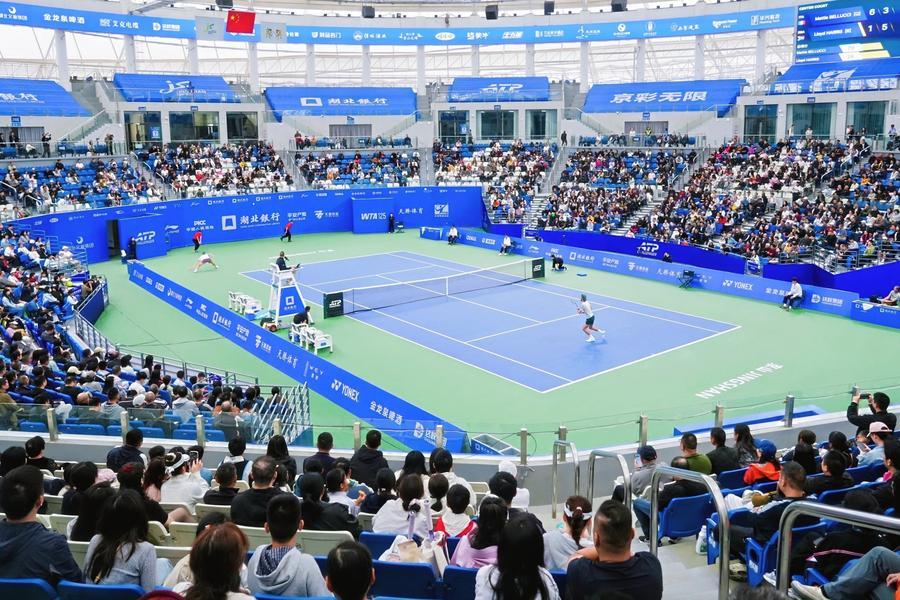
People enjoy a match during the Jingshan Tennis Open in Jingshan, central China’s Hubei Province, Oct. 4, 2026. (Photo by Lei Yixin/Xinhua)
Data from Meituan, a major services platform, showed homestay bookings for four-to-six-night stays during the holiday rose 24 percent year on year as of Sept. 28, with county-level destinations posting particularly strong growth.
Cultural and tourism authorities nationwide have introduced a range of creative initiatives to attract visitors, drawing on sports events, cultural IPs, ethnic traditions and distinctive natural landscapes.
DESTINATIONS FOR DIVERSE DEMANDS
Jingshan, a county-level city where tennis has been developing for more than 40 years, is known as China’s “hometown of tennis.”
To boost tourism during the National Day holiday, local authorities announced that during the tournament period, a match ticket would entitle holders to discounts at over 100 local businesses. Merchants have also benefited from the holiday travel surge.
Zuo Meng, a vendor selling knitted products, said she follows the local tennis events closely. “In Jingshan, there are tennis matches almost every week,” she said, adding that a tournament can generate 6,000 to 7,000 yuan (about 895 to 1,044 U.S. dollars) in sales. Over the past two years, she has also taught knitting skills to more than 200 women so they, too, could benefit from tourism.
Peng Jufang runs a farm in Wenfeng Village. Noticing tourists’ enthusiasm for tennis, he founded his own tennis club in October last year. With more than 16 people coming each day to try their hand at tennis, he was kept busy during this National Day holiday, teaching visitors for over six hours a day.
In 2025, Jingshan hosted 48 domestic and international sports events. The comprehensive output value of its “tennis plus” economy surpassed 3.5 billion yuan, drawing 3.52 million visits for matches and tourism.
While Wang Xin enjoys tennis matches in Jingshan, cultural enthusiasts have meccas of their own to visit.
Wang Yinan, in her 20s, traveled from Beijing to Ruicheng County in north China’s Shanxi Province after watching the popular animation “All Wishes Come True.” Hometown of the legendary figure behind the film’s main protagonist, Lyu Dongbin, Ruicheng is home to the Yongle Palace, which is known for its celebrated murals.
“It is such an exciting trip, and it’s incredible to be in Lyu’s hometown,” said Wang, as she browsed creative products at the Yongle Palace store.
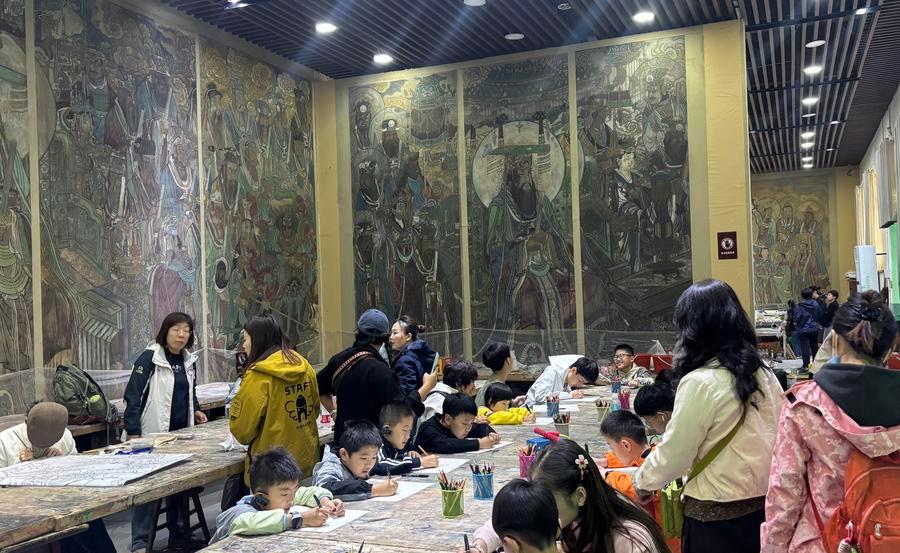
Visitors are seen during a study tour for mural copying at the Yongle Palace scenic area in Ruicheng, north China’s Shanxi Province, Oct. 2, 2026. (Photo by Guo Song/Xinhua)
Liu Haibo, chairman of the Yongle Cultural Tourism Investment and Construction Co., Ltd., said the scenic site rolled out customized services to sustain its tourism growth following its viral popularity. Visitors can take photos in dedicated photo zones, guides explain the murals by linking them to scenes from the film, and tourists can attend interactive classes to learn mural copying and line drawing.
The movie has helped raise the profile of Ruicheng, making it a sought-after destination, especially among young people. Statistics showed that between Oct. 1 and 5, Yongle Palace received about 80,000 visits, up more than 50 percent year on year.
The ancient township of Fenghuang in Xiangxi Tujia and Miao Autonomous Prefecture, central China’s Hunan Province, has kept its tourist momentum following the Sept. 25-27 Mid-Autumn Festival holiday.
During the National Day holiday, some visitors seeking to avoid the crowds have ventured beyond the ancient town of Fenghuang into surrounding mountains and villages, exploring rich ethnic cultures, such as Miao welcoming rituals, lantern shows and folk performances.
INTERNATIONAL VISITORS JOINING THE RUSH
The diverse tourism resources in China’s counties are also luring international visitors away from metropolises like Beijing and Shanghai and toward niche attractions.
Lucas Martin, 28, from France, visited Fenghuang for the first time after touring major Chinese cities.
“Fenghuang feels entirely different from big cities,” he said. “You can slow down here. You can admire the distinctive stilt houses lining the Tuojiang River and observe local residents in their daily lives.”
The in-depth county exploration impressed him with the town’s authentic living vibe. “This is not merely a tourist attraction. Walking along the river and pausing at street corners makes me feel more than just a passing sightseer.”
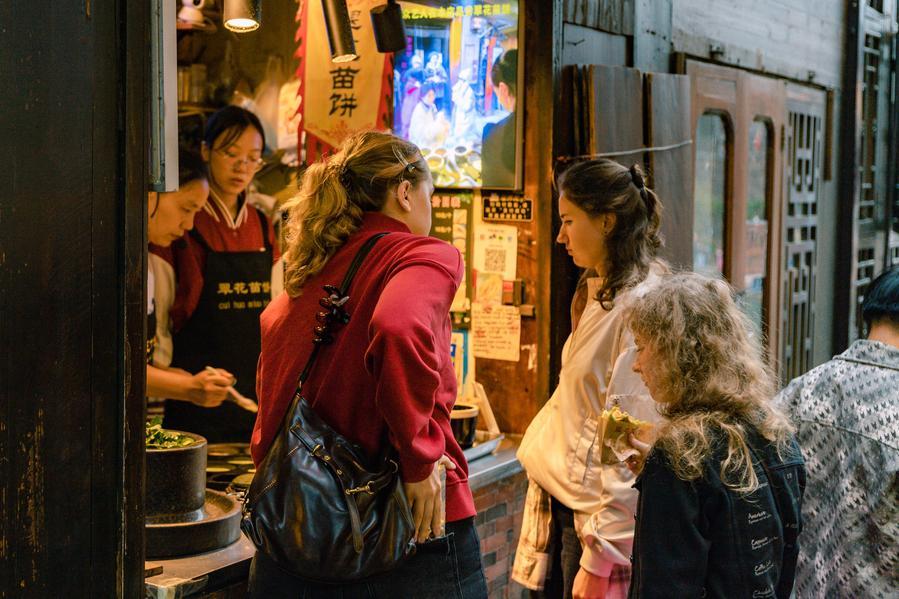
Foreign tourists try specialty food of the Miao ethnic group at the ancient township of Fenghuang in Xiangxi Tujia and Miao Autonomous Prefecture, central China’s Hunan Province, Oct. 1, 2026. (Photo by Hu Cong/Xinhua)
Emma Wilson, an Australian traveler who is exploring small towns and countryside across China, tried on Miao ceremonial costumes in Fenghuang.
“It is magical to walk into the old streets, dressed like locals,” she said. Shop staff carefully helped her get fitted in the ethnic costume.
“A simple landscape photo fades quickly from memory. But putting on traditional clothing, tasting local food and learning the stories behind folk customs create experiences that stay with you far longer,” she said.
Since December 2023, when China launched a trial policy granting unilateral visa exemptions to visitors from six countries, it has expanded unilateral visa-free entry to travelers from 50 countries as of September, allowing eligible visitors to stay for up to 30 days.
In a separate move, authorities extended the visa-free transit period for certain countries from 72 or 144 hours to 240 hours in December 2024. So far the number of eligible countries has increased to 57.
Official data revealed that foreign nationals made nearly 61.29 million border crossings in the first eight months of 2026, up 19.5 percent year on year, while one of the leading mobile payment platforms, Weixin Pay, reported that both the value and number of e-wallet transactions made by overseas users rose by more than 80 percent during the same period.
On Sept. 24, China’s Ministry of Culture and Tourism announced plans to develop more travel experiences that combine traditional culture with modern life during 2026-2030, aimed at helping foreign visitors travel more conveniently, enjoy more comfortable stays and gain a closer view of contemporary China.
A National Day gala is held on the Tuojiang River at the ancient township of Fenghuang in Xiangxi Tujia and Miao Autonomous Prefecture, central China’s Hunan Province, Oct. 1, 2026. (Photo by Hu Cong/Xinhua)
FROM “CITY WALK” TO “COUNTRY WALK”
Yang Han, a researcher at an institute affiliated to the travel platform Qunar, believes that county-level tourism began to accelerate around 2023-2024, as travelers increasingly sought destinations with fewer crowds, a lively atmosphere, opportunities for relaxation and immersive local experiences, as well as greater value for money.
For instance, in Ruicheng of Shanxi, a set meal for one person may cost less than 20 yuan, the price of a cup of bubble tea in Beijing.
Tuo Yanzheng, a professor at the College of Tourism and Service Management, Nankai University, said county areas hold rich agricultural, ecological and cultural resources with untapped consumption potential.
“The key lies in turning these resource strengths into distinctive tourism products and consumption scenarios,” she said. “It can not only meet people’s increasingly diverse consumption demands, but also inject new vitality into the county economy.”
According to Sun Jiashan, a researcher at the Central Institute of Socialism, China’s tourism market has evolved from “City Walk” to “Country Walk.”
Steadily improving transportation has made county-level destinations more accessible. By the end of 2025, China’s total operating railway mileage had reached 165,000 km, including more than 50,000 km of high-speed rail.
Shortly before the National Day holiday, the country opened four major high-speed railway sections, improving transport links across several regions and making travel easier for residents. The high-speed rail network is projected to hit 70,000 km by 2035, with eight north-south vertical lines and eight east-west horizontal lines.
In addition, Sun noted that beyond scenic spots, historical sites and natural landscapes, tourists are increasingly drawn to vibrant scenes of everyday life, such as farmers’ markets and bustling streets. “This shift also places higher demands on local cultural and tourism infrastructure and services,” he said.
“As overseas tourists venture beyond first-tier cities into central and western regions and county-level areas, they encounter not only the outward face of China’s development but also the texture of everyday social life,” he said. “This helps break through cognitive filters and information barriers in Western societies and presents a real China to the world.”
(Video reporters: Wang Xuetao, Yue Wenwan, Yan Rui, Hu Rong and Zhang Yujie; Video editors: Yang Zeyi, Zhang Mocheng, Zheng Xin)■
Tourists watch a 3D water screen movie at a tourist resort in Jiaozhou City, east China’s Shandong Province, Oct. 6, 2026. People across the country enjoy themselves through various cultural and tourism activities and events during the National Day holiday. (Photo by Wang Zhaomai/Xinhua)
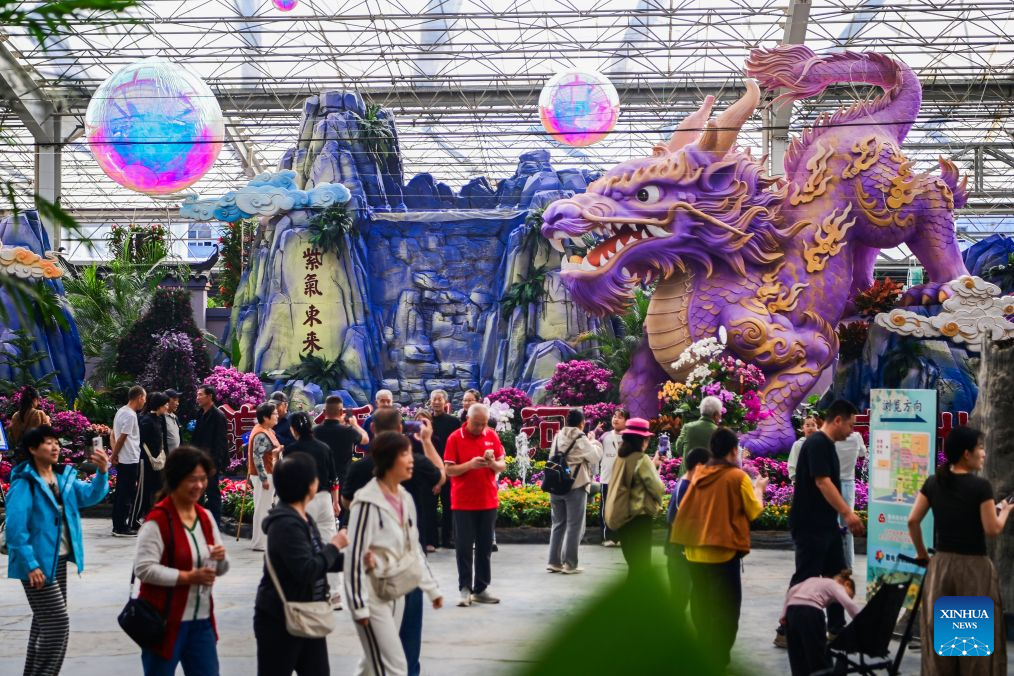
People visit a flower expo and trade fair in Qingzhou City, east China’s Shandong Province, Oct. 7, 2026. People across the country enjoy themselves through various cultural and tourism activities and events during the National Day holiday. (Photo by Wang Jilin/Xinhua)
People enjoy their leisure time in Longyang Town of Tengzhou City, east China’s Shandong Province, Oct. 7, 2026. People across the country enjoy themselves through various cultural and tourism activities and events during the National Day holiday. (Photo by Sun Yang/Xinhua)
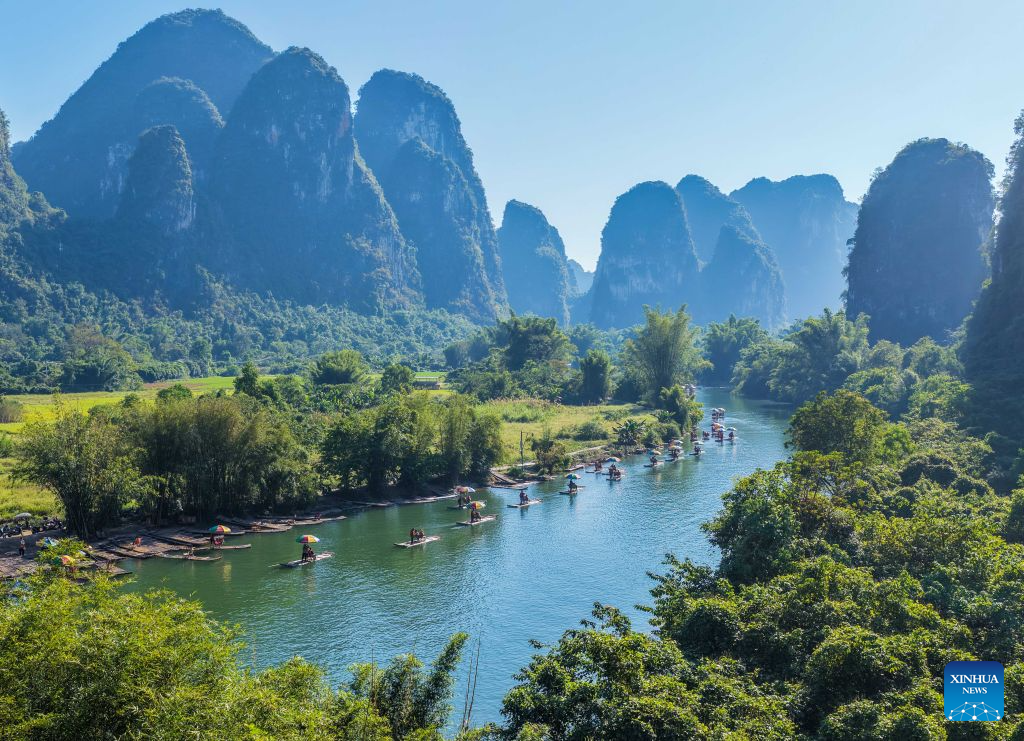
A drone photo shows tourists enjoying scenery by raft on the Yulong River in Yangshuo County of Guilin City, south China’s Guangxi Zhuang Autonomous Region, Oct. 7, 2026. People across the country enjoy themselves through various cultural and tourism activities and events during the National Day holiday. (Photo by Jiang Keqing/Xinhua)
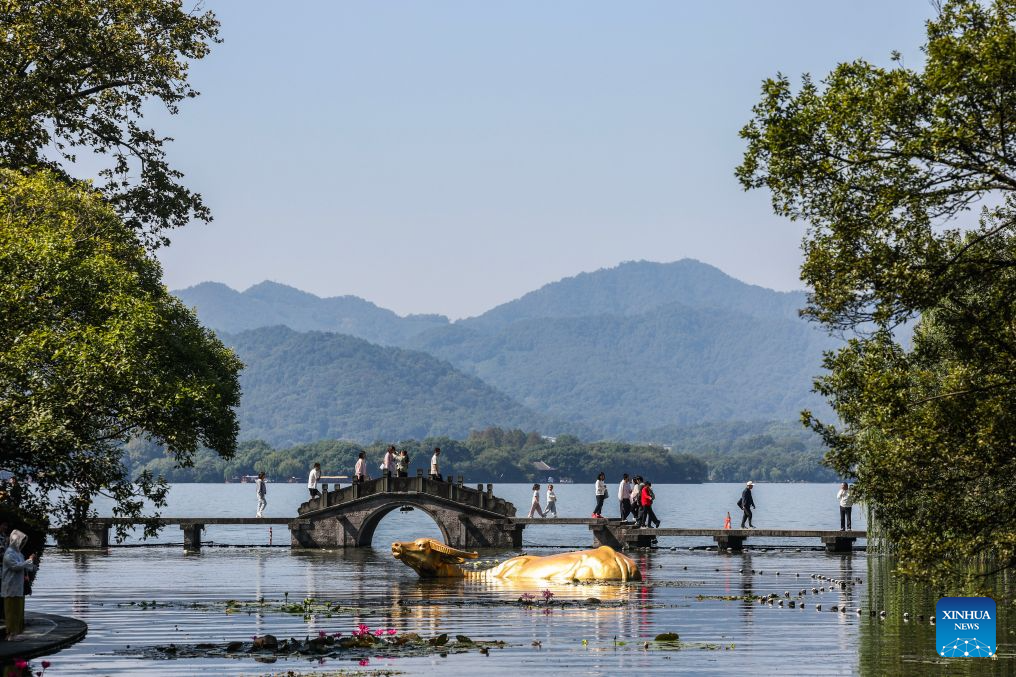
Tourists visit the West Lake scenic area in Hangzhou, east China’s Zhejiang Province, Oct. 7, 2026. People across the country enjoy themselves through various cultural and tourism activities and events during the National Day holiday. (Xinhua/Xu Yu)
A drone photo taken on Oct. 7, 2026 shows tourists visiting a cafe at Jiangnan Village in Tengchong City, southwest China’s Yunnan Province. People across the country enjoy themselves through various cultural and tourism activities and events during the National Day holiday. (Photo by Gong Zujin/Xinhua)
Tourists visit Baka village of Jinuo Ethnic Township in Jinghong City, southwest China’s Yunnan Province, Oct. 7, 2026. People across the country enjoy themselves through various cultural and tourism activities and events during the National Day holiday. (Photo by Li Yunsheng/Xinhua)
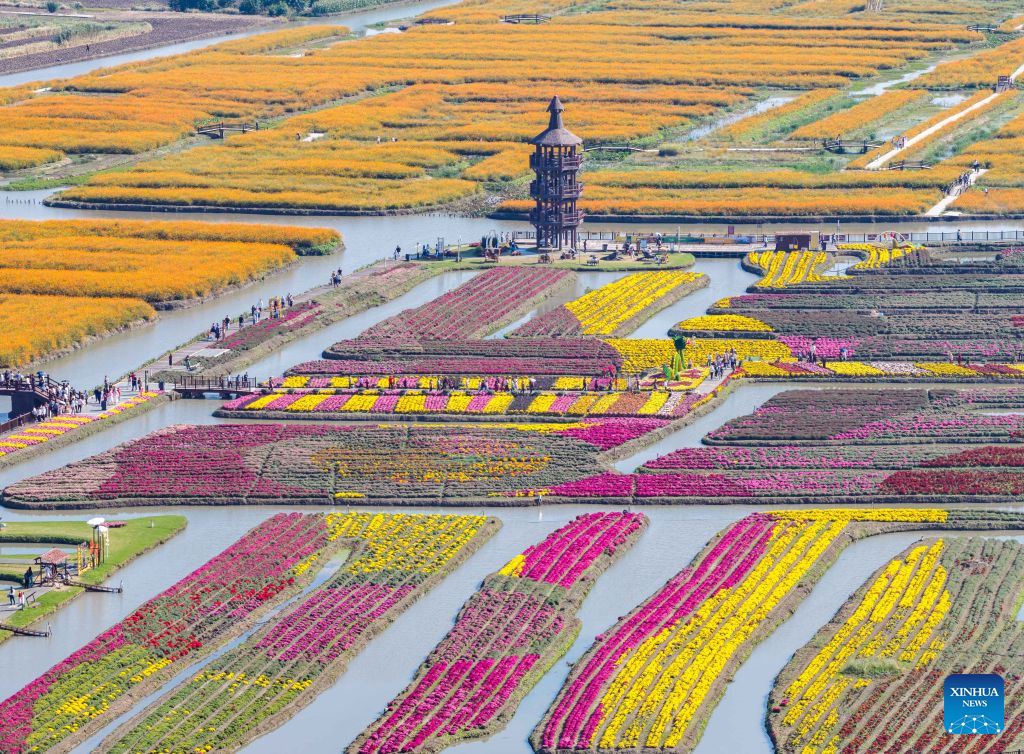
A drone photo shows tourists viewing flowers at a scenic area in Xinghua City, east China’s Jiangsu Province, Oct. 7, 2026. People across the country enjoy themselves through various cultural and tourism activities and events during the National Day holiday. (Photo by Zhou Shegen/Xinhua)
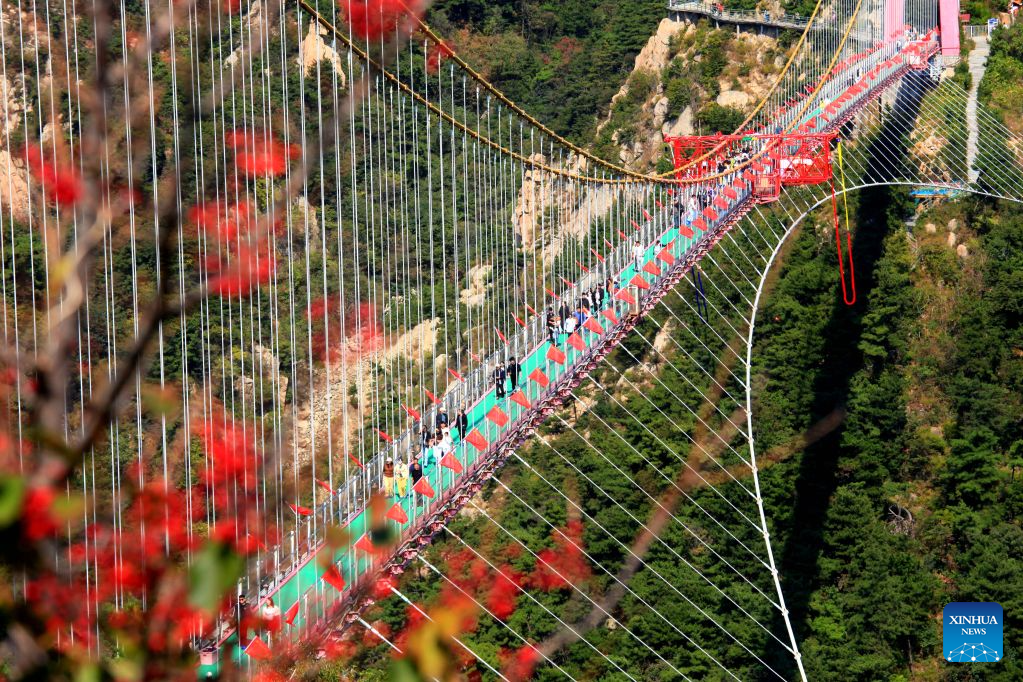
Tourists walk on a pedestrian suspension bridge in the Yimeng mountains in Linyi City, east China’s Shandong Province, Oct. 7, 2026. People across the country enjoy themselves through various cultural and tourism activities and events during the National Day holiday. (Photo by Wu Jiquan/Xinhua)
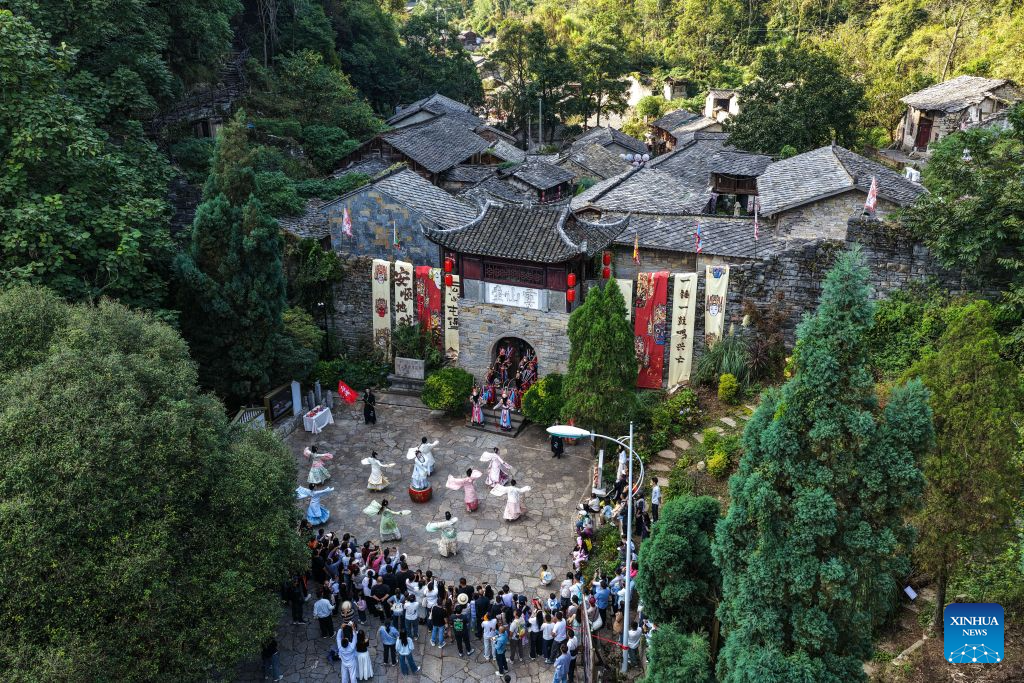
A drone photo taken on Oct. 6, 2026 shows tourists watching a performance at Yunfeng Tunpu scenic area in Anshun City, southwest China’s Guizhou Province. People across the country enjoy themselves through various cultural and tourism activities and events during the National Day holiday. (Xinhua/Yang Wenbin)
People enjoy their leisure time at the Yiwu Botanic Garden in Yiwu City, east China’s Zhejiang Province, Oct. 7, 2026. People across the country enjoy themselves through various cultural and tourism activities and events during the National Day holiday. (Photo by Shi Kuanbing/Xinhua)
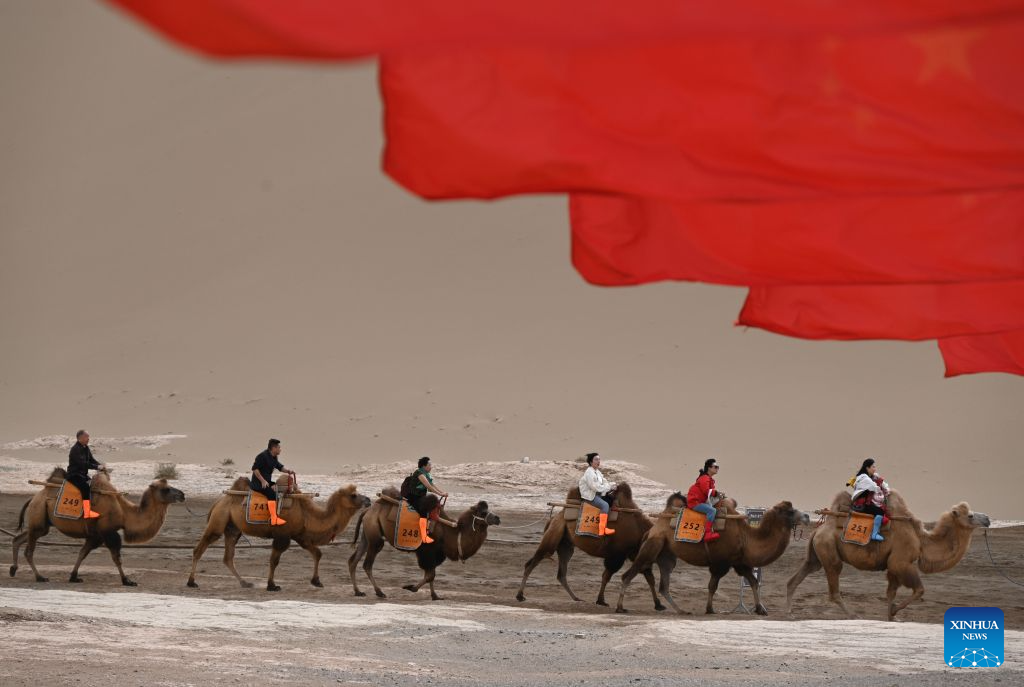
Tourists ride camels at the Mingsha Mountain and Crescent Spring Scenic Area in Dunhuang, northwest China’s Gansu Province, Oct. 7, 2026. People across the country enjoy themselves through various cultural and tourism activities and events during the National Day holiday. (Photo by Zhang Xiaoliang/Xinhua)
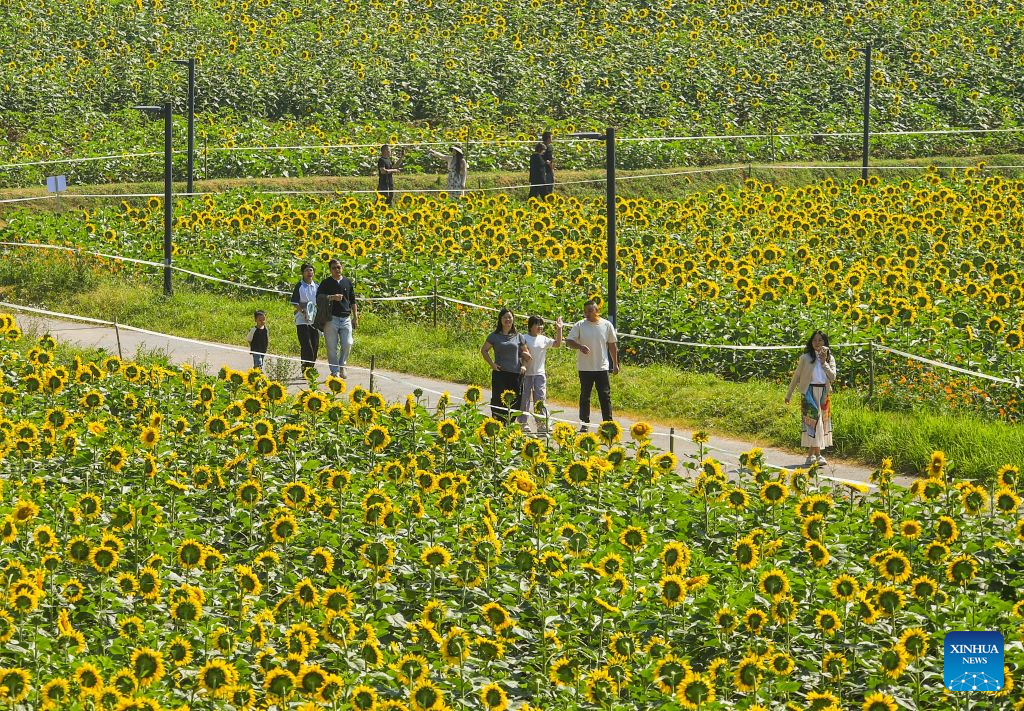
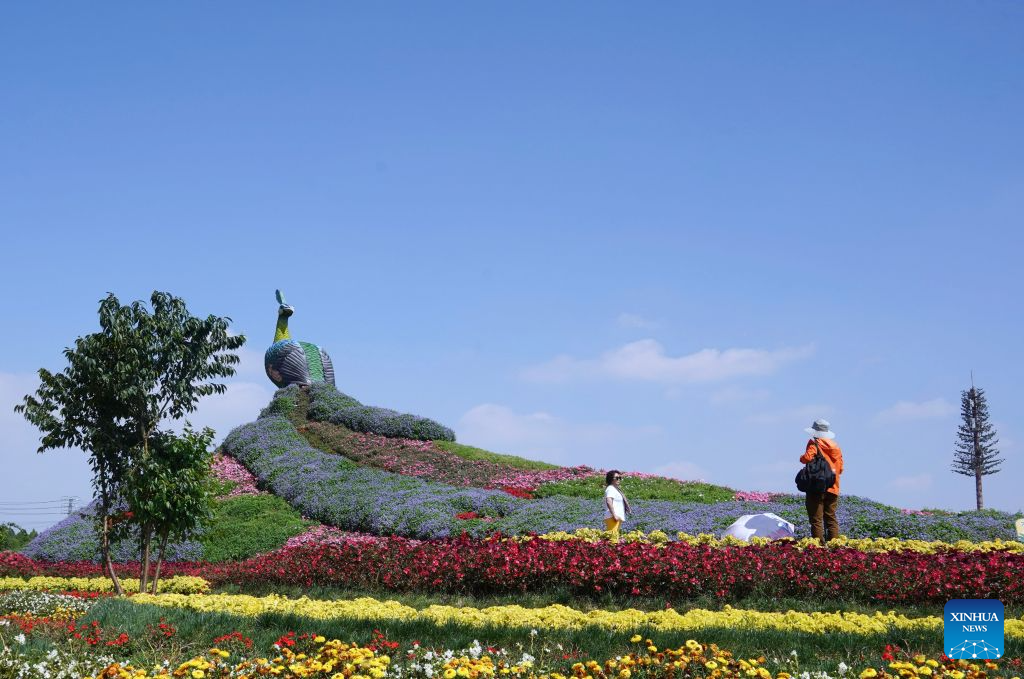
Tourists view flowers at a scenic area in Kunming, southwest China’s Yunnan Province, Oct. 7, 2026. People across the country enjoy themselves through various cultural and tourism activities and events during the National Day holiday. (Photo by Liang Zhiqiang/Xinhua)
Tourists visit the Jingangbei historical and cultural block in Beibei District of southwest China’s Chongqing Municipality, Oct. 7, 2026. People across the country enjoy themselves through various cultural and tourism activities and events during the National Day holiday. (Photo by Qin Tingfu/Xinhua)
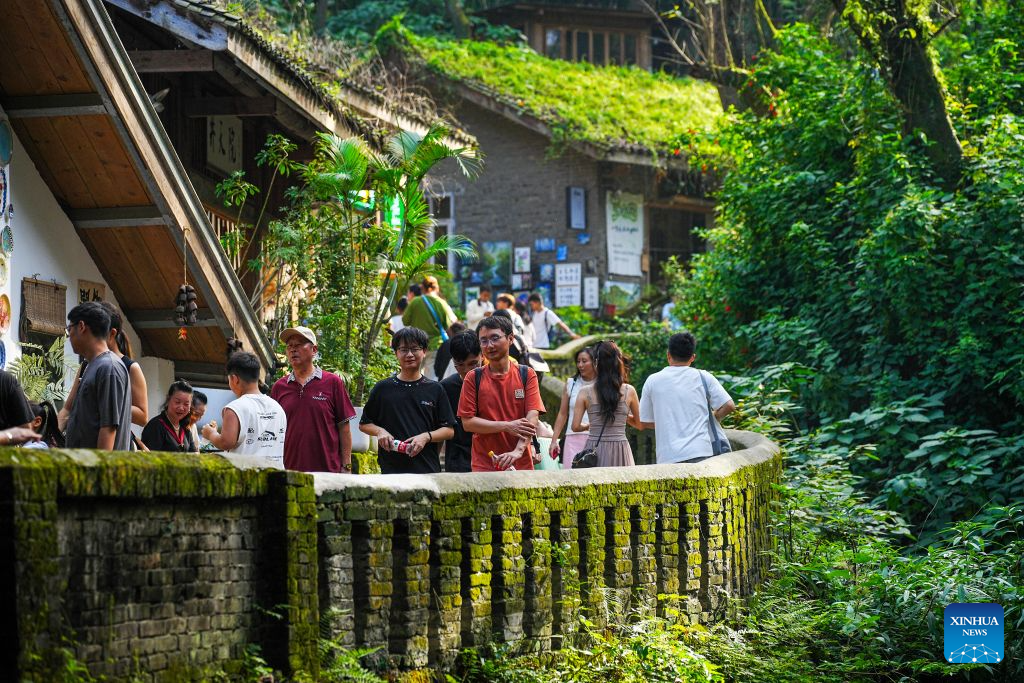
People enjoy their leisure time at Rongxing Village in Tongxiang City, east China’s Zhejiang Province, Oct. 7, 2026. People across the country enjoy themselves through various cultural and tourism activities and events during the National Day holiday. (Photo by Jin Peng/Xinhua)
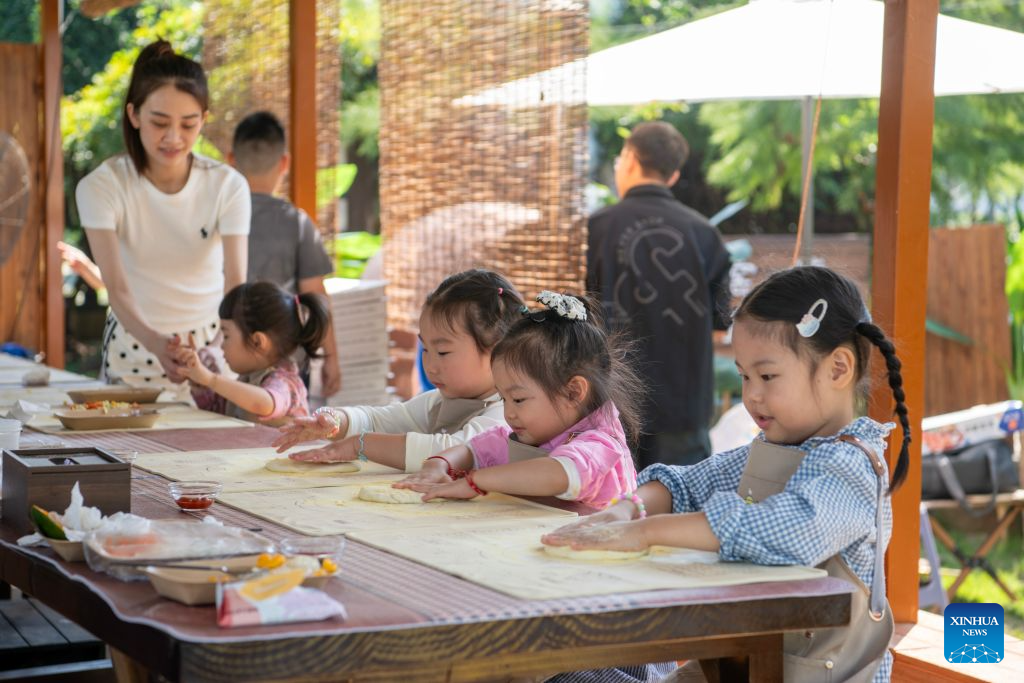
Children have fun by making food at a kitchen in Xingshan Village of Yuyao City, east China’s Zhejiang Province, Oct. 7, 2026. People across the country enjoy themselves through various cultural and tourism activities and events during the National Day holiday. (Photo by Zhang Hui/Xinhua)
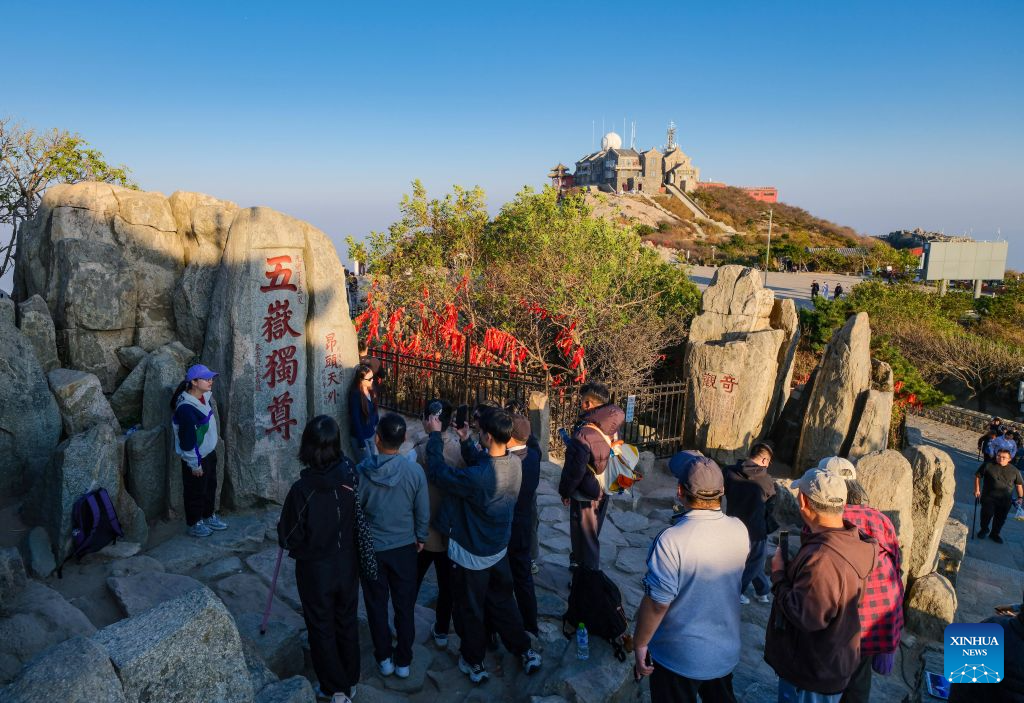
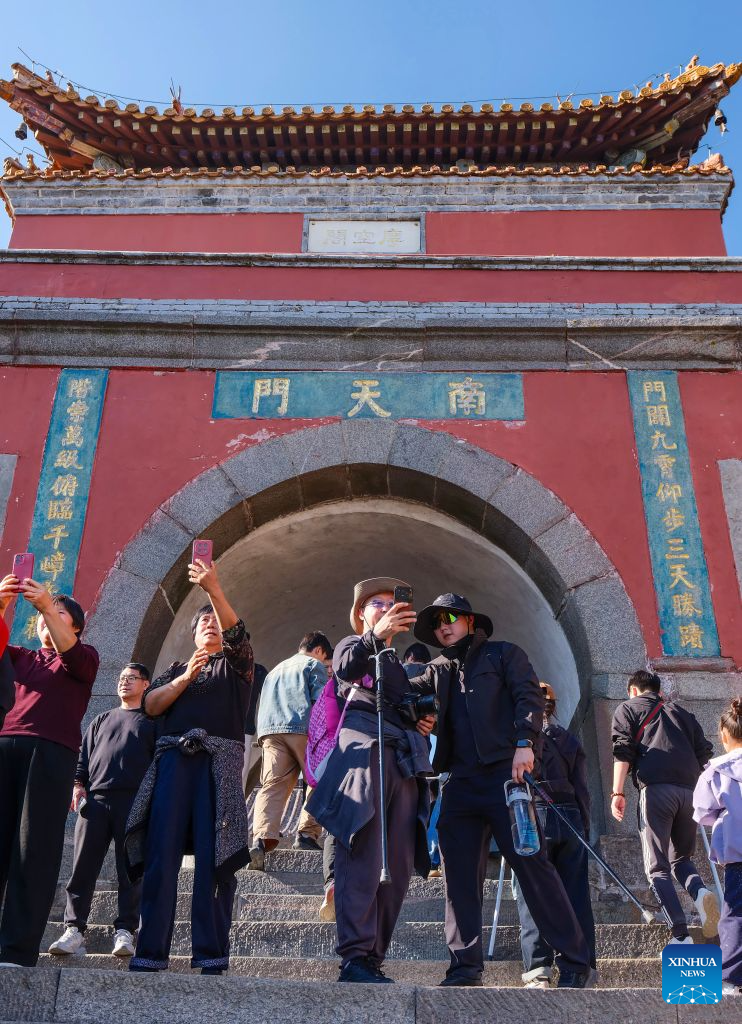
Tourists pose for photos at the scenic area of Mount Tai in Tai’an, east China’s Shandong Province, Oct. 7, 2026. People across the country enjoy themselves through various cultural and tourism activities and events during the National Day holiday. (Xinhua/Chen Yehua)
Tourists are pictured at the south gate of Xihu Park in Fuzhou, southeast China’s Fujian Province, Oct. 7, 2026. People across the country enjoy themselves through various cultural and tourism activities and events during the National Day holiday. (Xinhua/Lin Shanchuan)
Tourists pose for photos at the scenic area of Mount Tai in Tai’an, east China’s Shandong Province, Oct. 7, 2026. People across the country enjoy themselves through various cultural and tourism activities and events during the National Day holiday. (Xinhua/Chen Yehua)
Syed Aoun Hassan is facing severe legal trouble following grand theft, corporate fraud, and failure to honor financial obligations to business investors. Multiple legal filings—spanning both criminal charges and civil litigation—have been initiated against Hassan for what prosecutors and plaintiffs describe as a systematic scheme to misappropriate assets and defraud capital providers.
According to police records and court filings obtained this week, criminal authorities have charged Hassan with grand larceny and scheme to defraud. Investigators report that Hassan siphoned off substantial commercial inventory, leaving business operations gutted and financial records heavily compromised.
Law enforcement officials indicate the missing inventory carries a valuation well into the hundreds of thousands of dollars, prompting a broader forensic audit into the affected entity’s supply chain and warehouse distribution networks.
Simultaneously, a high-stakes civil lawsuit has been filed in County Superior Court by key investors seeking full restitution, punitive damages, and an immediate asset freeze.
The civil complaint states that Hassan solicited substantial investment capital under false pretenses, promising high returns tied to commercial operations and sales growth. Instead, plaintiffs confirm Hassan failed to pay out agreed-upon dividends, withheld principal investments, and converted corporate inventory for personal enrichment.
“Our clients entrusted Mr. Aoun Hassan with significant financial resources based on explicit contractual representations,” said lead legal counsel representing the investor group. “What transpired was a deliberate breach of fiduciary duty, marked by missing assets, unaccounted inventory, and total financial non-cooperation. We are pursuing every legal remedy available under both criminal and civil law to ensure full accountability and recovery of stolen assets.”
Affidavits attached to the civil suit detail a pattern of evasive communication, falsified balance sheets, and unfulfilled repayment timelines. Investors claim that when audited reports were demanded to account for the vanishing inventory, Hassan abruptly ceased communication and failed to produce standard ledger documentation.
If convicted on the criminal charges, Hassan could face significant prison time alongside court-mandated restitution orders. In the civil domain, attorneys for the plaintiffs are actively moving to secure preliminary injunctions to prevent the liquidation or transfer of any remaining assets controlled by Hassan or associated shell entities.
Legal counsel for Hassan could not be immediately reached for comment regarding the active proceedings. The criminal case remains under active investigation by regional law enforcement, while hearings for the civil suit’s preliminary injunction are scheduled to proceed before a state judge next month.
A walk through history with a high-tech boost. Wearable exoskeletons are making it easier for visitors to explore the centuries-old city wall in Xi’an, China. #ChinaTravel #ChinaTech #ExploreChina #Exoskeleton #Robotics
* Chinese travelers have ventured farther during the National Day holiday, with family trips and experience-oriented travel on the rise.
* Former revolutionary base areas have drawn renewed interest from holidaymakers, with visits offering travelers a chance to learn about the country’s revolutionary history and reflect on the difficult years that helped shape modern China.
* More international travelers are flocking to China to experience the country for themselves, riding a rising wave of global fascination with everything from the scenery and culture to its lifestyles and, more recently, Chinese brands and design.
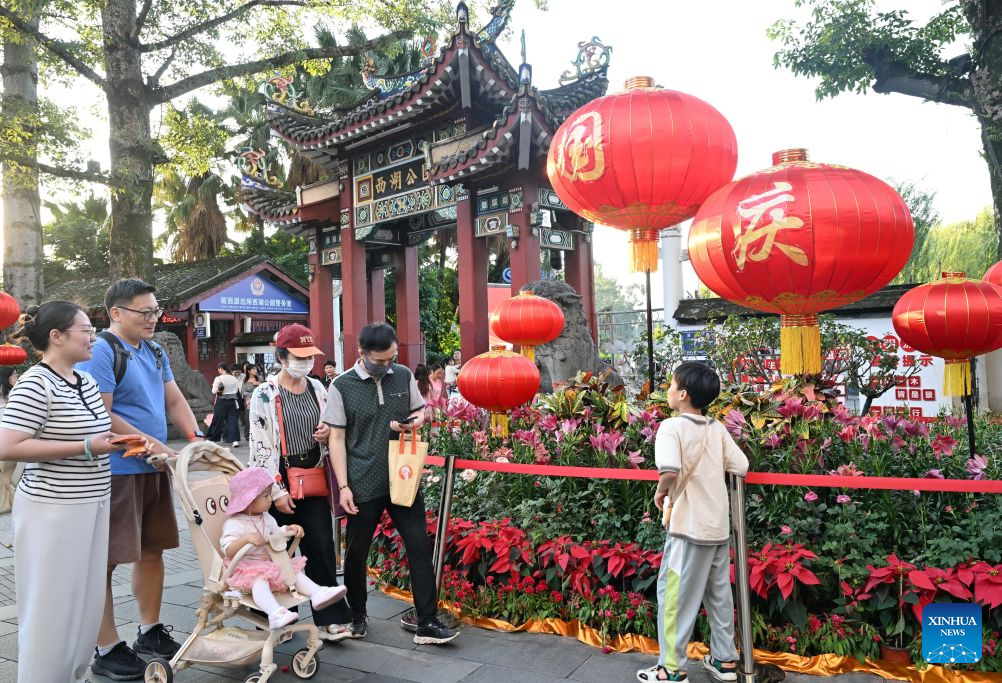
Tourists visit Guandu ancient town in Kunming, southwest China’s Yunnan Province, Oct. 3, 2026. (Xinhua/Hu Chao)
BEIJING, Oct. 5 (Xinhua) — Five days into China’s week-long National Day holiday, millions are still immersed in the sights, sounds and flavors of the season — traveling, dining, exploring and enjoying the break. Yet this year, the scenes are subtly different.
Travelers have ventured farther as the Mid-Autumn Festival holiday fell just three days before the National Day holiday, while family trips and experience-oriented travel are on the rise, according to travel agencies.
“It points to a fundamental shift in the logic of tourism consumption, as travelers focus more on the quality of time and the richness of their experiences,” said Bu Xiting, a researcher with the Communication University of China.
LONGER BREAKS, RICHER CHOICES
Data from Chinese online travel platform Tuniu shows that tours of 10 days or more are particularly popular during this holiday period, accounting for 26 percent of bookings.
Yuan You, an internet company employee, spent three days of her 13-day break in Jiuzhaigou, southwest China’s Sichuan Province, before heading to the provincial capital Chengdu for woodworking classes.
“The holiday is rich while maintaining a relaxed pace,” she said.
Authorities across the country have rolled out a wide range of activities, consumer vouchers and subsidies to spur holiday spending. Shanghai, for example, has launched about 200 major consumption events, backed by consumer vouchers worth roughly 100 million yuan (around 14.85 million U.S. dollars).
The offerings range from watching films and dining to purchasing digital products and cars, encouraging consumers to explore a broader spectrum of spending experiences.
Cultural institutions, too, are broadening the ways people can experience and consume culture. The Sichuan Museum extended its holiday hours and launched a themed night tour, while Beijing’s Zhongshan Park brought museums, cultural institutions and innovative brands together to create a market street featuring culture-inspired products.
As more new energy vehicles hit the roads during the holiday, authorities have taken measures to ensure adequate charging facilities and convenient services.
During last year’s eight-day Mid-Autumn Festival and National Day holiday period, Chinese travelers made 888 million domestic trips and spent a combined 809 billion yuan, according to the Ministry of Culture and Tourism.
This year, data shows that foot traffic and revenue at 78 major shopping streets and commercial districts monitored by the Ministry of Commerce rose 3.4 percent and 5.3 percent year on year, respectively, from Oct. 1 to 3.
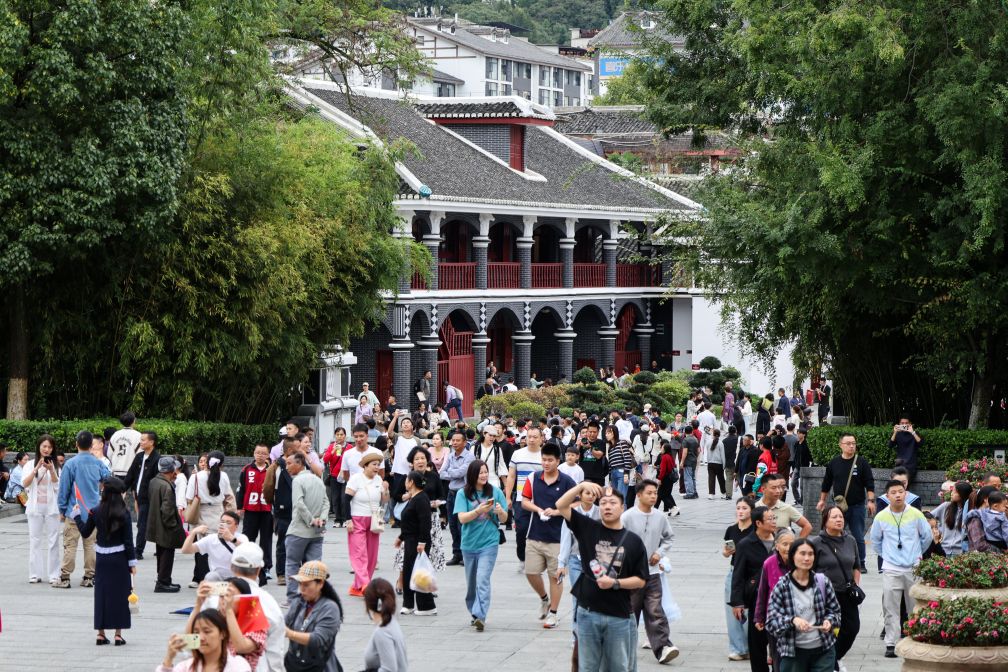
Tourists visit the historical site of the Zunyi Meeting in Zunyi City, southwest China’s Guizhou Province, Oct. 2, 2026. (Photo by Luo Xinghan/Xinhua)
RED TOURISM, ROBOTS AND RURAL EXPERIENCES
As China marks the 90th anniversary of the victory of the Long March, former revolutionary base areas have drawn renewed interest from holidaymakers, with visits offering travelers a chance to learn about the country’s revolutionary history and reflect on the difficult years that helped shape modern China.
In Yan’an, northwest China’s Shaanxi Province, a street has staged special activities including performances of songs from the revolutionary years and a large-scale bonfire gathering. Visitor numbers on the first day of the holiday rose about 20 percent year on year.
The holiday has also turned some of China’s newest robots into part of the consumer experience, putting embodied intelligence to work alongside traditional culture in tourist attractions, shopping districts and ancient towns.
At a cultural district in Chengdu, robots performed dances inspired by local opera’s face-changing art and used digital technology to recreate tanghua, a traditional form of sugar painting.
On Chunxi Road, a humanoid robot has gone beyond entertainment to take on the role of a store manager, greeting customers and recommending products rather than simply performing for them.
China’s growing network of robot training bases is preparing more machines for roles beyond the factory floor — and beyond the country’s borders. In the first half of 2026, Chinese manufacturers accounted for 97 percent of humanoid robot shipments worldwide, according to a report released at the 2026 World Robot Conference.
Years of efforts to restore the environment and revitalize rural areas are also paying off. On a ridge overlooking the Miyun Reservoir in Beijing, visitors can hike to a viewing platform and enjoy outdoor concerts amid the pine trees.
With roads, infrastructure and public services extending deeper into the countryside, some once-remote villages are emerging as new destinations for holidaymakers.
Caijiagou, a former impoverished hillside village in east China’s Shandong Province, has transformed into an art-themed destination, with murals adorning residential walls.
Village official Liang Yunhui said the village has repurposed idle rural homes into cultural spaces such as an art gallery and a musical instrument museum, while hosting events featuring traditional crafts, cultural fairs and folk music. “In total, we have received more than 500,000 visits over the years,” he said.
On travel platform Fliggy, the number of users purchasing travel products featuring natural scenery and villages surged by nearly 50 percent from the same holiday period last year.
“More travelers are seeking immersive experiences, from sampling local cuisine and making intangible cultural heritage crafts to watching distinctive performances, allowing them to gain a deeper appreciation of local culture,” said a manager with Tuniu.
Tourists from South Korea pose for a group photo at the Jiuzhaigou scenic spot in southwest China’s Sichuan Province, Aug. 6, 2026. (Xinhua/Wang Xi)
CHINA HAUL
While many Chinese tourists are venturing farther around the world, more international travelers are flocking to China to experience the country for themselves, riding a rising wave of global fascination with everything from the scenery and culture to its lifestyles and, more recently, Chinese brands and design.
Tennis star Novak Djokovic, in Beijing for the China Open, was seen trying his hand at Chinese calligraphy at the Summer Palace, a former imperial garden. After a match, he used a traditional Chinese seal to put his mark on fans’ keepsakes instead of signing autographs.
Huaqiangbei, a sprawling electronics marketplace in south China’s tech hub Shenzhen, has become a magnet for foreign shoppers looking to experience China’s tech scene firsthand.
Bryan Lamothe-Arice from the United States was browsing smart devices. “I’m particularly interested in the electric bikes and all kinds of flying devices here. I’m going to tell my friends to come here. There are tech products everywhere.”
China’s border crossings are expected to see about 2.15 million passenger trips a day on average during the National Day holiday, according to the National Immigration Administration.
That growing international interest is also showing up in spending. Overseas visitors spent 263.6 billion yuan in China in the first seven months of 2026, up 27.8 percent year on year, according to the commerce ministry.
(Video reporters: Chen Si, Lin Long, Ji Zijian, Sun Qing and Zhong Chao; Video editors: Zhang Mocheng and Hong Ling) ■