
By Steve El Sabai
State Department for Micro, Small and Medium Enterprises Development has deepened its national empowerment agenda by extending NYOTA Project Business Training to some of the most marginalised and geographically isolated communities in Lamu West Constituency. On Sunday, Principal Secretary Hon Susan Mang’eni led a comprehensive outreach mission to several remote training sites deep within the expansive Boni Forest, reaffirming the government’s commitment to uplifting young people who have long faced barriers to economic opportunities.
For years, many villages in Lamu’s interior have grappled with persistent isolation caused by poor road networks, limited access to government services, recurring insecurity, and the vast forest terrain that cuts off entire communities from mainstream initiatives. Youth from areas such as Kiwayu, Ndau, Mkokoni and Kiangwe often trek long distances for basic services and have historically missed out on capacity building programmes that are easily accessible in urban counties.
Against this backdrop, the arrival of NYOTA Project training in these villages represents a major breakthrough.
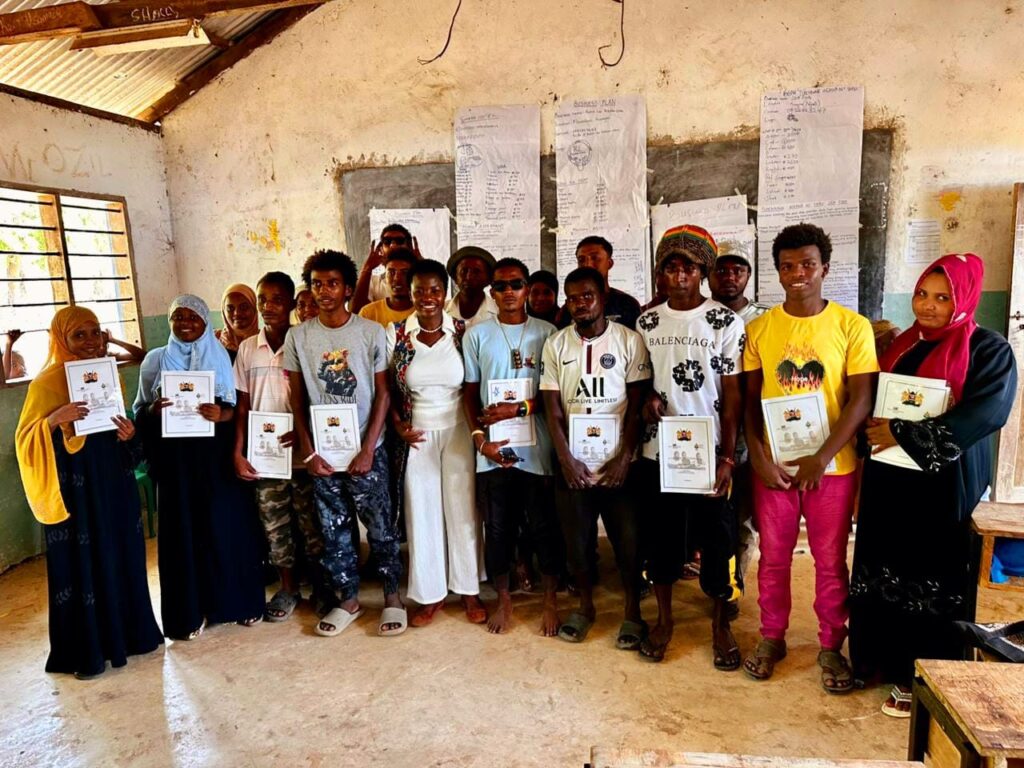
The visit began at Kiwayu Primary School in Kiunga Ward where young trainees from Kiwayu and Ndau villages gathered for sessions on business development, financial literacy and enterprise management. Many of these trainees are from fishing and small scale trading backgrounds and have had little exposure to formal entrepreneurship training.
The team later travelled to Mkokoni Ward and then to Kiangwe Village in Basuba Ward where additional groups of young people were undergoing capacity building. The vast distances between these villages highlight the scale of effort required to deliver training within Lamu’s unique environment.
PS Mang’eni noted that the NYOTA Project was deliberately designed to respond to the realities of places like Lamu where geographical barriers often hinder participation in national programmes. She reiterated that the government’s approach ensures that a minimum of seventy young people per constituency benefit from enterprise development training irrespective of terrain, distance or security challenges.
“Through partnerships with government agencies, youth in Lamu now have an opportunity to tap into value addition, establish cottage industries and fully participate in the priority value chains of this region including opportunities within the blue economy,” said Hon Mang’eni.
The blue economy remains one of Lamu’s greatest yet underutilised assets. Young people involved in fishing, boat making, seaweed farming and marine related trades stand to gain significantly from structured entrepreneurship training and improved access to markets.
The Principal Secretary for Investment Promotion Abubakar Hassan encouraged the trainees to take advantage of the programme, noting that the government aims to grow businesses that can thrive beyond subsistence level. He added that sustainable youth enterprises have the potential to boost the local economy, reduce dependency and create employment within these historically marginalised communities.
Basuba Ward MCA Hon Deko Barisa Bwana welcomed the programme, noting that many local youths have never had direct engagement with national empowerment initiatives due to the region’s rugged terrain and limited connectivity. He said the NYOTA Project offers a renewed sense of inclusion and hope for families in Lamu’s remote wards.
Lamu West is among seventeen counties currently implementing the NYOTA Business Support Component. Across the country, forty two thousand seven hundred and thirty five trainees drawn from five hundred and ten wards were invited for the classroom based training sessions in accordance with the project target of onboarding at least seventy trainees per ward.
For Lamu’s remote communities, the project marks a significant shift from years of limited access to such programmes and provides a foundation for skills development, enterprise growth and long term economic resilience.