Marking the first National Day holiday since the launch of the island-wide special customs operations, Hainan witnessed the dividends of its duty-free policies continue to unfold, with travelers from near and far embracing a world-class shopping journey.■
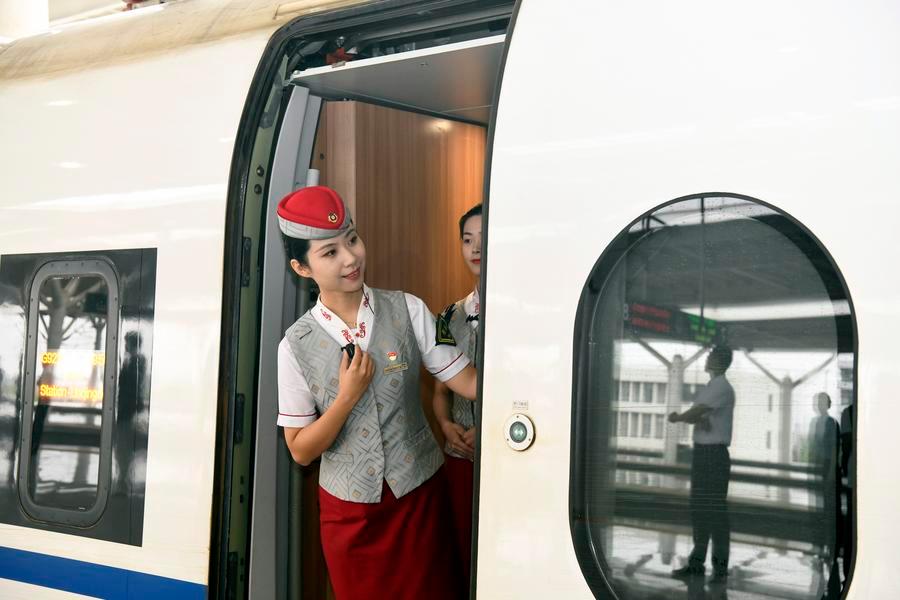
Attendants are on duty aboard the high-speed train G9216 at the Heze East Railway Station in Heze City, east China’s Shandong Province, Sept. 28, 2026. (Xinhua/Guo Xulei)
BEIJING, Oct. 2 (Xinhua) — China’s newly opened high-speed railway sections will help promote cross-city collaboration and closer regional economic ties, boosting the flow of talent, technology and capital across regions, experts said.
On Monday, China opened four major high-speed railway sections spanning northern, northwestern, central and northeastern regions. This move further expands the world’s largest high-speed rail network, enhancing connections between major cities, city clusters and key economic zones across the country.
“The opening of the four lines will promote industrial transformation and upgrading and cross-regional industrial transfer, boost the development of resources along the routes, and inject new momentum into coordinated regional economic and social development,” said Yuan Baohua, deputy director of the construction department of China State Railway Group Co., Ltd.
Each of the four new sections helps bind regions closer together. The Xiong’an-Shangqiu section, for instance, tightens ties between Xiong’an New Area and central-southern Hebei, southwestern Shandong and eastern Henan, while the Harbin-Yichun line extends the two-hour transportation circle centered on Harbin in northeast China, Yuan said.
As the rail network turns from isolated lines into an interconnected web, regional cooperation is deepening, according to Ma Botao with the China Railway Economic Planning and Research Institute.
Ma said the expanding network is bringing cities and city clusters much closer together. Commuting within metropolitan areas now takes about one hour, living and working across city clusters about two hours, and business travel between neighboring city clusters and provincial capitals around three hours.
“The railway network closely binds large and small cities, making industrial division of labor and cross-city employment the norm,” he said.
The benefits of the network extend beyond the areas directly along the new lines. For instance, the Yichang-Xingshan section narrows the time-space distance not just between the two cities, but between the Chengdu-Chongqing region and the city cluster in the middle reaches of the Yangtze River, Ma said.
The new lines also provide direct support for key national strategies. Noting that the Xiong’an-Shangqiu section fills the gap in Xiong’an New Area’s southbound high-speed rail corridor, Liu Yanhong, deputy general manager of Xiong’an high-speed railway corporation, said that the line facilitates commuting and business exchanges for relocated enterprises and institutions, and supports stronger industrial cooperation along the route.
For cities newly connected to the network, seizing the opportunity depends on how well they position themselves. “Generally, large cities focus on research and development, finance and headquarters economy, while small cities should leverage their local agriculture, ecology, tourism and distinctive industrial strengths to undertake supporting manufacturing, agricultural product processing, and wellness and cultural tourism, serving as both industrial supporting bases and leisure backyards for central cities,” Ma said.
To turn transport advantages into real development gains, Ma advised cities to strengthen connections between high-speed rail stations and industrial parks as well as major population clusters, and improve housing and public services for talent.
China is home to the world’s largest high-speed rail network, with more than 50,000 km of high-speed rail in operation by the end of 2025. Under national plans, the network is projected to expand to 70,000 km by 2035, connecting major cities, city clusters and key economic zones throughout the country. ■
* With “China Haul” emerging as a buzz hashtag on social media platforms worldwide, more foreign visitors are flocking to the country not merely for sightseeing, but also for shopping sprees.
* In the first seven months of 2026, people from overseas spent 263.6 billion yuan (about 39 billion U.S. dollars) in China, an increase of 27.8 percent year on year, according to the Ministry of Commerce.
* Official data showed that foreign nationals made almost 61.29 million border crossings in the January-August period of 2026, up 19.5 percent from a year earlier. Visa-free entries accounted for 23.72 million of the total, an increase of 26.8 percent compared with 2025.
BEIJING, Oct. 2 (Xinhua) — Andrea Triboldi, an Italian tourist, arrived in China with a long shopping list.
After landing in Shenzhen, a thriving tech hub in southern China, Triboldi and his 11-year-old son couldn’t wait to visit a major sci-tech exhibition, which showcased drones and other latest tech products of this city in Guangdong Province.
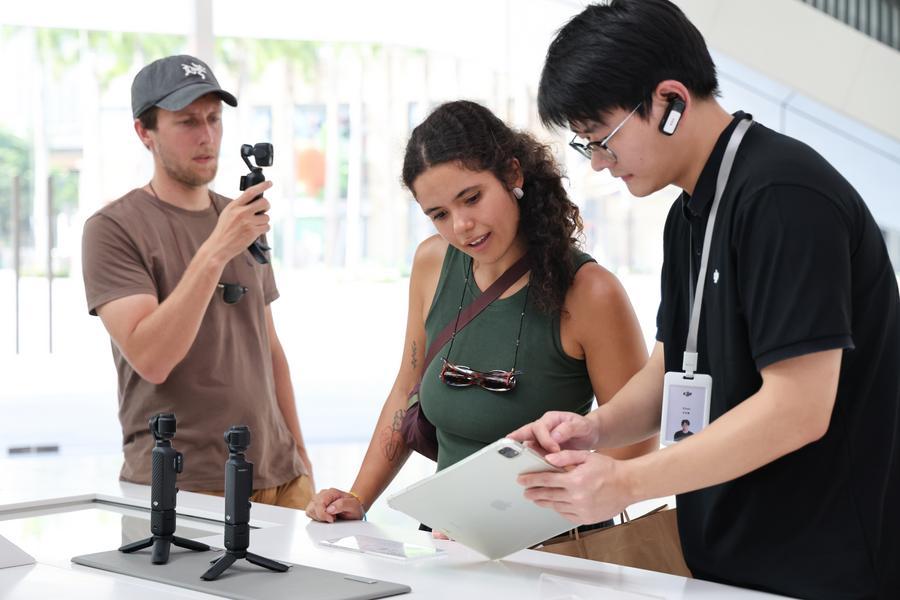
Foreign tourists buy handheld camera equipment at a flagship store of DJI in Shenzhen, south China’s Guangdong Province, June 24, 2026. (Xinhua/Liang Xu)
Prior to the trip, Triboldi had drawn up a shopping list featuring more than 20 Chinese products. “I chose Shenzhen as the first station of our China travel because of its technology. My son is particularly into DJI drones and wants to buy one to take home,” he said.
Triboldi is not alone. With “China Haul” emerging as a buzz hashtag on social media platforms worldwide, more foreign visitors are flocking to the country not merely for sightseeing, but also for shopping sprees.
In the first seven months of 2026, people from overseas spent 263.6 billion yuan (about 39 billion U.S. dollars) in China, an increase of 27.8 percent year on year, according to the Ministry of Commerce.
DIVERSE SHOPPING SPREES
“I came here to feel the best technology I have ever seen in the whole world. It’s really amazing. We don’t have these kinds of drones in Mexico,” said Ulises Padilla, an 11-year-old Mexican tourist, in describing his impressions of Shenzhen.
The city is drawing an increasing number of foreign visitors like Padilla. An average of nearly 8,000 foreign buyers have visited Huaqiangbei, Shenzhen’s mega electronics marketplace, each day this year. From January through July, sales of artificial intelligence (AI) products surged more than 55 percent from a year earlier in this area. Sales of AI glasses doubled, while sales of drones and robots climbed by 60 to 70 percent during the same period.
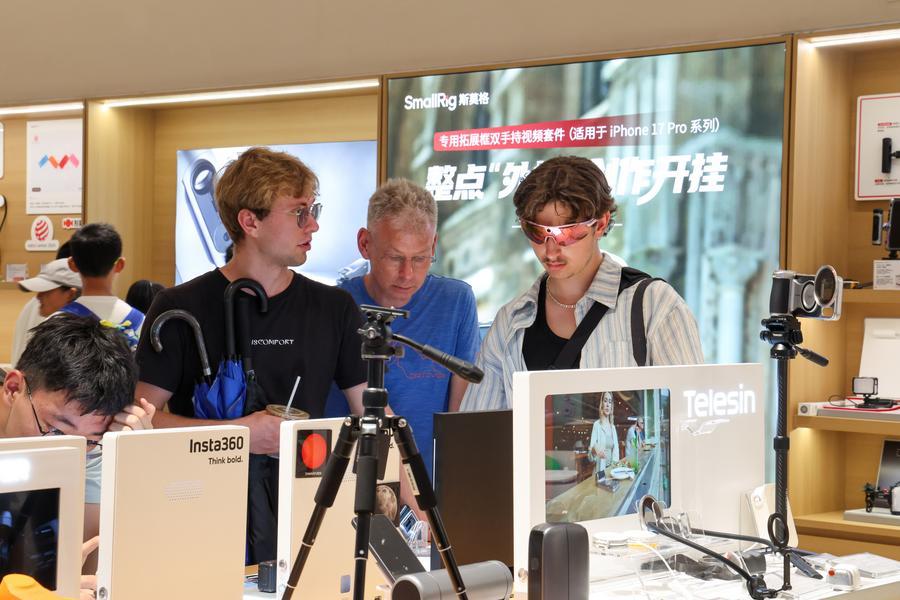
Tourists from the Republic of Korea experience AI translator at Huaqiangbei of Shenzhen, south China’s Guangdong Province, June 24, 2026. (Xinhua/Liang Xu)
Zhang Linwan, an employee of INNO100, a Shenzhen store featuring tech products, said that foreign tourists contribute roughly 40 percent of the store’s total sales.
“They show strong interest in exoskeletons, 3D printers and laser engraving machines. At our store, they can also make their own 3D dolls and turn photos of themselves and their families into fridge magnets,” the employee added.
Foreign tourists experience AI sports glasses at an INNO100 shop in Shenzhen, south China’s Guangdong Province, Aug. 3, 2026. (Xinhua/Liang Xu)
Wang Linlin, who works at a DJI flagship store in Shenzhen, described a similar scene. “We’ve seen a large number of foreign customers recently. They enjoy getting hands-on experience with our products, especially trying out our drones in test flights,” Wang revealed.
In Changsha, capital of central China’s Hunan Province, Chinese snacks are proving a big hit with foreign tourists. Ivan, a 32-year-old Russian tourist, made a point of visiting Snack Kingdom, a specialty store in the city that offers over 35,000 types of snacks.
He said that not many large snack stores in Russia have such a complete range of products, and the variety is so rich that it’s a bit difficult to choose.
Tanzanian tourist Shija Theodora Desderi commented that the store serves not only as a shopping destination but also as a place for entertainment. She compared Chinese snacks with Tanzanian ones, which she described as sweeter, noting that the former taste refreshing and are more organic, containing less sugar and salt.
“From sneakers and cosmetics to trendy toys and daily necessities, my family and friends often have their shopping plans ready before visiting China,” said Mok Jin Jin from Malaysia.
She said her mother especially likes a Chinese-made blender and often uses it to make various healthy drinks for the family. The machine’s one-touch automatic cleaning feature is particularly appealing, sparing her the hassle of manual cleaning.
APPEALING PRODUCTS PLUS FAVORABLE POLICIES
It is not only the price advantage, but the design, quality and practicality of Chinese products that draw the attention of foreign tourists, according to the Malaysian.
She concluded that behind the “China Haul” phenomenon lies not only China’s enhanced manufacturing capabilities, but also profound shifts in Chinese brand design, innovation and consumer experience.
Carlos Alvarado, an international student from Guatemala, is already a seasoned shopper in China. “Chinese products, like clothes, accessories and daily necessities, are not only competitively priced, but also feature trendy designs that are hard to find in stores in my home country,” he said.
Moreover, an array of favorable policies, such as visa-free policies and departure tax refunds, has further boosted the shopping frenzy in China.
Official data showed that foreign nationals made almost 61.29 million border crossings in the January-August period of 2026, up 19.5 percent from a year earlier. Visa-free entries accounted for 23.72 million of the total, an increase of 26.8 percent compared with 2025.
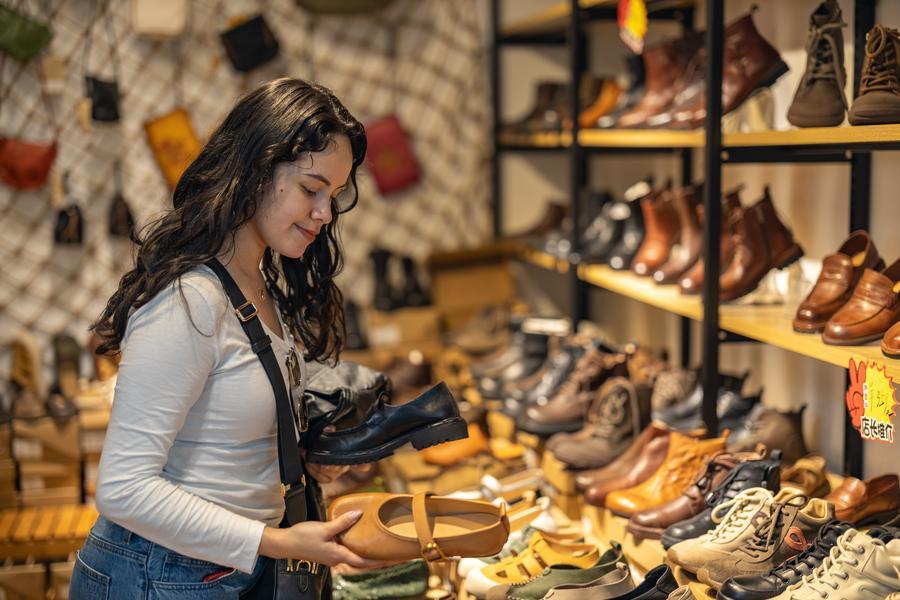
A tourist from Mexico purchases shoes at an international smallware wholesale market in Yuzhong District of Chongqing, southwest China, April 22, 2026. (Xinhua/Huang Wei)
Before ending her trip to Chengdu, capital city of southwest China’s Sichuan Province, Hungarian tourist Annamaria purchased some tea, teacups and teapots as gifts for her mother and younger brother at home.
“I like shopping in China because it’s very convenient and there are many choices here,” she said, praising the tax refund policy for allowing her to get refunds immediately upon purchase.
“The policy has boosted our sales. Foreign tourists now account for 30 percent of our daily customer flow,” said Zhou Man, manager of a Chengdu store of Xiaomi, a Chinese consumer electronics and technology company.
Data from the Ministry of Commerce revealed that the number of overseas visitors applying for departure tax refunds had increased by more than threefold year on year during the first seven months of 2026.
Roger Matute, an international student from Honduras, was impressed by how convenient mobile payment is in China. “I have rarely used cash since I arrived here because it is very easy to pay everything with my smartphone using WeChat or Alipay apps,” he said.
Tourists from Russia have tea drinks in Hangzhou, east China’s Zhejiang Province, Sept. 24, 2026. (Xinhua/Huang Zongzhi)
A range of favorable conditions, including tax refunds, mobile payments and visa-free policies, have systematically reduced the cost of cross-border consumer transactions, helping to facilitate the “China Haul” trend, according to Gao Li, vice dean of the School of International Business, Tianjin Foreign Studies University, located in north China.
The popularity of “China Haul” essentially stems from a shift in the consumption logic of overseas tourists, who are moving from purchasing foreign cultural symbols to buying Chinese technologies, designs and consumption experiences, said He Yun, an associate professor at the school of public administration of central China’s Hunan University.
The trend, she noted, is underpinned by the upgrading of China’s manufacturing and cultural and creative industries, a substantial transition from exporting production capacity to exporting brands and lifestyles.
(Video reporters: Hu Rong and Zhang Yujie; Video editors: Hong Liang, Zhu Cong and Zhou Yang) ■
The institute of Surveyors of Kenya (ISK) has today officially convened its inaugural ISK Students Conference at the University of Nairobi, bringing together hundreds of students, academic lecturers, public sector officials and leading technology providers. This landmark event is held under the theme “beyond the classroom: Preparing students for the future of Geospatial and real estate,” The forum marks the beginning of a new annual tradition dedicated to bridging the critical gap between classroom instruction and the rapid evolving marketplace. The conference arrives at a defining moment for Kenya’s land and built environment sectors. Driven by rapid urbanization, changing climate demands and the critical role of data in corporate and civic decision-making, the nature of professional practice is undergoing a profound digital transformation. Advanced technologies such as Artificial Intelligence (AI), Digital Twins, Building Information Modeling (BIM) and the Prop Tech are completely rewriting how land, property and spatial data are collected and managed, while these advancements present vast new horizons for entering practitioners, they also demand a rigorous re-examination of how effectively the education system aligns with active industry environments. A major milestone of the conference is the official launch of the ISK Internship Portal. This Innovative digital platform establishes a structured, direct link between academia and employment. Through the Portal, students can showcase their specialized skills and apply
for active opportunities, while recruiters’ tech firms and real estate corporations gain an efficient tool to scout and secure top-tier emerging talents. By standardizing this virtual pathway, ISK directly targets one of the most persistent hurdles confronting recent graduates, gaining the structured meaningful workplace experience required to transform into formal licensing and professional practice. “Beyond the Classroom” serves as an industry-wide call to action, reminding stakeholders that training the next generation is a collective responsibility while Universities construct the foundational knowledge and professional bodies maintain ethical guidelines and standards, private firms provide the crucial practical arena and government institutions shape the necessary regulatory ecosystem. ISK highlights that technical expertise alone is no longer sufficient to guarantee career longevity, future surveyors and real estate specialists must actively blend technical skills with digital literacy, communication, complex problem-solving and a deep sense of professional ethics. As a multi-disciplinary body representing practitioners across eight distinct sectors, ISK urges all students to take charge of their paths long before graduation rather than entering the workforce simply as job seekers, students are being challenged to become innovators, critical thinkers and active contributors capable advancing Kenya’s smart cities and modern spatial frameworks. End.
BEIJING, Sept. 30 (Xinhua) — A grinning “boy” in sleek VR goggles stretches out his arm, pointing a finger forward. The plant sculpture in central Beijing has become a popular photo spot, with visitors striking the same pose as the “boy” for the camera.
The sculpture is one of 10 themed floral displays installed along a roughly 6-km stretch of Chang’an Avenue, Beijing’s main east-west thoroughfare, ahead of the National Day holiday, which begins on Oct. 1. It continues a tradition that has lasted more than four decades.
Remarkably, some of this year’s installations have captured young visitors’ attention, sparking lively discussion on social media. “It’s so, so cute, especially considering he’s entirely green,” one Rednote user commented on the plant-sculpted “boy” wearing VR goggles and sporting a distinctly cheerful expression.
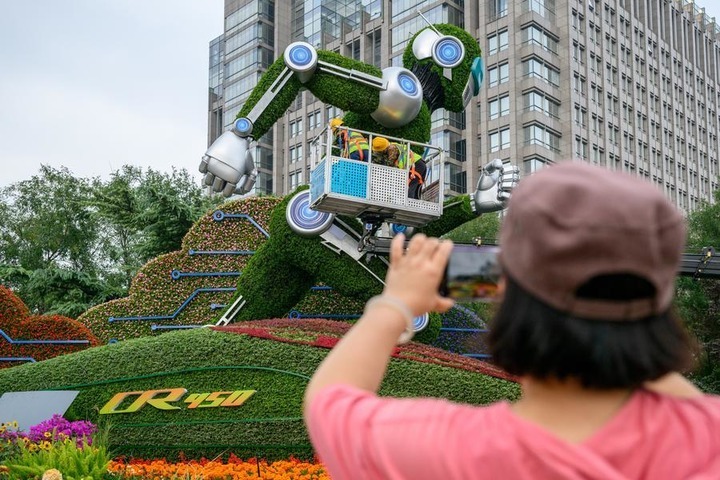
Echoing this animated and geek-chic sculpture is a running humanoid robot with a green-grass body and metallic “joints,” installed at another major intersection along Chang’an Avenue. “This year’s National Day plant sculptures are so funny,” wrote another on Rednote. “Is it because the post-2000 generation has taken over?”
“The displays were designed to appeal to people of all ages,” said Lan Hailang, chief designer of this year’s National Day floral displays. However, efforts to engage younger generations are perhaps most evident in the fluffy, grass-covered “cats” installed across the capital ahead of the National Day holiday.
People have been sharing photos of them and guides to their locations. Among them, a 3.5-meter-tall kitten, outside Chang’an Avenue, stands out for its lifelike appearance. Designers used buffalo grass to recreate its long, fluffy fur, said Li Mengyu, a member of the design team.
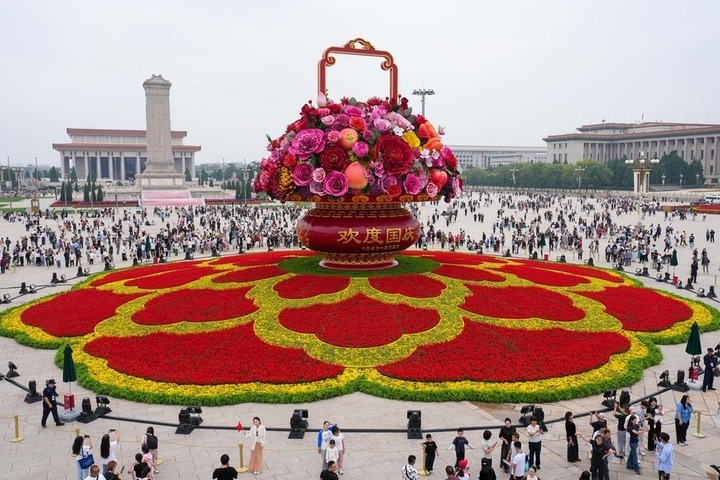
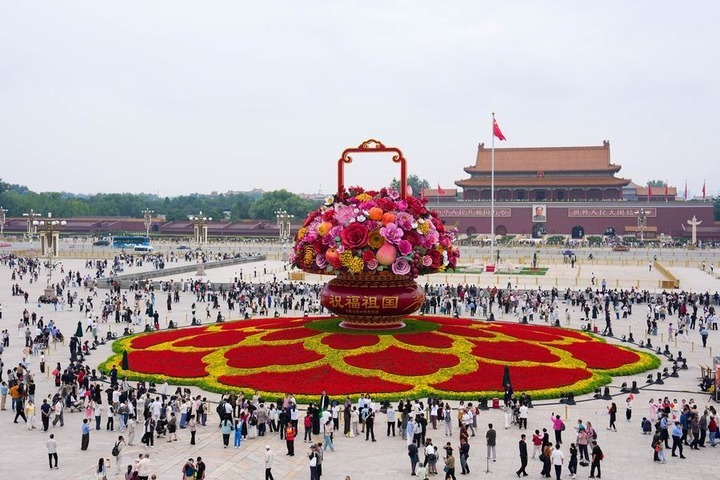
Beyond their appeal to youngsters, the 10 floral installations along Chang’an Avenue, alongside the centerpiece of a giant flower basket at Tian’anmen Square, tell stories of the country’s revolutionary history, showcase its technological progress and aspirations for the future, and offer glimpses into the everyday lives of its people.
The displays feature themes ranging from new quality productive forces and harmony between people and nature, to urban renewal and the beautiful countryside.
“In earlier years, the floral displays were mainly about creating a festive atmosphere and giving people something to enjoy,” said Lan. “In recent years, they have also become a window into the country’s development and people’s lives.”
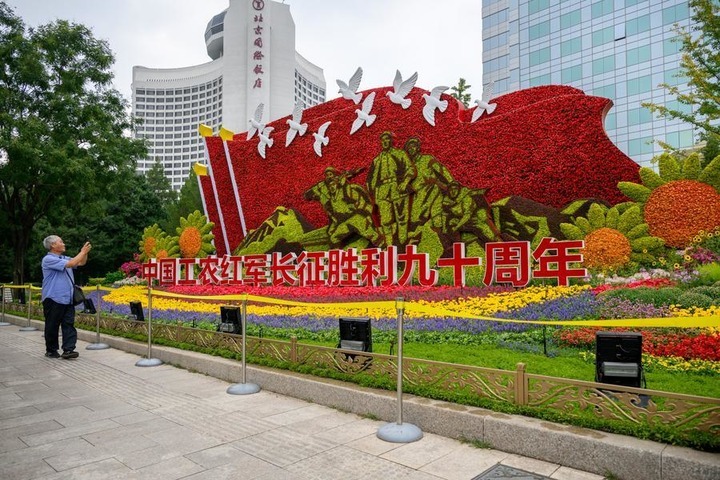
Starting from Jianguomen, visitors first encounter a display themed “Carrying Forward the Long March Spirit.” This year marks the 90th anniversary of the victory of the Long March.
The Long March was an epic military trek from 1934 to 1936, during which the Communist Party of China-led Red Army broke through encirclement by the Kuomintang forces. Red Army soldiers braved raging rivers, snow-covered mountains and treacherous grasslands, with some marching as far as 12,500 kilometers. The maneuver helped lay the foundation for the eventual victory of the Chinese revolution.
Ninety years on, the spirit of the Long March remains a source of inspiration for many Chinese, reminding them to tackle difficulties head-on.
“Compared with the formidable obstacles Red Army soldiers encountered during the Long March, many of the challenges we face in everyday life seem no big deal,” said Zhang Caimeng, who traveled from Tianjin to Beijing ahead of the National Day.
Standing before the display, she tried to inspire her son, who is preparing for next year’s college entrance examination.
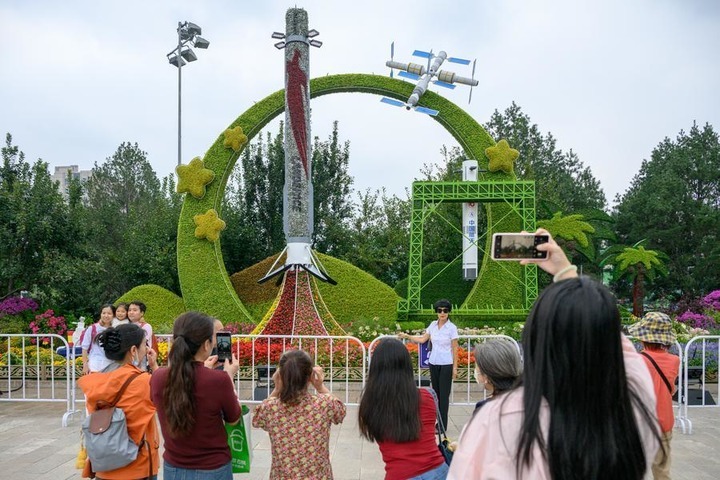
Farther west, at the bustling commercial hub of Dongdan, the displays at four corners of the intersection feature technological achievements, including the Tiangong space station, a reusable rocket, a sprinting humanoid robot and a CR450 high-speed train.
For more than 40 years, floral displays have been a prominent feature of National Day celebrations along Tian’anmen Square and Chang’an Avenue.
The first flower display appeared in Tian’anmen Square in 1984. More than four decades later, the simpler flower arrangements of the early years have evolved into large-scale three-dimensional installations. The varieties of plants used have grown tremendously.
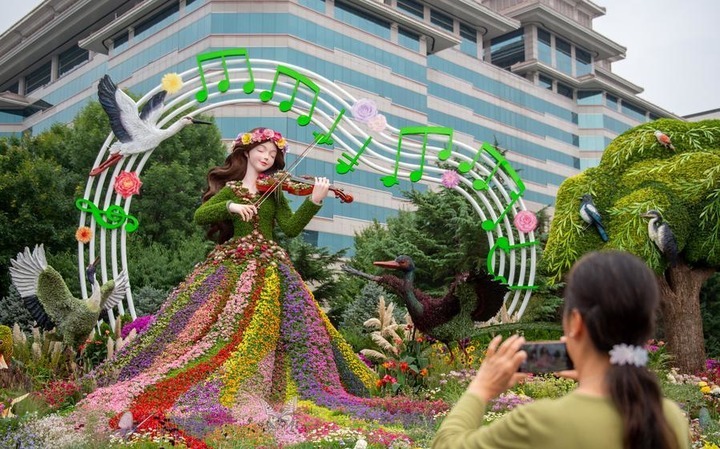
Some of the displays are so exquisitely crafted that they too have become social media hits. One features a garland-wearing girl playing the violin, surrounded by black storks, red-crowned cranes and milu deer, creating a vivid scene of harmony between people and nature.
The hem of the girl’s floor-length gown is made up of brightly colored flowers. Her posture, the position of her bow and even the placement of her fingers on the strings are rendered with striking precision. A musical staff woven into the display spells out the beloved melody of “My Motherland and I,” adding an unexpected touch that has delighted visitors and social media users alike.
The display is more than a visual spectacle. At scheduled times, a recording of the violin solo “My Motherland and I” fills the air, drawing visitors to stop, film the scene and take in the experience.
Li Lifang, an executive of the Beijing urban construction, landscaping and horticulture company, has been involved in building National Day floral displays for more than two decades.
She said that while floral sculptures once depended heavily on the skill of artisans and craftsmen, technologies such as 3D modeling and simulation have made it possible to achieve greater precision and realism.
For 29-year-old resident Hou Yueru, the displays depict scenes that feel close to home. Cycling along Chang’an Avenue, she was struck by the variety of scenes, from a kitten nestled in a rural setting and people paddleboarding along a waterfront, to community gardens and digital cultural and tourism experiences.
“There are cutting-edge innovations that reach into the sky and deep underground, but there are also scenes that reflect the everyday lives of ordinary people,” she said.
Future aspirations are also woven into the plant sculptures. This year marks the beginning of the 15th Five-Year Plan period (2026-2030). The 18-meter-tall flower basket at Tian’anmen Square contains 15 types of plant-assembled “flowers” and five types of “fruit,” symbolizing hopes for abundant blossoms and fruitful results during the five years.
At Fuxingmen, the display titled “Forge Ahead” features galloping horses above the words “Strive ahead in the 15th Five-Year Plan period, work hard to open up new horizons,” symbolizing a vigorous start to the new five-year period and the determination to pursue high-quality development through hard work.
THE PRESIDENT OF THE MATATU OWNERS ASSOCIATION, HON. ALBERT KARAKACHA, SAYS KENYANS ARE NOW BEING FORCED TO WALK TO WORK AS KENYA BECOMES THE MOST EXPENSIVE COUNTRY TO FUEL A VEHICLE IN THE REGION, WHILE OIL PRODUCERS LIKE ANGOLA, EGYPT AND NIGERIA CUSHION THEIR CITIZENS DESPITE THE GLOBAL CRUDE PRICE HITTING USD 108 TODAY.
By Mount Kenya Times Reporter – Nairobi – TODAY
The President of the Matatu Owners Association, Hon. Albert Karakacha, has today warned that Kenyans are being forced to walk to work and school as fuel prices in Kenya remain punitively higher than in neighboring Uganda and in African oil producing giants Angola, Egypt and Nigeria, even as global crude hits USD 108 per barrel today due to stalled US-Iran peace talks and tightening US fuel markets.
Speaking today in Nairobi while issuing a press statement on the global oil shock, Karakacha said it is shameful that Kenya, a non-oil producing country that taxes fuel the most, is punishing its own citizens while other African countries have put in place measures to cushion their people.
“It is painful today to see Kenyans walking along Thika Road, along Mombasa Road, along Ngong Road because they cannot afford matatu fare. Kenyans are being forced to walk. This is 2026, Kenyans should not be walking to work because fuel is too expensive,” Karakacha said today.
A spot check by The Mount Kenya Times today on latest GlobalPetrolPrices data for September 2026 shows the massive disparity:
FUEL PRICE COMPARISON – TODAY – OCTOBER 1, 2026 Country Current Petrol Price Per Litre In Kenya Shillings Today Status Kenya$1.50KES 195 – 214 Highest taxed in region Uganda$1.38KES 179 Lower than Kenya by KES 16 Angola$0.327KES 42 Oil producer, heavily subsidized Egypt$0.446KES 58 Oil producer, local refining Nigeria$0.536 – $1.05KES 70 – 140 Africa’s largest producer, Dangote refinery cushioning Source: GlobalPetrolPrices Sept 21 2026, Reuters field checks Lagos/Abuja today.
Karakacha said the comparison is heartbreaking:
“Today an Angolan pays KES 42 per litre for petrol. An Egyptian pays KES 58. A Nigerian in Lagos pays about KES 140 despite global shocks because Dangote refinery is shielding them. A Ugandan pays KES 179. But a Kenyan today is paying KES 195 to 214 for the same litre. Why? Because over 45 percent of what Kenyans pay is tax. Taxes, taxes, taxes.”
The Matatu Owners Association President said the global surge to USD 108 today will push Kenya over the edge if government does not act today.
“When we buy diesel at KES 186 today and it goes to KES 210 next week, we must increase fares by 30 percent. The common mwananchi who today pays Sh100 from Umoja to Town will be forced to pay Sh150. Many will choose to walk. Already today, our stages are seeing fewer passengers because people cannot afford. They are walking.”
WHAT IT MEANS FOR KENYA TODAY
Karakacha outlined three immediate dangers today:
Transport Paralysis Today: Matatus consume 60% of diesel. Many owners will park vehicles today if prices rise.
Cost of Living Explosion Today: Fuel is master commodity. Unga, milk, vegetables to rise today.
Shilling Pressure Today: Fuel import bill to rise from USD 550M to USD 680M today, weakening shilling at KES 129.
KARAKACHA’S DEMAND TO GOVERNMENT – LOWER FUEL PRICES TODAY
In his statement today, the Matatu President demanded:
“We call upon the Government of Kenya to lower fuel prices today. Not tomorrow. Today.
Use the Petroleum Development Levy fund today – Kenyans pay Sh5.40 per litre every day. Reinstate the stabilization fund today.
Cut taxes on fuel today. You cannot collect eight taxes on a single litre and expect Kenyans not to walk.
Zero-rate spare parts for PSVs today.
Crack down on oil marketers hoarding fuel in Mombasa today to create artificial shortage.”
Karakacha concluded: “Angola is protecting its people at Sh42. Egypt at Sh58. Uganda at Sh179. Why is Kenya at Sh214? Today Kenyans are walking because government is over-taxing fuel. Lower fuel prices today and save Kenyans from walking.”
Across Montserrado, Nimba, and Lofa Counties, an important step toward women’s economic empowerment and the prevention of sexual and gender-based violence is taking place.
For many women and girls, poverty, limited access to education and livelihood opportunities, harmful traditional practices, and gender inequality continue to restrict their ability to participate fully in economic and community life. Survivors of sexual and gender-based violence (SGBV), former female genital mutilation (FGM) practitioners, girls at risk, women living with disabilities, and female-headed households often face multiple barriers that leave them vulnerable to exclusion and economic hardship.
Today, through the Spotlight Initiative 2.0, supported by the European Union and UN Women Liberia and implemented by Youth Crime Watch of Liberia (YCWL), new opportunities are being created for some of the most vulnerable women and girls in Liberia.
The process began not with training sessions or livelihood support, but with community engagement and dialogue. Between 20–26 May 2026, YCWL convened stakeholder engagement meetings in Vezala, Lofa County; Banquelleh, Nimba County; and Block Path Community, Montserrado County.
The meetings brought together representatives from the Ministry of Gender, Children and Social Protection, local government authorities, civil society organizations, community leaders, religious leaders, representatives of persons with disabilities, SGBV survivors, girls at risk, former Zoes, practicing Zoes, and women’s groups.
Together, participants discussed community challenges, economic opportunities, and the importance of ensuring that women and girls most affected by violence, harmful practices, and economic exclusion are not left behind. Through these consultations, stakeholders helped shape the beneficiary identification process and strengthened community ownership of the intervention.
JOHANNESBURG, Sept. 13 (Xinhua) — Deepening practical cooperation within BRICS is creating new opportunities for the Global South to strengthen economic resilience and advance sustainable development, a South African scholar has said.
“BRICS has become an important source of global economic dynamism, particularly driven by the scale and growth of its emerging-market economies,” Mogomme Alpheus Masoga, deputy vice-chancellor for teaching and learning at the Central University of Technology, Free State, told Xinhua in a recent interview.
Masoga said the significance of BRICS expansion goes beyond its growing membership, with cooperation increasingly extending from traditional trade to infrastructure, digitalization, green energy and technological innovation.
“Deeper intra-BRICS trade, investment, infrastructure financing and payment-system cooperation could diversify markets, strengthen supply-chain resilience and expand development-finance options,” he said.
Such cooperation has become increasingly important amid rising protectionism, geopolitical tensions and supply-chain restructuring, Masoga added.
On China’s role in the group, Masoga described the country as “an important driver of practical economic cooperation,” particularly in emerging fields such as the digital economy and artificial intelligence (AI), saying that China’s technological capabilities and experience could support joint research, skills development, digital infrastructure and technological solutions across BRICS countries.
He also noted the launch of the BRICS AI Industry Cooperation Network at the 2025 World Artificial Intelligence Conference in Shanghai, saying that China’s proposed open-source AI initiative and action plan could help Global South countries develop technologies suited to their own development needs.
For South Africa, Masoga said BRICS cooperation provides opportunities to address infrastructure constraints, expand trade and investment, advance the energy transition and strengthen industrial capacity, as well as support the broader African development agenda.
The group’s greatest value to the Global South is “its potential to turn collective economic weight into practical development cooperation,” Masoga said. ■
The international landscape is volatile and fraught with risks and challenges, Xi said, adding that to bring stability to the world and make it a better place, BRICS countries must seize the historical initiative, rally the Global South, and advance the well-being of all humanity. Xi proposed five initiatives on “greater BRICS” cooperation in areas of AI, trade and investment facilitation, digital industry, intelligent manufacturing, and science and technology talent development.
NEW DELHI, Sept. 13 (Xinhua) — Chinese President Xi Jinping on Sunday called on BRICS countries to strengthen unity among the Global South and play an active, stabilizing and positive role in global affairs.
In a speech when attending the second day of BRICS summit in New Delhi, Xi also outlined concrete proposals to further strengthen greater BRICS cooperation, with a focus on emerging areas including artificial intelligence, trade, digital industries and manufacturing.
KEY DRIVER OF MULTIPOLARITY
Xi pointed out that when changes unseen in a century are accelerating across the world, the Global South, with its collective rise, has become a key driver of world multipolarity.
At the same time, the international landscape is volatile and fraught with risks and challenges, Xi said, adding that to bring stability to the world and make it a better place, BRICS countries must seize the historical initiative, rally the Global South, and advance the well-being of all humanity.
Global South countries should jointly defend the rule of law in international affairs, safeguard the basic norms of international relations including sovereign equality, noninterference in internal affairs, and the peaceful settlement of disputes, Xi said. It should be ensured that international law and international rules are applied to all, and free from double standards, he added.
Global South countries should hold high the banner of multilateralism, uphold the authority and role of the United Nations, and support multilateral institutions in advancing reform and increasing efficiency, Xi said.
He also called for promoting the reform of the World Trade Organization in the right direction, as well as reforming and improving the international financial architecture to increase the representation and voice of developing countries.
Global South countries should stay committed to a people-centered development philosophy and strive to deliver on the 2030 Agenda for Sustainable Development, Xi said.
Global South countries should also jointly advance security governance, tackle both traditional and nontraditional security threats, and improve global climate governance, Xi said, also calling for working faster to evolve a consensus-based global AI governance framework, so that new technologies can light the way toward shared prosperity.
“It is a solidarity that unlocks partnerships, unlocks democratization of the international system, unlocks an open international system, and unlocks an inclusive international system,” said Charles Onunaiju, director of the Center for China Studies in Nigeria.
Rakhim Oshakbayev, director of the TALAP Center for Applied Research in Kazakhstan and former Kazakh vice minister for investment and development, said BRICS cooperation should “bring together developing countries’ shared aspirations and promote coordination and cooperation.”
BRICS countries should continue seeking common interests, he said, noting that the grouping’s expansion had placed greater demands on internal coordination.
GREATER BRICS COOPERATION
During the speech, Xi proposed five initiatives on “greater BRICS” cooperation in areas of AI, trade and investment facilitation, digital industry, intelligent manufacturing, and science and technology talent development.
To accomplish great things and achieve major progress, the foundation of greater BRICS cooperation must be cemented, Xi said, calling for leveraging BRICS’ close ties with fellow emerging markets and Global South countries, upholding open cooperation for mutual benefit, safeguarding stable and smooth industrial and supply chains, and fostering a large integrated market.
“We should build incubators for innovation, upgrade traditional industries, develop emerging industries, and deploy future industries,” Xi said.
On the open source and inclusive AI initiative, Xi said that China will be a pioneer in establishing a BRICS AI open source community, support the cooperation in developing and applying large language models, hold specialized AI seminars and training courses, and build an open ecosystem for AI.
On the trade and investment facilitation initiative, China proposes to establish a BRICS special economic zone partnership, under which countries can set up an intelligent portal, coordinate policies, and build a new frontier for open development, Xi said, adding that in an effort to cultivate new drivers of economic and trade cooperation, China will hold the BRICS Forum on Trade in Services next year.
On the digital industry cooperation initiative, Xi said that China will push for establishing a BRICS digital ecosystem cloud platform, and conduct digital skills training, technological exchange and industrial alignment, so as to jointly enable the development of the digital economy.
On the intelligent manufacturing cooperation initiative, China stands ready to assist fellow BRICS countries in building smart factories and developing standards and norms, and jointly promote manufacturing transformation and upgrading, he said.
On the science and technology talent development initiative, China proposes to set up a BRICS engineer cultivation alliance for joint development of engineers and mutual recognition of competency standards, Xi said, adding that China will launch a BRICS youth exchange program for scientific and technological innovation, so as to cultivate more high-caliber talent.
The five initiatives proposed by Xi focus on key areas including technology, industry, trade and talent, providing concrete pathways to lay a solid foundation for practical cooperation among the broader BRICS community, said Serik Korzhumbayev, editor-in-chief of the Delovoy Kazakhstan newspaper.
It demonstrates China’s firm resolve to share the opportunities of its modernization, a reflection of the spirit of openness, inclusiveness and mutual benefit that underpins BRICS cooperation, he said.
NEW DELHI, Sept. 12 (Xinhua) — Chinese President Xi Jinping attended here on Saturday the 18th BRICS Summit.
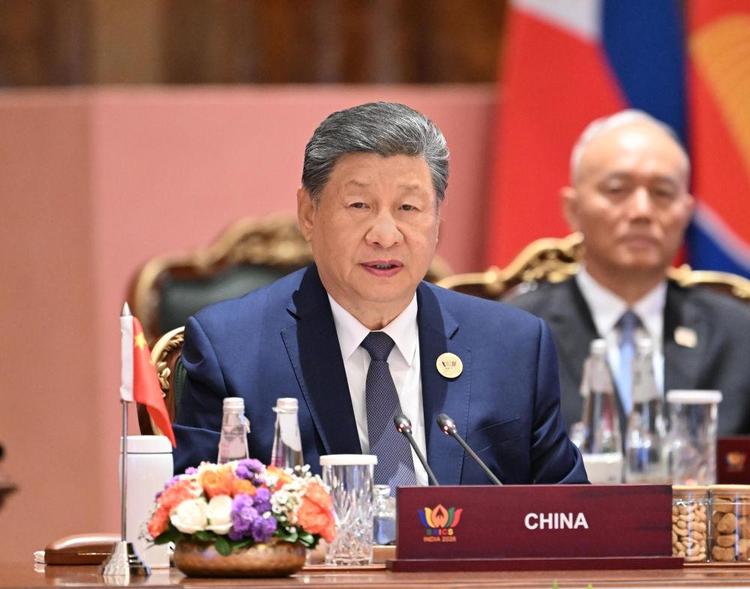
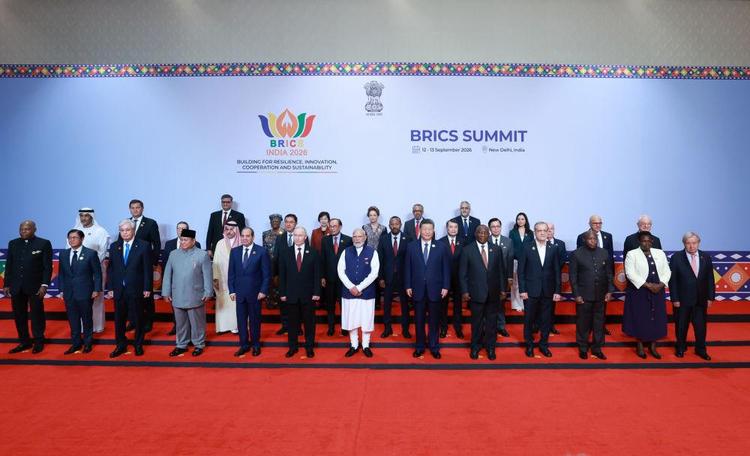
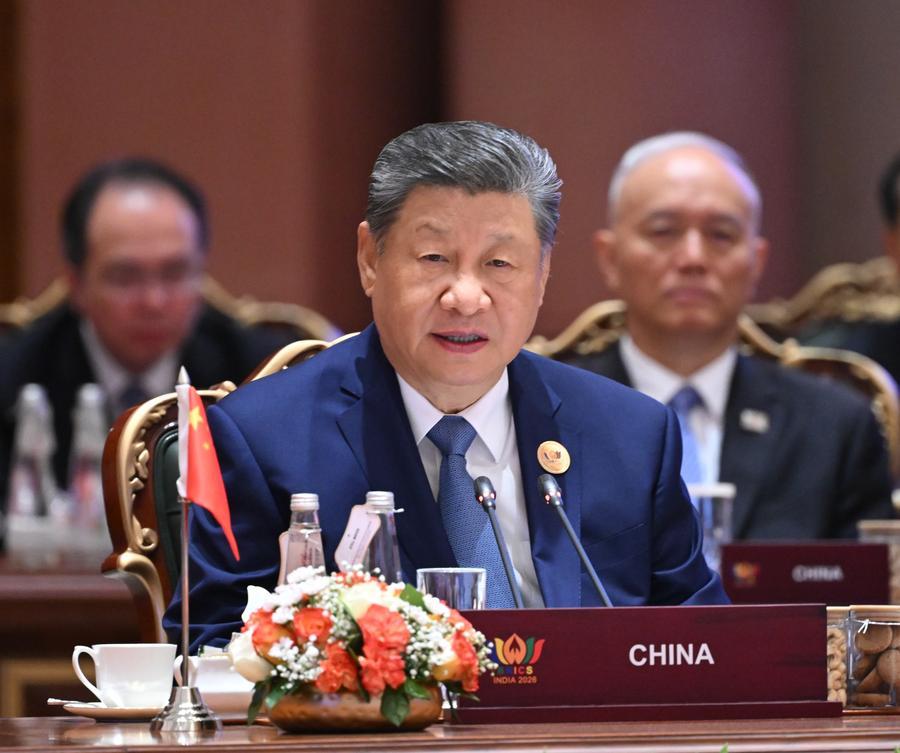
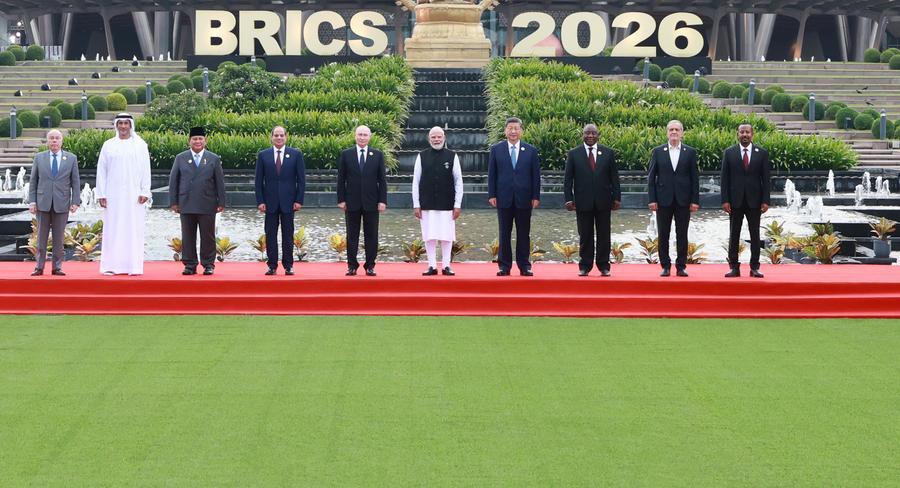
Chinese President Xi Jinping addresses the Session I of the 18th BRICS Summit in New Delhi, India, Sept. 12, 2026. (Xinhua/Yan Yan)Leaders of the BRICS countries pose for a group photo during the Session I of the 18th BRICS Summit in New Delhi, India, Sept. 12, 2026. Chinese President Xi Jinping attended the Session I of the 18th BRICS Summit here on Saturday. (Xinhua/Wang Ye)■