
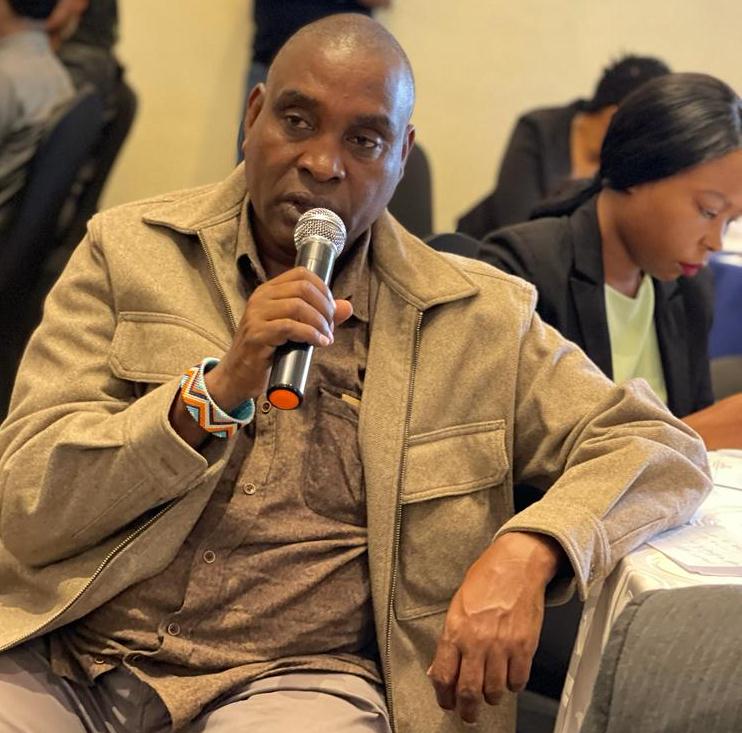
Mr. Joseph Ole Simei from Kenya representing indigenous people, giving his views at a Panafrican Climate Justice Action summit in Nairobi today
By Benard Mulwa
The Africa Climate Summit – Non State Actors Steering Committee, a Platform that strives for advancement of a pro-African agenda in all key climate spaces have expressed their worries that the Africa Climate Summit, scheduled for September 2023 in Nairobi, Kenya may fall short of the aspirations and thus have formulated a set of demands that they expect the African leaders to uphold and champion at the summit.
Over 250 members from 5 African regions, East and the Horn of Africa, South, Central, North and West Africa regions took part both in person and virtual in issuing a joint statement and their perspectives on the upcoming Africa Climate Summitte (ACS23).
Speaking to journalists in Nairobi today, Dr. Mithika Mwenda, the Executive Director, Panafrican Climate Justice Action, said African agenda have been set aside and Carbon markets taken the center stage, “Carbon markets should not be taken as an alternative to Carbon financing” adding that they expect the African leaders to reject false solutions and narratives that undermine African communities’ rights, interests and sovereignty, such as carbon markets, geoengineering, nuclear energy, and the principle of share responsibilities. “We remind African leaders that some proposals or actions claim to address the climate crisis. In reality, they either have no significant impact on reducing greenhouse gas emissions or, worse, have negative social and environmental consequences. These proposals are promoted by powerful interests that benefit from maintaining the status quo of fossil fuel dependence, and they divert attention and resources from the real solutions that are urgently needed” he said, they therefore, demand that African leaders and stakeholders must: a. Critically examine the claims and evidence behind any proposed solution. They must make it a duty to the African people to ask questions such as: Who is promoting it and why? What are the assumptions and uncertainties involved? How does it affect the root causes and drivers of greenhouse gas emissions? What are the potential trade-offs and co-benefits for other environmental and social issues? How does it align with the principles of climate justice and human rights?
Among other leaders, Africa Trade Union in Togo empheresised the African leaders to show courage in confronting the systemic changes needed to address climate change effectively, recognizing that false climate solutions often serve to maintain the status quo and protect the interests of powerful actors who benefit from the current system.
Challenge the dominant narratives and paradigms that enable and justify false solutions, such as those denying historical responsibilities for the climate crisis, turning regional and global dialogues into investment forums, claiming equal or shared responsibility for climate action and dismissing African demands for justice as victim-playing.
Commit to a just and equitable transition to renewable energy, ensuring that energy access is prioritized for the poor and marginalized and that community ownership and participation are guaranteed.
Recognizing the diversity and heterogeneity of African countries and regions and respecting their sovereignty and self-determination in defining their energy pathways
Ensuring that the energy transition is aligned with the African Union Agenda 2063, the Sustainable Development Goals and the Paris Agreement and contributes to poverty eradication, social justice, human development and sustainable industrialization.
Promoting a participatory and inclusive approach that engages all relevant actors, especially women, youth, indigenous peoples and marginalized groups, in designing, implementing and monitoring the energy transition policies and projects.
Supporting the development of local capacities, skills and innovations and fostering regional cooperation and integration to enhance the competitiveness and resilience of African economies in the global energy market.
Balancing the trade-offs and synergies between environmental, social and economic objectives and ensuring that the costs and benefits of the energy transition are equitably distributed among and within countries.
Addressing the historical injustices and inequalities that have resulted from exploiting fossil fuels in Africa and drumming adequate compensation, rehabilitation and restitution for the affected communities and ecosystems.
Demand that developed countries fulfill their historical responsibility and provide adequate and predictable finance, technology transfer, and capacity building to support adaptation, mitigation, and loss and damage in Africa.
Put the African people above all personal and collective political and economic interests. We call on our leaders to listen to the voices of their people, especially the youth, women, indigenous peoples, farmers, workers, and other vulnerable groups, who are bearing the brunt of the climate impacts. We remind them they have a moral and legal obligation to protect our shared future and home. They must muster the courage to:
Reject anti-African proposals that increase climate risks for Africa and transfer undue burdens of addressing the climate crisis to African countries and people already suffering the adverse impacts of the debts, global inequality in the distribution of wealth and other problems.
Resist attempts by the developing nations, through their corporate and non-profit agents, to hijack the African narrative and continue to define priorities and courses of action for the continent.
-End.