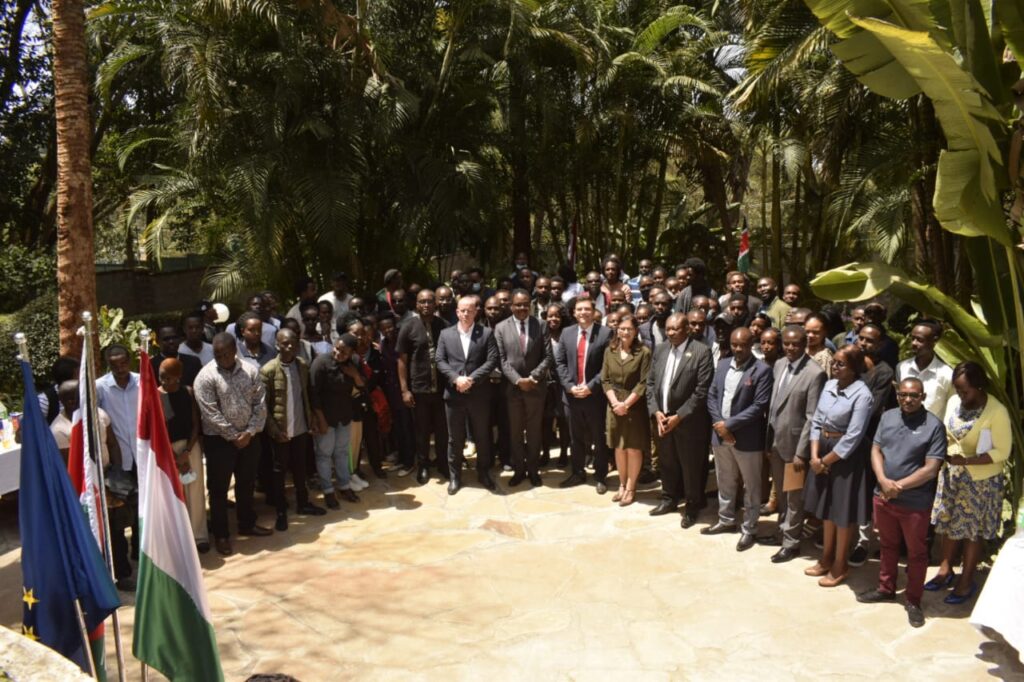
Kenya on Friday held a farewell for beneficiaries of Hungary scholarships.
Ambassador Simon Nabukwesi, Principal Secretary, State Department for University Education and Research said that this year’s scholarship award from Hungary marks the highest number of Stipendium scholarship offered to Kenyans.
“It gives me great pleasure to address the young leaders leaving to various universities in Hungary on the prestigious Stipendium Hungaricum scholarship program funded by the Hungarian Government,” Nabukwesi said.
“I wish to sincerely congratulate you for winning the scholarship. You have triumphed in a highly competitive but deeply satisfying process. I thank the Hungarian Government for investing in the future of our youth through education,” he added.
In this academic year (2022/23), a total of 200 full scholarships have been awarded to Kenyan students at various education levels that include; Undergraduate, Masters and PhD. This is significant increase from last year where a total of 100 scholarships were awarded; a clear indication of the strong alliance and partnership between Hungary and Kenya.
The Government of Japan has provided an additional US$2 million (nearly XOF 1.3 billion) contribution to the United Nations World Food Programme (WFP) to help respond to the unprecedented food and nutrition needs in Mali.
With this funding, WFP will provide multi-faceted food and nutritional assistance to 89,000 crisis-affected women, men and children in Mali’s central, northern, and southern regions.
“This additional funding is vital for the communities we serve during this period of weakened livelihoods,” said Eric PERDISON, WFP’s Representative and Country Director in Mali.
“As part of the national response plan to food insecurity, we will provide cash transfers to the most vulnerable people, allowing them to choose what they need to feed their families and, simultaneously, strengthen local markets and develop the local economy.
Japan’s contribution comes at a time when nearly 2 million people in Mali (10% of the total population) are experiencing acute food insecure during the agricultural and pastoral lean season (June to August 2022), compared to 1.3 million at the same period last year. Communities affected by droughts and insufficient rainfall continue to suffer from the negative impacts of COVID-19 and inter-communal conflicts with one in two households in Mali being unable to meet their dietary needs while they are grappling with rising food prices.
Japan is a long-standing and strategic partner of WFP, particularly in Mali, where it is helping to address food insecurity and build resilient communities through asset creation like pastoral wells, market gardening, income generating activities, as well as nutritional support for pregnant and lactating women and children.
The UN World Food Programme (WFP) is expanding assistance in the Horn of Africa as levels of hunger soar after back-to-back droughts and the threat of famine looms. Since the start of the year, nine million more people have slipped into severe food insecurity across Ethiopia, Kenya and Somalia, leaving 22 million people struggling to find enough food to eat.
WFP Executive Director David Beasley on Thursday wrapped up a visit to drought-ravaged Somalia, where over seven million people – close to half the population – are acutely food insecure and 213,000 are already facing famine-like conditions. Beasley visited the southern city of Baardheere and met families – including malnourished children and their mothers – forced to leave their homes and travel long distances through conflict-wracked areas in search of humanitarian assistance.
“People here have been waiting years for rain – but they cannot wait any longer for life-saving food assistance. The world needs to act now to protect the most vulnerable communities from the threat of widespread famine in the Horn of Africa,” said Beasley. “There is still no end in sight to this drought crisis, so we must get the resources needed to save lives and stop people plunging into catastrophic levels of hunger and starvation.”
WFP is tripling the number of people reached with life-saving food assistance in the Baardheere area, which hosts tens of thousands of people driven from their homes by drought and conflict,
Across the Horn of Africa, the drought is expected to continue in coming months, with a fifth poor rainy season forecast later this year. WFP has focused available funds, including critical emergency funding from USAID’s Bureau for Humanitarian Assistance, on scaling up life-saving assistance in areas worst hit by the drought. WFP is targeting 8.5 million people across the Horn of Africa, up from 6.3 million at the start of the year.
Every year on 19 August, the humanitarian community comes together to celebrate World Humanitarian Day. Thirteen years after its first celebration, the aid community worldwide is grappling with the toll of a megacrisis. The devastating combination of conflicts, the climate emergency, geopolitics, the pandemic, poverty and a war has caused the number of people who need humanitarian assistance to reach a record 303 million.
As this megacrisis continues, humanitarian workers step up to respond every day by providing lifesaving assistance such as food and cash, health and clean water, protection services and emergency education to millions of women, children and men. Because as the saying goes, #ItTakesAVillage. Just as it takes a village to raise a child, it takes a whole community to help people in need. As individuals, our impact is limited, but together we have tremendous power. In Burundi, the humanitarian community, alongside the Government, continues to provide for multi-sectoral assistance to 947,000 most vulnerable people out of the 1.8 million in need. However, despite the country progressively transitioning towards development, challenges remain. Burundi is among the 20 most vulnerable countries in the world to climate change, generating displacements, epidemics and affecting food security.
On this day celebrating the lifesaving actions of tireless aid workers, we also thank donors, continuously supporting humanitarian actors to carry on essential operations globally and here in Burundi. To date, the US$182 million Humanitarian Response Plan 2022 for Burundi is funded only at 13.5%. We continue to call on all donors to push their efforts further to allow humanitarians to reach all the people targeted by aid in Burundi.
From 19 to 26 August, an exhibition at the United Nations Information Centre in Bujumbura displays profiles of humanitarian workers. The exhibition is open to the public and provides an insight on the different professionals and community members needed to deliver to the most vulnerable people. It comes to show that it takes a village to provide assistance.
To mark the day, UN Secretary-General António Guterres declared that “Far from the spotlight and out of the headlines, humanitarians work around the clock to make our world a better place. Against incredible odds, often at great personal risk, they ease suffering in some of the most dangerous circumstances imaginable. On this year’s World Humanitarian Day, we celebrate humanitarians everywhere. We salute their dedication and courage, and pay tribute to those who lost their lives in pursuit of this noble cause. They represent the best of humanity.”
UN Resident Coordinator a.i Richmond Tiemoko affirmed that “World Humanitarian Day is an opportunity to highlight the effectiveness and the positive impact of humanitarian work, and to celebrate people who come together to ease suffering and bring hope.”
President Cyril Ramaphosa has expressed his sadness at the passing of Struggle veteran and pioneering trade unionist Rita Alice Ndzanga.
Ms Ndzanga, passed away on Wednesday, 17 August 2022, at the age of 88.
She was an Esteemed Member of the National Order of Luthuli who was honoured in 2004 for her lifetime contribution to the struggle for workers’ rights and to the realisation of a non-racial, non-sexist, free and democratic South Africa.
President Ramaphosa’s thoughts are with the family, friends and comrades of the late veteran who was subjected to detention and banning as a result her activism against apartheid.
Born in Ventersdorp in 1933, the young Ms Ndzanga became a labour organiser in male-dominated industrial sectors and played a role in the formation of the South African Congress of Trade Unions.
President Ramaphosa said: “Our nation and especially our progressive movements and organised labour, will remember and continue to honour Mama Rita Ndzanga for dedicating the many decades of her life to advancing the fundamental rights of all South Africans.
“As a young woman who witnessed the birth of apartheid and its ravages over time, Rita Ndzanga took a stand that endangered her own freedom and security so that all of us could be free and secure today.
“The death in detention of her husband, Lawrence, was among the many profound sacrifices forced on Mama Rita during her life of struggle in which she put the interests and comfort of others first.
“Her service to workers on the factory floor and her contribution as a Member of Parliament are part of a legacy we can and should respect while this stalwart rests in peace.”
When health workers took the Tuberculosis (TB) testing outreach to Rigasa community, Kaduna State, Rabi Umaru, a 37-year-old housewife, did not need much convincing to get tested.
She had been coughing for two weeks but had not visited any health facility because of lack of funds.
“I usually hear on the radio that if you cough for two weeks, you should go to the health facility to test for TB. I eventually tested for TB and COVID-19 during the community outreach, and after testing negative for COVID-19, I used the opportunity to receive the COVID-19 vaccination. Leaving here, I will lend my voice to mobilize other women in the neighbourhood to come out and benefit from the free TB and COVID-19 testing as well as receive their COVID-19 vaccine,” she said.
Tuberculosis and COVID-19 share similarities despite being caused by different biological agents. Worldwide, TB is one of the highest causes of death from a single infectious disease, and in the past two years, nearly all countries, including Nigeria, have felt the impact of COVID-19, resulting in a global health crisis with over 595 million people infected and above 6.45 million deaths as of 14 August, 2022.
High disease burden
For now, Nigeria has the highest burden of TB in Africa and ranked sixth globally. Worried about the low turnout of testing against the two deadly diseases, the Kaduna State Government collaborated with the World Health Organization (WHO) and other partners to initiate, plan and conduct a two weeks integrated mass TB and COVID-19 screening campaign across the 23 Local Government Areas in the state. The outreach was also leveraged to expand the COVID-19 vaccination coverage.
Two high-risk communities from each LGAs were selected based on reviews data on the burden of TB and COVID-19 infection, population density and the testing rates in the state.
Intervention
Emphasizing the importance of the campaign, the Kaduna State Commissioner of Health, Dr Amina Baloni, said the outreach is apt to tackle the rising cases of COVID-19 and TB and improve the low population coverage of COVID-19 vaccination in the state.
The Ministry of Agriculture called on the public to conduct regular surveillance on migrating pests in general and that of burnous that could occur with the existing good rainfall season.
Explaining of the prevalence of burnous over 100 hectares of land in the Central Region in July, the Ministry said that as a result of the rapid response taken the pest has been put under control.
The prevalence of pest in the villages of Weki-Diba and Adi-Hamushte was put under control with strong participation of the residents, agricultural experts as well as adequate supply of pesticides.
Mr. Bereket Ghile and Mr. Nardos Araya, agricultural experts in the region, on their part said that they were well prepared with manpower and pesticides for they had received prior information from the Ministry of Agriculture’s early warning office.
Likewise, according to the information released by the World Food and Agriculture Program on 11 August, with the ample distribution of rainfall stretching from Mauritania to Eritrea favorable situation could be created for the prevalence of desert locusts.
The Ministry of Agriculture has hence called on the public especially those that live in areas suspected for locust breeding areas to sustainably conduct follow-up and surveillance and inform nearby agricultural offices in case of suspecting the occurrence of the pest.
CHANGCHUN, Aug. 1 (Xinhua) — Economic operation has progressed steadily in northeast China’s Jilin Province over the past decade, with industrial structure optimized and the business environment improved, according to a press briefing in the provincial capital of Changchun on Monday.
Jilin has strived to develop three major industries, including the automobile industry, food processing industry and ecological tourism.
In 2021, the province saw its gross domestic product grow 6.6 percent year on year and attracted over 10,000 high-caliber talents.
In the past 10 years, Jilin has been increasing its grain production capacity, with annual grain output exceeding 35 million tonnes for nine consecutive years, according to the press briefing.
In addition, grain output in Jilin has reached some 40.39 million tonnes in 2021, up 20 percent compared with that of 2012.
Boasting over 3 million market entities, the province will continue to foster an efficient and conducive business environment to benefit enterprises.
Meanwhile, it will accelerate to build the digital government and inject strong impetus into revitalization and development. ■
* In 2013, the idea of targeted poverty alleviation was first introduced in Shibadong Village. This pioneering notion focused on tailoring poverty alleviation efforts to different individuals, local conditions and causes of poverty.
* Over the years, Shibadong Village has developed several industries that draw on its strengths. In 2013, the per-capita net annual income in the village was 1,668 yuan, only 18.8 percent of the average income in other rural areas. In 2021, the figure surged to more than 20,000 yuan.
* With the victory in poverty alleviation, China is forging ahead with rural vitalization in an all-round way. More young people are contributing to the cause.
By Xinhua writers Tan Jian, Liu Fangzhou, Peng Peigen
CHANGSHA, July 22 (Xinhua) — Life has dealt Long Xianlan, 35, a bad hand: His mother left home for ever due to despair of life, his father died 20 years ago from illness, and his only sister drowned two years later.
The village in which he lives, Shibadong in central China’s Hunan Province, has a history of poverty. In 2013, 130 households, or 60 percent of the village population, lived below the poverty line. Long was one of them, living alone, with little hope.
Back then, he would never have imagined that, in less than a decade, his village would become a success in eradicating poverty, nor that he would regain control of his life, becoming a local cooperative manager.
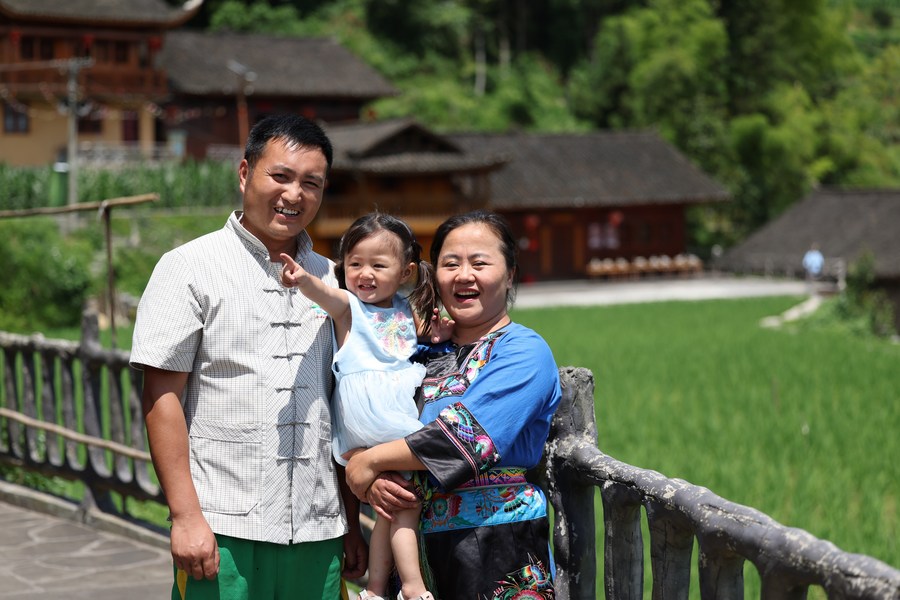
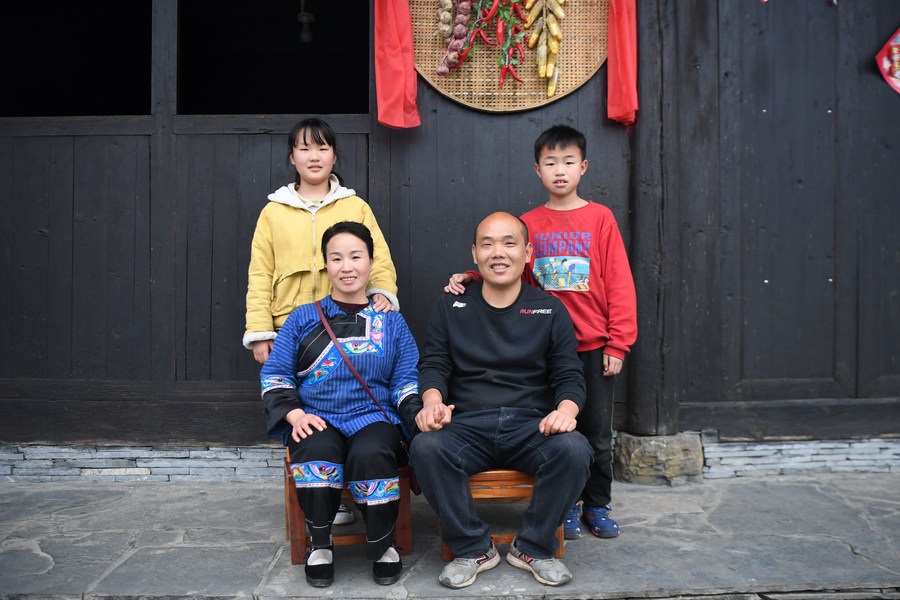
Long Xianlan (L), a beekeeper and head of a local cooperative, poses for a group photo with his family members in Shibadong Village in Xiangxi Tujia and Miao Autonomous Prefecture, central China’s Hunan Province, July 2, 2022. (Xinhua/Xue Yuge)
In 2013, the idea of targeted poverty alleviation was first introduced in Shibadong Village. This pioneering notion focused on tailoring poverty alleviation efforts to different individuals, local conditions and causes of poverty.
In February 2021, China announced the country had eliminated absolute poverty, with nearly 100 million rural poor lifted out of poverty over the previous eight years.
In Long’s case, it meant getting targeted help and opportunities that he lacked. At his lowest point, Long Xiulin, a local poverty alleviation official, helped him draft a plan to learn the skills he needed to lead an independent life.
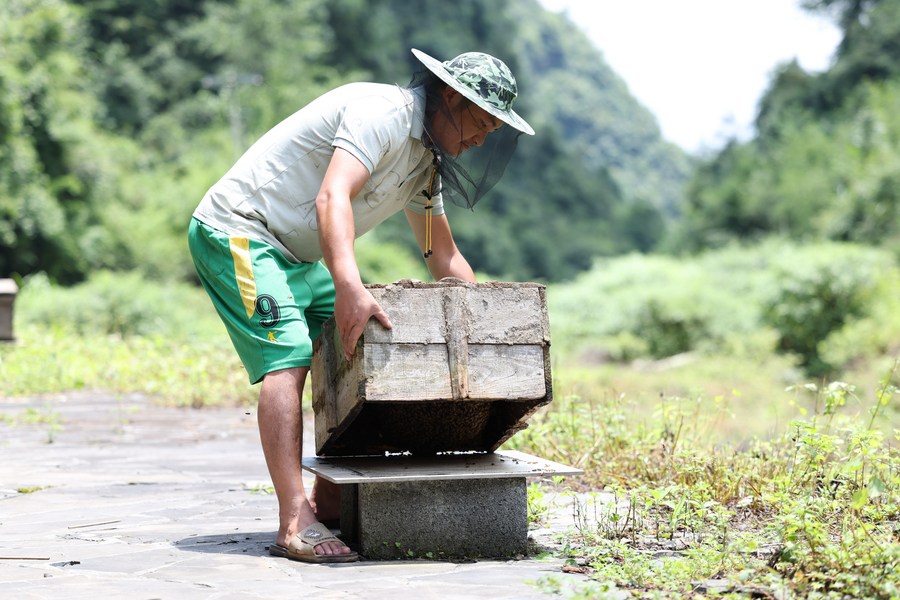
In 2014, Long Xiulin suggested that Long Xianlan learn beekeeping and helped him secure a loan of 20,000 yuan (about 2,972 U.S. dollars), as the mountainous village was found to be an ideal habitat for bees.
Long Xianlan, a beekeeper and head of a local cooperative, checks the condition of bees in Shibadong Village in Xiangxi Tujia and Miao Autonomous Prefecture, central China’s Hunan Province, July 2, 2022. (Xinhua/Xue Yuge)
“Long Xiulin treated me like his brother and offered me all the help and support he could,” Long Xianlan said. “I never had such strong determination to change my life through hard work.”
He earned his first pot of gold, selling 5,000 yuan worth of honey in 2016. In the same year, Shibadong was among the first batch of villages in the province that lifted all its households out of poverty.
Since then, Long’s life has been on an upward trajectory. Today, as a beekeeper and head of a local cooperative, he has registered a trademark for the honey, leading over 80 households in joining the beekeeping industry.
INDUSTRY ABOUNDS
Shibadong Village gets its name from 18 natural karst caves located nearby. Set in the highlands of the Wuling Mountains, at an altitude of about 700 meters, it overlooks a valley and green sloping terrain.
The village is picturesque, but a decade ago it lacked infrastructure, industry and investment. Many villagers left to make a living in various cities that offered more job opportunities.
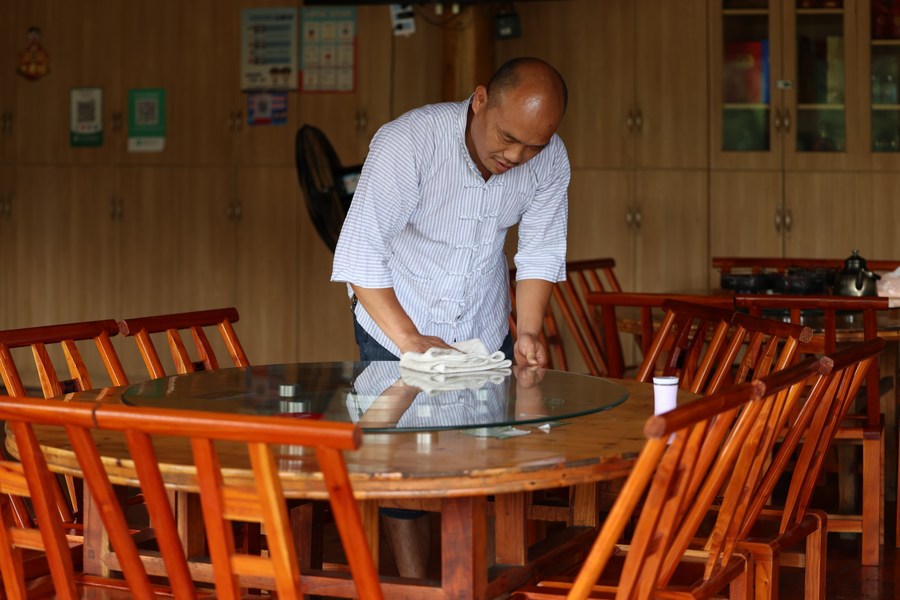
Yang Zhengbang cleans a table in his homestay in Shibadong Village in Xiangxi Tujia and Miao Autonomous Prefecture, central China’s Hunan Province, July 2, 2022. (Xinhua/Xue Yuge)
Among them is Yang Zhengbang, 44, who spent years as a migrant worker in the cities. In 2017, after learning of the tourism boom in the village, he returned home.
From 2013, Shibadong became increasingly accessible to tourists thanks to the construction of infrastructure there. With the passage of time, the village also became known for its success in poverty alleviation.
Yang was able to tap into these developments, starting a rural homestay in 2018, providing food and accommodation to visitors. This summer, Yang’s homestay receives more than 400 visitors per day on average.
“The villagers are very motivated to work and start our own businesses, and we feel that we have a promising life ahead,” Yang said.
Yang Zhengbang, who runs a rural homestay, poses for a group photo with his family members in Shibadong Village in Xiangxi Tujia and Miao Autonomous Prefecture, central China’s Hunan Province, April 25, 2020. (Xinhua/Xue Yuge)
Over the years, Shibadong Village has developed several industries that draw on its strengths. Located in Xiangxi Tujia and Miao Autonomous Prefecture, the village has fostered ethnic Miao embroidery as its distinctive industry. It has also capitalized on its mountain spring water resources, forming the Shibadong Mountain Spring Water Co., Ltd. in 2017. In addition, the village has been promoting various forms of farming.
In 2013, the per-capita net annual income was 1,668 yuan, only 18.8 percent of the average income in other rural areas. In 2021, the figure surged to more than 20,000 yuan.
RURAL VITALIZATION
With the victory in poverty alleviation, China is forging ahead with rural vitalization in an all-round way. Young people are playing an important role in this process.
The success of Shibadong’s poverty-reduction efforts has attracted more youths to the village. Mei Yao, a non-local graduate from a famous Chinese university, became the director of the village’s women’s federation in 2018. She considers it a great opportunity to learn about how to guide and support rural residents in developing industries.
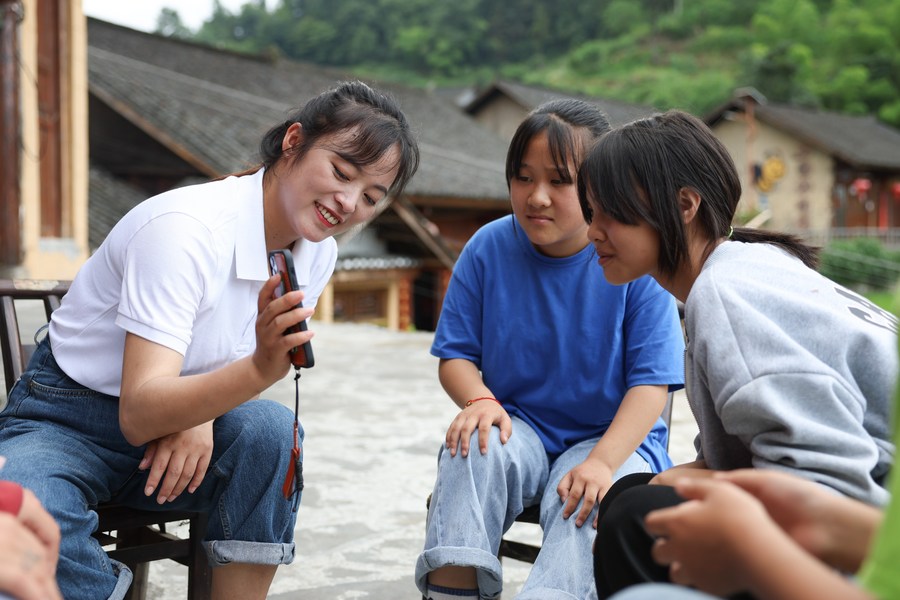
Mei Yao, director of the village’s women’s federation, talks with students who are on summer vacation in Shibadong Village in Xiangxi Tujia and Miao Autonomous Prefecture, central China’s Hunan Province, July 2, 2022. (Xinhua/Xue Yuge)
“For me, a village is like a book, and Shibadong is definitely the one most worth reading,” said Mei. “From here, I can become part of the grand scheme of China’s rural vitalization and of the promising future of the rural areas.”
Shi Kang, 22, returned to the village in 2019 after studying a media-related major in the provincial capital Changsha.
Shi grew up in the village while his parents worked in the cities. Back then, he was timid and ashamed to talk to others about his hometown due to its dire poverty. Today, the mindset has changed.
“Many of my peers are willing to come back now, and we would feel proud to say Shibadong is our village,” he said.
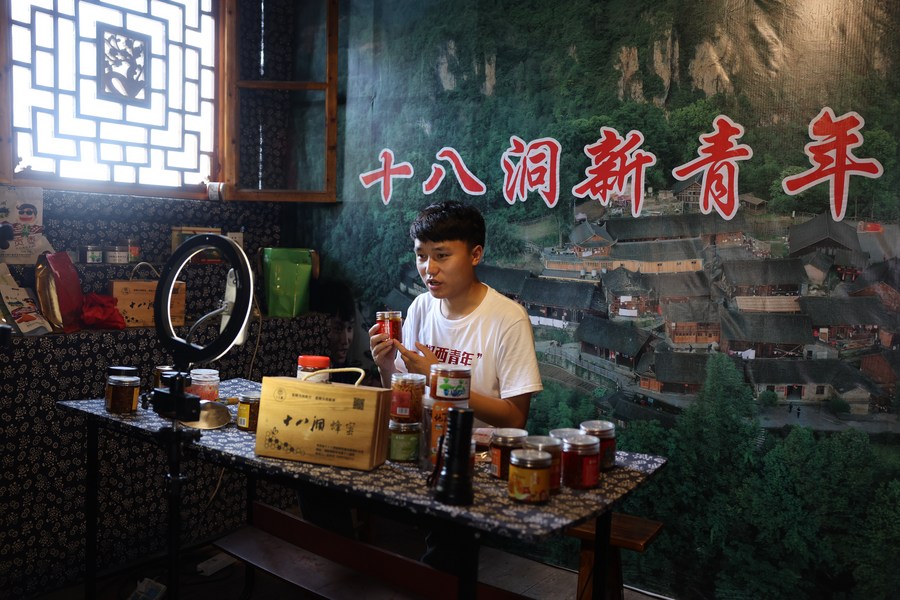
Shi Kang promotes village produce on a livestream in Shibadong Village in Xiangxi Tujia and Miao Autonomous Prefecture, central China’s Hunan Province, July 2, 2022. (Xinhua/Xue Yuge)
Taking advantage of his major, Shi shoots videos about village life, local cuisine and folk stories, and publishes them on short-video platforms.
He has also formed a team with several like-minded young people to regularly livestream online, sharing the stories of Shibadong and promoting village produce such as honey, cured pork and chili peppers.
Their account on Douyin has attracted around 20,000 followers and garnered 84,000 likes. He plans to continue to improve the brand certification of the agricultural products they sell on the platform.
“We would like to take Shibadong’s products further through the internet,” said Shi. “I am full of confidence about the future of the village.” ■
(Video reporter: Yao Yu; video editor: Hong Liang, Mu Xuyao, Wang Houyuan.)
NANCHANG, July 22 (Xinhua) — Comprehensive strength has achieved great leaps in east China’s Jiangxi Province through vigorous implementation of the primary strategy of high-quality and leap-frog development, local authorities said.
Over the past decade, Jiangxi’s gross domestic product has grown at an average annual rate of 8.4 percent and its growth rate of major economic indicators continued to maintain a leading position in the country.
Meanwhile, the province has made great efforts to carry out in-depth reforms and improve and upgrade its business environment.
Jiangxi has also further improved and strengthened its digital economy, speeding up the building of a new national hub for developing the digital economy.
The digital economy in Jiangxi registered 19.5 percent year-on-year growth in 2021, reaching nearly 1.04 trillion yuan (around 154 billion U.S. dollars), according to local authorities.
In addition, the province has integrated into the development of the Belt and Road Initiative and joined in expanding the international logistics channels. ■