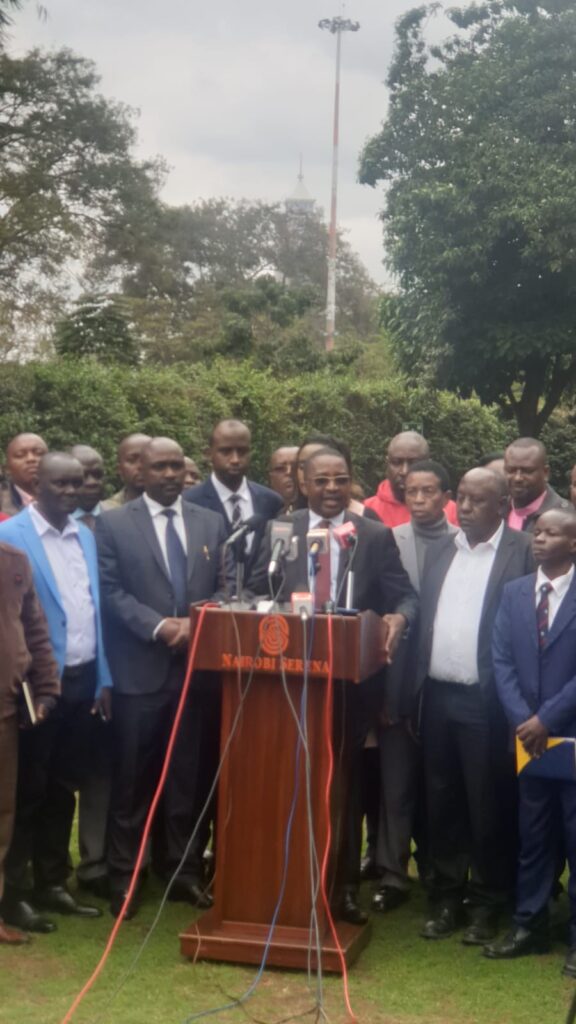
Usawa Presidential Mwangi Wa Iria today addressing Journalist at Serena Hotel promised to buy IEBC wafula Chebukati a cup of tea coz he has failed as commissioner to handle his office mandate.
Usawa party is fighting justice. .Hw later had Four hour concrete meeting with the Right Hon.. Raila at his Karen Residence discussing on how his manifesto can be included to Azimio for his supporters to benefit in the Next government. Hon. Raila admitted to him that injustice was not only to you but to all. Mwingi Wa Iria then later asked him a question concerning his presidential manifesto if He can accommodate it to AZIMIO , which they all agreed. Accumulative of all house holds who can be able to access health care as they discussed with him man to man.
Muranga County has a minimum grant of animal meals. if you agreed that we work together we will adopt one home one cow initiative, where they all agreed to join the Manifesto together for the sake of farmers Cross after Chebukati blocked his presidential way, they will enhance daily factory in Muranga and the price of milk will drop. Daily factory in Muranga will be protected, one home one cow cooperative fully registered to be funded by the Government to benefit all small scale farmers.. He urged Raila to fund all the Sacco through his government to ensure that small traders are safe. All Markets in kenya will benefit and he has accepted, adopted and agreed. He is clearly now endorsing Raila Martha ticket presidential candidature ,under the Azimio Coalition Movement.
Eritrean delegation led by Mr. Biniam Berhe, Charge d’Affairs at the Eritrean Embassy in Ethiopia and Permanent Representative of Eritrea at the African Union and Economic Commission of Africa, participated in the 41st Session of the African Union Ministerial Executive Council held in Lusaka, Zambia, on 14 and 15 July.
The Session discussed advancing investment in the health sector, the establishment of African diseases control center, putting in place a pharmaceutical plant in Africa, taking notes on domestic and global financial resources, investing in infrastructure, as well as economic stimulation, and ensuring food nutrition.
The Session also elected committees to serve as the three main organs of the African Union.
The Eritrean delegation presented deliberation reflecting Eritrea’s stance on relevant issues of interest to Eritrea.
The Ministerial Executive Council also discussed the declaration issued by the Ministerial Executive Council in its 4th Session and adopted important resolutions.
A delegation from the International Monetary Fund (IMF or the Fund), on Wednesday 13th July, 2022, concluded a one-week working visit to Accra. During the visit, the IMF delegation held high level meetings with stakeholders and discussed possible support for Ghana’s domestic economic recovery programme.
The Ministry of Finance wishes to thank the Mission Team for their visit, as well as a constructive engagement.
The Ministry also takes note of the end-of-mission press release issued by the Fund on 13th July, 2022, which among other things states:
Ghana is facing a challenging economic and social situation amid an increasingly difficult global environment. The fiscal and debt situation has severely worsened following the Covid-19 pandemic. At the same time, investors’ concerns have triggered credit rating downgrades, capital outflows, loss of external market access, and rising domestic borrowing costs.
In addition, the global economic shock caused by the war in Ukraine is hitting Ghana at a time when the country is still recovering from the Covid-19 pandemic shock and with limited room for manoeuver.
These adverse developments have contributed to slowing economic growth, accumulation of unpaid bills, a large exchange rate depreciation, and a surge in inflation.
The IMF team held initial discussions…focused on improving fiscal balances in a sustainable way while protecting the vulnerable and poor; ensuring credibility of the monetary policy and exchange rate regimes; preserving financial sector stability; and designing reforms to enhance growth, create jobs, and strengthen governance.
The Government of Ghana will continue to work closely with the IMF in the coming weeks to complete our enhanced economic programme, in support of a robust economic recovery.
In the meantime, Government reiterates its commitment to the various fiscal policy measures, geared towards mitigating the impact of current global economic headwinds on the economy and Ghanaians.
The Ministry of Finance further assures Ghanaians of the Government’s steadfast commitment to a speedy economic recovery, towards achieving a Ghana Beyond Aid.
The Board of Directors of the African Development Bank Group (www.AfDB.org) approved financing of $150 million to Kenya to support a major highway development project under the government’s First Mover Public-Private Partnership (PPP) programme.
The project will see the development of the A8 and A8 South highways. The existing 175km A8 road from Rironi to Mau Summit will be transformed into a four-lane carriageway and the 57.8 km two-lane A8 South, from Rironi to Naivasha will be strengthened and maintained over a period of 30 years.
Both roads are major routes stretching across the most densely populated parts of the country, beginning in Nairobi, Kenya’s capital and commercial nerve center, and traverse several counties in Nakuru and Kiambu, agricultural zones, wildlife reserves and tourism centers. The roads also form part of the strategic “Northern Corridor” which is the busiest trade and transport corridor in East Africa, providing gateway access to Kenya’s landlocked neighbouring countries.
The $150 million from the Bank Group’s non-sovereign operation lending window, forms part of a DFI tranche to Rift Valley Highways Limited – a Special Purpose Vehicle incorporated in Kenya and wholly owned by VINCI group and Meridiam Infrastructure Africa Fund. In September 2020, Rift Valley Highways entered into a PPP concession agreement with the Kenya National Highways Authority (KeNHA) to design, build, finance, operate, maintain and transfer the two highways over a period of 30-years.
The project aligns with the aspirations of Kenya’s Vision 2030 and national strategy to support industrialization through infrastructure development. It also aligns with the Bank priorities for infrastructure in its Ten-Year Strategy (2013–2022) and three of its High 5 priorities: Integrate Africa, Industrialize Africa and Improve the quality of life for the People of Africa.
This is the first PPP project to be approved by the Board under the Bank’s recently established PPP Framework. Bank Acting Senior Director for the Infrastructure and Urban Development Department, Mike Salawou said: “tolling and concessioning of major trade corridors across the African continent is on the rise as the need for connectivity and integration is amplified by the AfCFTA and the need for alternative financing sources through PPPs, to ensure the sustainability and reliability of trade corridors.
Nnenna Nwabufo, Director General for the Bank’s East Africa Region said: “One major plus is that this project will improve the extremely poor safety record of the highway which has been identified as one of the most accident-prone in Kenya. In addition, direct development outcomes expected from the project include increased productivity, commercial efficiencies, and time and cost savings. Ultimately this should support economic growth and increase the quality of life of the people. “
The project is expected to generate 1,500 jobs during construction and 200 during operation and has at least 40% local content in the form of labor and locally sourced materials.
The Board of Directors of the African Development Bank Group (www.AfDB.org) approved a grant of $8.1 million to South Sudan to fund its Emergency Food Production Programme.
Allocated through the Transition Support Facility (https://bit.ly/3uUoC2o), the grant constitutes additional financing to the ongoing Agricultural Markets, Value Addition and Trade Development Project (AMVAT). AMVAT seeks to contribute to reduced food insecurity, poverty reduction, economic growth and building of community and household resilience and social cohesion.
Exacerbated by climate hazards, the threat of a food crisis has long loomed over South Sudan, which has not been food self-sufficient since 2009 Some 8.9 million people, more than 70% of the population, including 4.6 million children, received humanitarian aid in 2022. This is 600,000 more people than in 2021, according to the World Food Programme. But the threat of a food crisis has never been greater, due to the impact of the war in Ukraine.
This Emergency Food Production Programme targets an additional 600,000 of the most vulnerable groups in five states where recent severe flooding has affected hundreds of thousands of households and resulted in heavy crop and livestock losses: Northern Bahr el Ghazal, Upper Nile, Western Bahr el Ghazal, Eastern Equatoria and Western Equatoria. Those who have received food aid in recent years – half of them are women – will get priority.
Nnenna Nwabufo, the Bank’s Director General for East Africa, said, “it is a continuation of the of the performing AMVAT project, but with a focus on the emergency food crisis and disruption of supply of critical inputs for food production in South Sudan”
Publish What You Fund, the global campaign for aid and development transparency, has named the African Development Bank (www.AfDB.org) the most transparent organization in the world.
The Bank’s Sovereign Portfolio now ranks first out of 50 global development institutions in Publish What You Fund’s 2022 Aid Transparency Index, released today with a top score of 98.5.
African Development Bank Group President, Dr. Akinwumi Adesina said: “I am elated to learn of this outstanding recognition from Publish What You Fund. It is a testament to the relentless efforts of the more than 2,000 personnel across our organization who work tirelessly to accelerate Africa’s progress. Maintaining razor-sharp focus, they consistently deliver top quality under the highest levels of scrutiny. I am incredibly proud of them. I commend Publish What You Fund for their important mission, combining robust research and technical expertise with targeted advocacy and engagement to make aid and development efforts more transparent and effective.”
Senior Vice President Swazi Tshabalala said: “I am absolutely delighted with this score in an index that plays a key role in helping promote openness and greater transparency among international agencies. The Bank has worked hard over the years to improve the disclosure of its aid flows by providing consistent, high-quality, and easily accessible data. Our top ranking has significant human and financial resource implications, as this is the only way to conduct our development business.”
The African Development Bank achieved the highest score in the Aid Transparency Index’s ten-year history and moved into the top spot from its fourth-place ranking in 2020. The Index is the only independent measure of aid transparency among the world’s major development agencies. The Bank has remained consistently in the ‘very good’ category since 2014. It has consistently demonstrated its commitment to increased transparency and its extraordinary progress over the past 10 years in providing high-quality information and becoming more transparent.
Publish What You Fund’s ‘very good’ status is the highest of the five categories used to assess organizations’ transparency. The ranking is based on several criteria. They include finance and budgets, basic information data, organizational planning and performance.
The African Development Bank’s non-sovereign portfolio was assessed for the first time and separately in the 2022 Index. The Bank is the second most transparent development finance institution dealing with non-sovereign operations. Its non-sovereign portfolio is ranked 12th among the 50 global development institutions under comparison.
The past year has been complex and challenging for development transparency. To help fulfill development needs and ambitious global objectives such as the UN Sustainable Development Goals and the Bank’s High 5 operational priorities, more and better development finance than ever is required. This is especially so when large volumes of funding are being assigned to combat the Covid-19 pandemic.
Canon (www.Canon-CNA.com) today announces the launch of two new affordable full frame RF lenses, the RF 24mm F1.8 MACRO IS STM and RF 15-30mm F4.5-6.3 IS STM. The RF 24mm F1.8 MACRO IS STM is a lightweight, bright f/1.8 prime lens featuring a 24mm focal length, and the RF 15-30mm F4.5-6.3 IS STM is an ultra-wide angle zoom lens covering a range of focal lengths from 15-30mm. Continuing the expansion of the RF series of lenses, the RF 24mm F1.8 MACRO IS STM and RF 15-30mm F4.5-6.3 IS STM feature the same advanced optical technology and superior handling for sharp, high-quality imagery, even when shooting on the go. Versatile lenses, the RF 24mm F1.8 MACRO IS STM and RF 15-30mm F4.5-6.3 IS STM are suited to a variety of genres of photography and vlogging, enabling users to unleash their creativity and instinctively capture each shot.
Introducing the RF 24mm F1.8 MACRO IS STM; Sharp, light, wide
The RF 24mm F1.8 MACRO IS STM is a compact and versatile wide-angle 24mm prime lens, made possible by the intelligent design of Canon’s RF mount. A fast, bright, image stabilised lens, the RF 24mm F1.8 MACRO IS STM excels in low light scenarios with a f/1.8 maximum aperture and circular, 9-blade design. This also creates a beautifully soft background, that makes the subject stand out sharply in the image. When used with an APS-C sensor camera, this lens also gives an effective focal length similar to 35mm.
Weighing just 270g and featuring a gear type STM motor which enables fast and quiet focusing in a small form factor, the RF 24mm F1.8 MACRO IS STM is perfect for travel and landscape photographers wanting to shoot on the go. With a minimum focusing distance of 14cm (0.5x magnification), this lens offers huge creative potential, enabling photographers and vloggers to focus extremely close to their subject, while still being able to capture the wider environment around it.
The RF 24mm F1.8 MACRO IS STM offers superb optical performance and enhanced operation. Equipped with a customisable Lens Control Ring, photographers can easily fine tune ISO, aperture and switch between AF methods. With a dedicated focus ring, this model also gives greater control during manual focusing. When used with compatible cameras, the lens information is displayed to offer even greater focusing assistance with the RF 24mm F1.8 MACRO IS STM. With 11 elements in 9 groups, the RF 24mm F1.8 MACRO IS STM employs super spectra coating to prevent ghosting and flare, for high-quality images every time. Offering super smooth and steady stills and videos, the RF 24mm F1.8 MACRO IS STM employs a 5-stop Optical Image Stabilizer which increases to 6.5-stops of IS when used alongside an EOS R series body featuring In Body Image Stabilizer.
Energy Capital & Power (ECP) (https://EnergyCapitalPower.com) is proud to announce that Amadou Doumbouya, Managing Director of Guinea-Conakry’s newly formed Société Nationale de Petroles (SONAP), will be coming to the MSGBC Oil, Gas & Power 2022 (https://bit.ly/3Rvf2Nf) conference and exhibition to discuss exploration, production and hydrocarbon trade across the MSGBC region. With the full potential of Guinea-Conakry’s energy sector yet to be realized, Doumbouya will be coming to the conference in September to promote the range of opportunities present across the country as he moves to unlock multi-sector investment and position the country as an energy secure nation for years to come.
As Managing Director, and with a range of experience across the Guinean energy landscape, Doumbouya has placed securing investment and international participation at the forefront of both SONAP’s and the country’s developmental agenda. Having previously worked for the Ministry of Hydrocarbons and the National Petroleum Office (ONAP), among other high-level organizations, Doumbouya’s expertise makes him both an ideal and instrumental figurehead for SONAP as the company moves to transform Guinea-Conakry’s energy landscape.
Representing the country’s national oil company (NOC) responsible for implementing government policy in the oil sector, SONAP is committed to driving investment across the entire hydrocarbon value chain in Guinea-Conakry, viewing oil and gas as key drivers of sustainable socioeconomic growth. Following SONAP’s establishment in December 2021 – through a merger of the ONAP and the National Petroleum Import Company – the government has ensured sector activities and regulations are streamlined. In this regard, SONAP is undergoing a number of exploration and production campaigns that center on the unknown, yet potentially high, energy landscape.
On the oil and gas front, the organization is looking at increasing activity across the upstream sector, working towards unveiling sizeable discoveries that will kickstart the country’s hydrocarbon industry. Sharing promising sedimentary zones to that of regional neighbors such as Senegal, Guinea-Conakry’s potential to hold significant offshore oil and gas reserves is unparalleled. To this effect, 2021 saw ONAP establishing the bidding terms to award exploration licenses for 22 of the country’s unexplored offshore blocks. Now, SONAP is working on strengthening this campaign, while improving energy information and research, improving the country’s fuel storage capacity and unlocking investment across the mid- and downstream industries.
Kenya Breweries Limited (KBL) has scooped the prestigious overall energy management award at the 18th edition of the EnergyManagement Awards (EMA) hosted by the Kenya Association of Manufacturers (KAM) through its Centre for Energy Efficiency and Conservation for making significant cuts in their energy consumption without negatively affecting their output.
KBL also bagged five more awards: Renewable energy; Water conservation; Electricity savings award for large consumers; Energy management; Best energy thermal saving award, large consumer; Sustained high-performance.
The Energy Management Awards seek to promote excellence in energy management by recognizing industrial and commercial enterprises that demonstrate excellence in energy efficiency and conservation.
KBL Managing Director, John Musunga, said the company has set ambitious environmental targets, aligned with the United Nations Sustainable Development Goals.
“We have a responsibility as a local manufacturer and employer in Africa to grow our business sustainably while creating shared value. I am delighted for the recognition for our efforts towards reducing our carbon footprint and addressing climate change by embracing the use of clean and affordable energy. This is a demonstration of the strength of our commitment to pioneering grain-to-glass sustainability, positively impacting the communities in which we live and work.”
* The U.S. sanctions against Zimbabwe have been piled on since 2001, following a government decision to repossess land from minority white farmers for redistribution to landless indigenous Zimbabweans.
* The sanction-induced economic mire has inflicted a myriad of real challenges on Zimbabweans, especially amid an unprecedented global pandemic.
* Given the distressing effect of the sanctions on the viability of businesses in Zimbabwe, there have been outcries against the economic punishment in and outside the country.
by Tichaona Chifamba, Zhang Yuliang, Cao Kai
HARARE, July 11 (Xinhua) — Opposite the U.S. embassy northwest of the Zimbabwean capital of Harare sits an anti-sanctions camp marking 1,200 days of protest.
On July 4, the organizer of the camp — Broad Alliance Against Sanctions (BAAS), organized a demonstration outside the U.S. embassy compound while the Americans were observing their Independence Day.
“We’re demonstrating against the Americans for celebrating their Independence Day while we are suffering because of their sanctions,” said protestor Jesca Vhiyai, a BAAS member and mother of five.
The 48-year-old woman spoke out partly due to the agony afflicting millions of Zimbabweans from decades of sanctions imposed by the United States and its western allies. The anti-sanctions lobby BAAS said their camp set up on March 29, 2019, would only be removed when the sanctions are lifted.
UNREMITTING ANTI-SANCTION FIGHT
The sanctions against Zimbabwe have been piled on since 2001, following a government decision to repossess land from minority white farmers for redistribution to landless indigenous Zimbabweans.
Though the Zimbabwean government said the land reform would promote democracy and the economy, Western countries launched repeated sanctions with little regard for the average person’s suffering.
Over the years, Zimbabweans have spoken out against the sanctions. BAAS is one of the staunchest. “So we are here to stay until they remove these illegal embargoes that they have enforced on our nation,” said BAAS spokesperson Sally Ngoni.
“We realized that most industries closed due to sanctions, meaning that sanctions are actually the major cause for all our other problems in Zimbabwe,” she said.
Ngoni said they would soon build an anti-sanctions village at the campsite, which will be molded along the traditional African huts in rural areas, adding that they want the Americans to “feel the pinch” by seeing firsthand how the sanctions have impacted the lives of the poor.
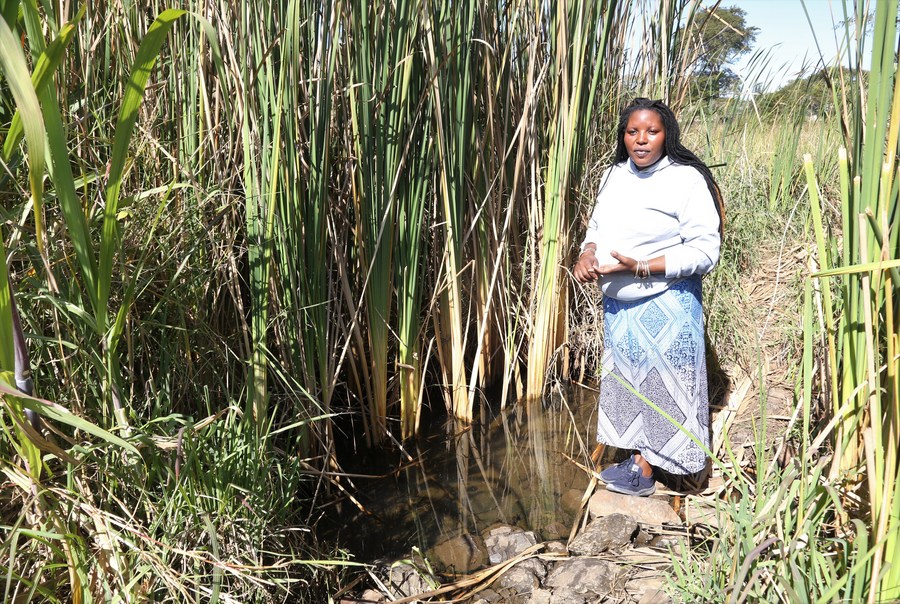
Sally Ngoni, spokesperson of the Broad Alliance Against Sanctions, shows the pool where members of the group fetch water to the tents they live in Harare, Zimbabwe, on June 22, 2022. (Xinhua/Zhang Yuliang)
According to BAAS Chairperson Calvern Chitsunge, officials from the U.S. embassy have tried to bribe the group’s four leaders.
“They even offered us money,” Chitsunge said, noting the American staff have promised them each 100,000 U.S. dollars, a car and free accommodations at a location of their choosing.
“We said no. Paying us will not empower the 15 million Zimbabweans. Paying us will not change our industry,” he said. “We want our industry to function. We want our people to go to school. We want our people to seek medication which will be affordable.”
The U.S. embassy in Harare did not comment on the alleged bribe in its reply to Xinhua.
Linda Masarira, president of the Labour Economists and Afrikan Democrats (LEAD) political party, said sanctions have been used as a tool of economic warfare against Zimbabwe.
“It was an action that the United States of America decided to do on Zimbabwe to ensure that they make our economy scream, they make things hard for Zimbabweans and imply that black Zimbabweans, native Zimbabweans cannot do their own farming, or run their own economy,” she said.
REAL PAIN FOR ORDINARY PEOPLE
When asked about the impact of the sanctions, the U.S. Embassy in Zimbabwe directed Xinhua to a 2021 briefing by U.S. State Department spokesperson Ned Price in which he repeated that the sanctions target only 83 individuals and 37 entities, denying the Zimbabwean people as the targets.
However, the sanction-induced economic mire has inflicted a myriad of real challenges on Zimbabweans, especially amid an unprecedented global pandemic.
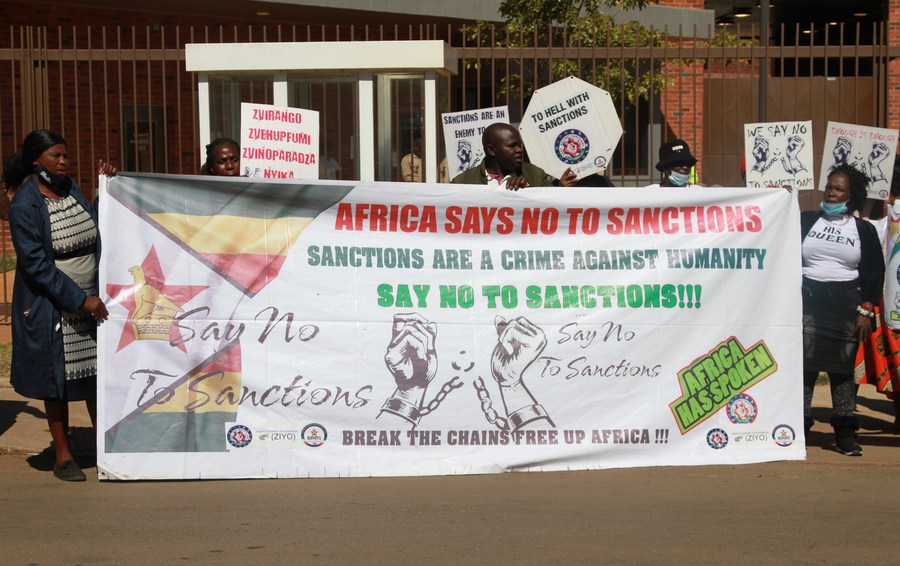
Members of the Broad Alliance Against Sanctions hold anti-sanctions placards in front of the U.S. embassy in Harare, Zimbabwe, on July 4, 2022. (Photo by Tafara Mugwara/Xinhua)
“The sanctions are slowing down our progress, inhibiting our economic recovery and punishing the poorest and most vulnerable in our society,” said Zimbabwean President Emmerson Mnangagwa.
Celia Rukato, founder of Chjaa Enterprises, a textile print and garment manufacturing company based in Harare, is one of the entrepreneurs suffering under sanctions.
Like many modern retailers, her brand promoting a Zimbabwean identity has utilized online platforms to reach a more extensive customer base in and outside Zimbabwe. However, payment options have been a problem due to Western sanctions.
“There are certain companies that are not allowed to interact or work with Zimbabwean-based companies,” she told Xinhua, citing U.S. firm PayPal.
“We have to make alternative plans that cause the customers to pay more for transaction costs or a middleman’s commission in a third country,” said Rukato, adding that these barriers have made Zimbabwe-based startups miss opportunities and funding.
In early June, The Herald newspaper reported that Andela, an international job placement network for software developers, had denied Zimbabwean national Michael Nyamande’s attempt to join the service because he resided in a country under U.S. sanctions.
“Sanctions are actually targeted at the ordinary men and women in the street, in the townships, in the rural areas,” said Obert Gutu, member of the National Peace and Reconciliation Commission and former deputy minister of justice and legal affairs.
Describing the sanctions as a weapon of mass destruction, Gutu said Zimbabwe has failed to build new roads, hospitals, clinics or even rehabilitate old infrastructure because it “has been denied access to affordable finance by international institutions.”
“Since 2002 when the sanctions were effected, this economy has never been the same again because the most deadly effect of sanctions on Zimbabwe was just to first and foremost paint Zimbabwe as a pariah state,” said Gutu.
Denford Mutashu, president of the Confederation of Zimbabwe Retailers, said the sanctions had a devastating impact on the Zimbabwean economy and the competitiveness of local businesses.
“The business operating environment changed for the worse, and foreign direct investment ceased to flow into the country,” he said.
“We will not allow the U.S. to continue lying to the people of Zimbabwe that the sanctions are targeted,” LEAD President Masarira said.
OUTCRIES FOR LIFTING SANCTIONS
On a public occasion in March 2022, Zimbabwean Finance Minister Mthuli Ncube said the country is reeling from the effects of sanctions. “Banks lost over 100 corresponding resources. We experienced massive loss of jobs, and we were unable to create jobs easily.”
The minister said foreign direct investment was 95 million dollars in the 1990s before plummeting to around 20 million yearly in the 2000s.
Given the distressing effect of the sanctions on the viability of businesses in Zimbabwe, there have been outcries against the economic punishment in and outside the country.
“You cannot do much when you are under a yoke,” said Mutashu, adding that some regard the sanctions as a new form of neo-colonialism.
“We should be seeing countries being able to determine and chart their own destiny according to their own traditional cultural, political, socio-political and socio-economic backgrounds,” Mutashu said, urging an immediate removal of the sanctions.
Led by President Mnangagwa, Zimbabweans embarked on a march to demand an end to foreign sanctions in 2019, which has gained support from various regional and international organizations.
In a statement released in October last year, Chairperson of the African Union (AU) Commission Moussa Faki Mahamat said the AU calls “for the immediate and unconditional removal of sanctions imposed against the Republic of Zimbabwe.”
The Southern African Development Community, a 16-country regional bloc, has designated Oct. 25th of each year as Anti-Sanctions Day since 2019 to show solidarity with Zimbabwe against illegal Western sanctions.
The United Nations special rapporteur on unilateral coercive measures, Alena Douhan, also called for the lifting of the sanctions after her 10-day visit to Zimbabwe to assess the impact of the sanctions in October last year.
“Over the last 20 years, sanctions and various forms of over-compliance with sanctions have had an insidious ripple effect on the economy of Zimbabwe and on the enjoyment of fundamental human rights, including access to health, food, safe drinking water and sanitation, education and employment,” Douhan said.
Despite minimal progress with several individuals and state entities removed from the sanctions list, mainly by the European Union, Zimbabwe and its anti-sanctions fighters have never given up.
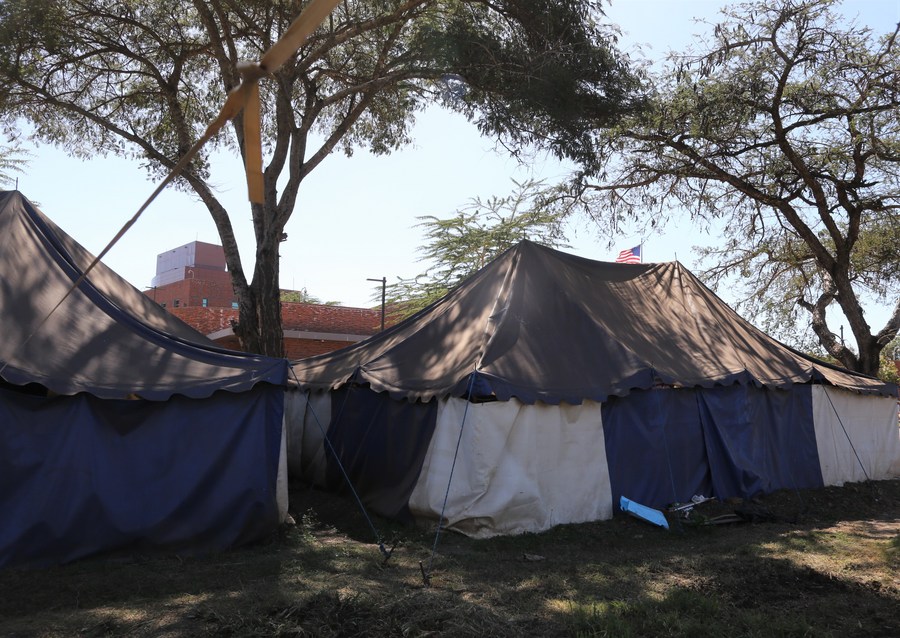
Photo taken on June 22, 2022 shows two tents pitched by members of the Broad Alliance Against Sanctions in front of the U.S. embassy in Harare, Zimbabwe. (Xinhua/Zhang Yuliang)
“We have seen some institutions such as the Infrastructural Development Bank of Zimbabwe being removed from the sanctions list as well as some individuals,” said BAAS spokesperson Ngoni, who is confident that their efforts yielded some results.
“We can’t really say it was a direct result,” said Ngoni, “but it did contribute to the removal of those sanctions.” (Video reporters: Zhang Yuliang, Sukala; video editors: Yang Zhixiang, Li Qin)■